| Author |
 Replies: 22 / Views: 3,488 Replies: 22 / Views: 3,488 |
Page 2 of 2
|
|
|
|
Pillar of the Community
Canada
1984 Posts |
Old Mike....the stats on a normal cent are not relevant. This is struck on a different planchet.
Cupro nickel is generally not magnetic. I will pull out my NZ coin and test it later. But check any silver coloured cupro nickel UK coin from 1947 to 1967....all non mag.
|
|
Moderator
 Canada
10477 Posts |
In can be tougher to tell. I usually XRF these coins. If there are traces of tin (Sn) and zinc (Zn), then it is likely a plated coin. Just copper (Cu) and nickel (Ni) and you have a good coin! Here is my 1979 1c struck on a New Zealand Cu-Ni 5-cent, the thinner planchet made it a weak strike - anything 1980 and newer should be almost fully struck: 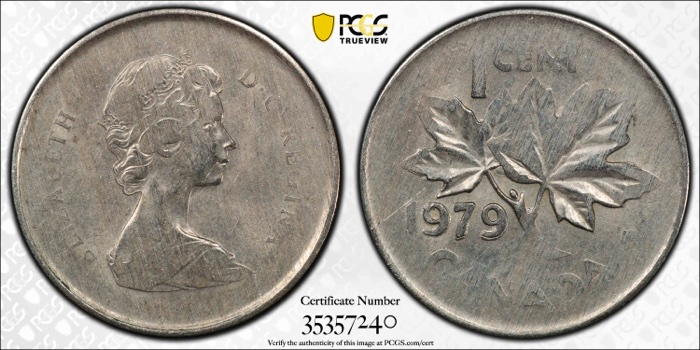 "Discovery follows discovery, each both raising and answering questions, each ending a long search, and each providing the new instruments for a new search." -- J. Robert OppenheimerContent of this post is licensed under a Creative Commons Attribution-NonCommercial 3.0 Unported License. See: http://creativecommons.org/licenses...0/deed.en_USMy eBay store
|
|
Pillar of the Community
 Canada
1164 Posts |
SPP maybe one day I will have to send it your way just to make sure.
|
|
Pillar of the Community
Canada
1634 Posts |
Quote:
anything 1980 and newer should be almost fully struck Interesting, what makes you say that SPP? Did the planchet thickness change between 1979 and 1980? |
|
Pillar of the Community
Canada
1984 Posts |
The RCM made Australia 5 cents for 1981 (2.8g, CuNi) and NZ 5 cents for 1978 and 1981 (2.83g CuNi). These are candidates for 1979 and 1980 Canadian cents. Here are three coins: 1979 non mag 2.84g cent, 1980 non mag cent 2.9g, and Australia 1980 5 Cents non mag 2.89g. In hand the planchets all looks identical. None are plated. As you say SPP, looks like the 1979 is NZ and the 1980 is Australia. 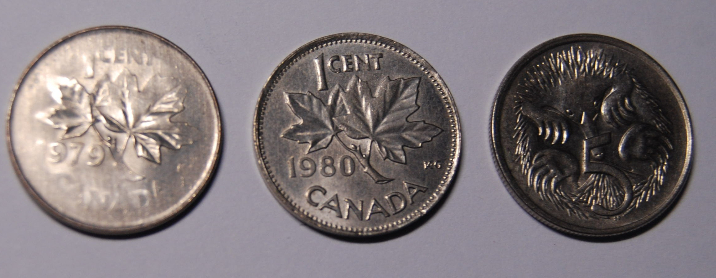 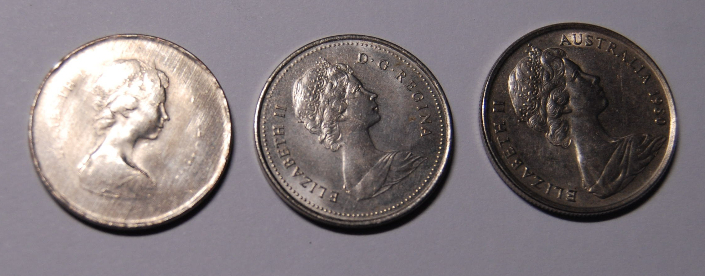 Edited by Smallcentguy
12/20/2021 09:49 am
|
|
Pillar of the Community
Canada
668 Posts |
I'd be interested to see what this xrf's like.
|
|
Pillar of the Community
Canada
1164 Posts |
When I look at that coin at the highest magnification with the microscope, coins have that pitty graininess. This coin has that and the proper look with no sign at all of copper. It might be the real thing with the proper weight. Smallcentguy you sure got me thinking now.
|
|
Pillar of the Community
Canada
1634 Posts |
Quote:The RCM made Australia 5 cents for 1981 (2.8g, CuNi) and NZ 5 cents for 1978 and 1981 (2.83g CuNi). The RCM also struck NZ 5c coins in 1980. Quote:
These are candidates for 1979 and 1980 Canadian cents. If the RCM struck coins in 1981 for Australia and NZ, the OPs coin cant be on those planchets, as his was struck on a 1980 1c die, which wouldnt have been around in 1981. |
|
Pillar of the Community
Canada
5342 Posts |
But the foreign planchet could have been stuck in a bulk bin and filled with blanks for the 1980 Canadian strikes or many other logical reasons or in this time period a purpose built coin
|
|
Pillar of the Community
Canada
1634 Posts |
All I'm saying is that planchets from 1981 are ruled out; planchets dont travel back in time as far as I'm aware.
It could still be struck on a 1978 or 1979 NZ 5c planchet, but since the OPs coin doesn't look anything like SPP's, I dont think it was struck on a foreign planchet IMHO
|
|
Pillar of the Community
Canada
1984 Posts |
But they don't travel back they travel forward..... If NZ wanted coins to be ready for 1981, they may have struck them in Canada in 1980 so that they could be sent to NZ in time for a 1981 launch.
|
|
Moderator
Canada
10477 Posts |
Quote:
Did the planchet thickness change between 1979 and 1980? For normal 1c coins? Absolutely - from 3.24 grams in 1979 to 2.8 grams in 1980. The die set up to strike those coins would have been adjusted accordingly. So a 2.8 gram Cu-Ni planchet in 1979 would be weakly struck, but a 2.8 gram planchet in 1980 would be fully struck. "Discovery follows discovery, each both raising and answering questions, each ending a long search, and each providing the new instruments for a new search." -- J. Robert OppenheimerContent of this post is licensed under a Creative Commons Attribution-NonCommercial 3.0 Unported License. See: http://creativecommons.org/licenses...0/deed.en_USMy eBay store
|
|
Pillar of the Community
Canada
668 Posts |
Very interesting to see the tight tolerances the dies must hold in correspondence with the planchet.
|
|
Moderator
Canada
10477 Posts |
Quote:
Very interesting to see the tight tolerances the dies must hold in correspondence with the planchet. Yes... and no. if tolerances were really tight, We'd never see a die clash!! "Discovery follows discovery, each both raising and answering questions, each ending a long search, and each providing the new instruments for a new search." -- J. Robert OppenheimerContent of this post is licensed under a Creative Commons Attribution-NonCommercial 3.0 Unported License. See: http://creativecommons.org/licenses...0/deed.en_USMy eBay store
|
|
Pillar of the Community
Canada
668 Posts |
Quote:
Yes... and no. if tolerances were really tight, We'd never see a die clash!! Great point! if the tolerances were that tight the dies in theory would never clash.. I have lots to learn still in terms of how clashes occur in the first place! |
|
Page 2 of 2
|
Replies: 22 / Views: 3,488 |
Page 2 of 2
|








 First Page

 Posted 12/19/2021 8:14 pm


