| Author |
 Replies: 23 / Views: 3,722 Replies: 23 / Views: 3,722 |
Page 2 of 2
|
|
|
|
Pillar of the Community
  Sweden
2124 Posts |
Post #5: End Of Sapèques
or
The Holey Coins PrevailSapèque, French Indochina, 1897. Bronze, 2.0 g, 20 mm. 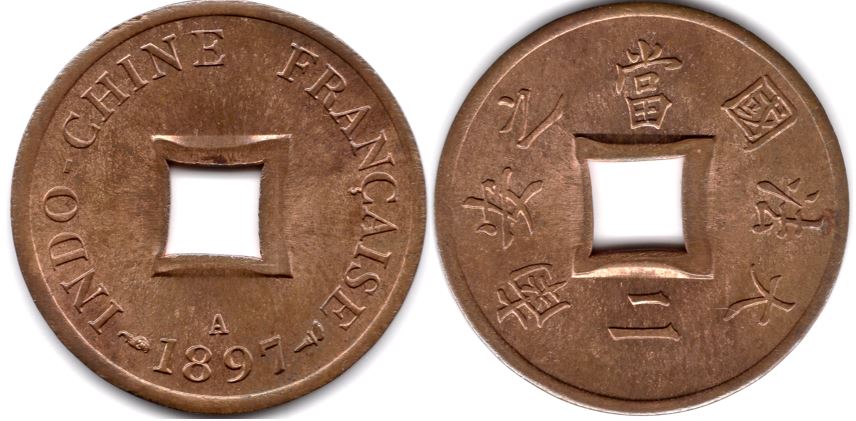 France continued to mint the sapèques until 1902, identical to the original Cochinchina design except for substituting Indo-Chine for Cochinchine in the inscription. Even the Chinese character inscription - which translates to "Great Country France, Annam Part" (see Note 3 in post #1) - was kept, although it referred only to Annam (i.e., Vietnam), even though both Cambodia and Laos were part of its circulation area. The struck sapèque never really struck a chord with the locals, despite its undoubted superiority in design and durability compared to the indigenous cash coins. The Vietnamese court continued to cast cash coins of the old type, although by this time almost exclusively in copper alloys (usually brass made of copper and a substantial proportion of zinc). The 10 van coin shown in post #1 is an example of those. 1 centième, French Indochina, 1900. Bronze, 7.5 g, 27.5 mm. 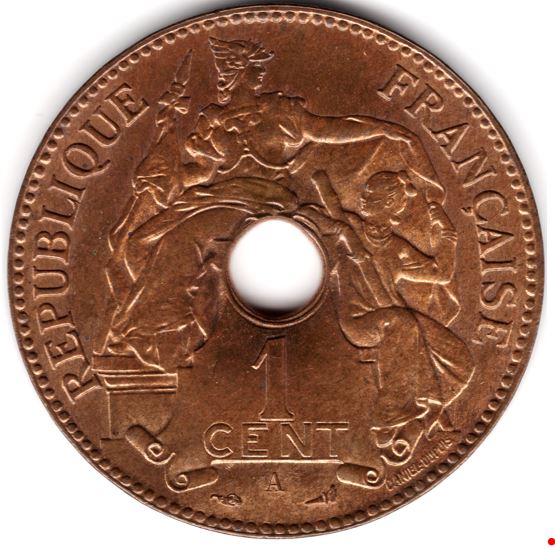 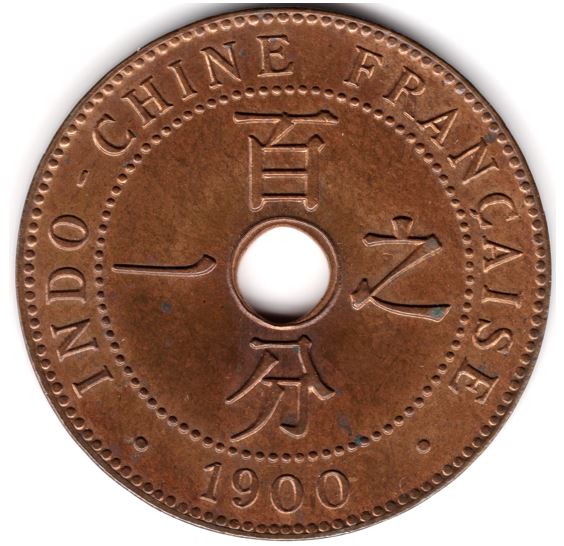 The old type of 1 centième coin (shown in the previous post #4) was replaced by a new design in 1896. It was a bit smaller, weighed only 72 % of its predecessor (the weight was no longer stated on the coin). The Chinese/Vietnamese inscription on the reverse was the same, just arranged differently. The obverse, however, had a new motif. The stern looking Republic with its spiked crown was replaced by a somewhat more lenient Republic with a winged Phrygian cap instead, and holding a (probably French) flag. Below her sits a lady who should clearly represent Annam/Vietnam, holding a bamboo stick (?). Lady Republic (i.e., France) holds her cape in a protective gesture over Annam. It is really a mishmash of symbols - national, cultural, commercial - but the overall message is quite clear: Proud but benevolent France has arrived to share its civilizational feats with a needy Indochina. The motif is very close to the one shown on the contemporary 1 piastre banknote shown in post #5 in the piastre thread. And, it has got a hole! Albeit a round one, but a hole. One of the earliest "Western" coins with an original hole (not counting Western minted coins that mimic cash coins, like the early Hong Kong mils and, of course, the French sapèques). Absolutely inspired by the "holey" Indochinese and Chinese cash coins. Almost two decades later, the idea was mature enough to reach France itself. In 1914, the first French coins with a center hole were issued. In part to save material for the war needs, although the patterns for holed coins came already 1913, one year before the outbreak of World War 1. No doubt the idea came from the Indochinese coins - after all, it was the Paris mint that minted those - even though that link is not stated anywhere in the documentation. Both French and Indochinese coins kept the holed designs until World War 2. 25 centimes, France, 1914. Nickel, 5.0 g, 24 mm. 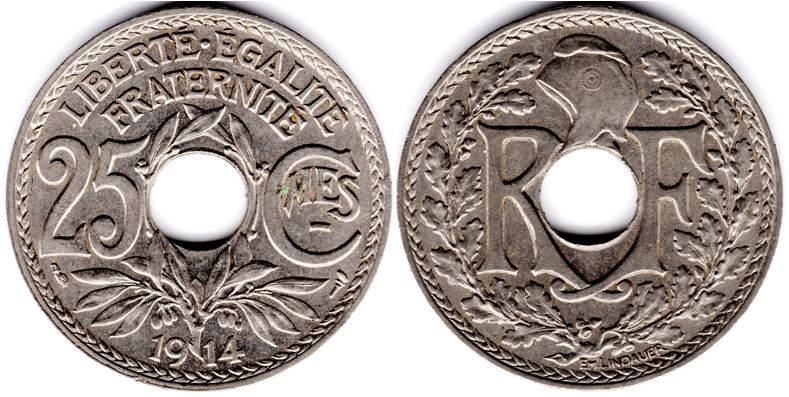 Next time Next timeA new century and a surprise return.
|
|
Moderator
 United States
196944 Posts |
Fascinating.  |
|
Pillar of the Community
United States
2645 Posts |
I guess I can say this is my best junkbox find ($0.15-.20) 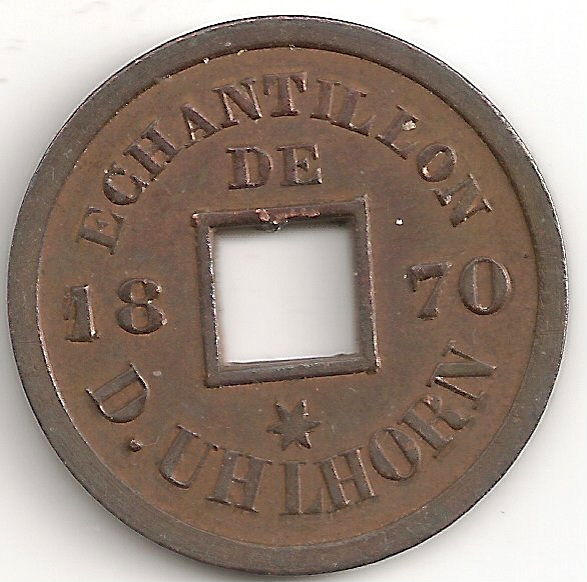 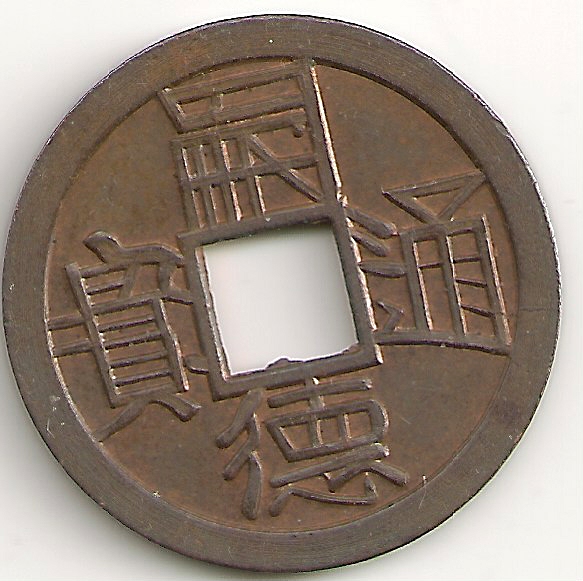 PCGS identifies it as an authentic French Cochin Chinese essai -- graded SP 63 BN. |
|
Pillar of the Community
Sweden
2124 Posts |
|
|
Moderator
United States
196944 Posts |
Quote:
I guess I can say this is my best junkbox find ($0.15-.20) Outstanding!  |
|
Pillar of the Community
Sweden
2124 Posts |
Post #6: The Return Of The Sapèque
or
"You Minted How Many Coins?"1/600 piastre, Tonkin, 1905. Zinc, 2.7 g, 25 mm.  The sapèque was dead ... and yet not quite. Minting of the bronze sapèque ended in 1902 and the need for cash coins had to be met by indigenous cast cash coins and the existing stocks of struck sapèques. That was far from sufficient and there was a severe lack of cash coins. Since there was no fixed exchange rate towards the piastre, the rate decreased: From the normal 6-8 ligatures (each with 100 copper or 600 zinc coins), the rate fell to 3-4 per piastre. Tonkin, the northernmost region in Vietnam, with a border to China and with many Chinese immigrants, was the most densely populated region in Indochina at the time. It was the economic hot spot of Indochina and the lack of small change for everyday business was particularly noticeable. Local merchants pressured the authorities to do something about the situation. The French authorities, burned by the experiences of striking sapèques, hesitated. Eventually though, they gave in, but only for Tonkin, which had a special status as a protectorate and was separately administrated from the rest of Annam/Vietnam (which was something the Vietnamese emperor did not fully agree on). Tonkin has rich zinc deposits, and in an attempt to connect with the tradition of zinc cash coins, it was decided to mint a new sapèque in pure zinc. Hopefully that, together with the traditional square hole, would be met with appreciation by the discerning locals. It was minted in Paris and assigned a value of 1/600 piastre (that is, the ordinary rate of copper cash coins to one piastre before the problems). Interestingly the denomination was stated with Chinese characters only: "Six hundred part of one". The coin was minted in 1905 only, but in that single year 60 million coins were minted! Unfortunately, this French sapèque was met with the same aversion as the previous attempt to mint a "good" cash coin. That was despite the desperate need for precisely this type of currency, and despite that the French authorities had declared the zinc sapèque to be legal tender and thus accepted for payments to the colonial authorities (a status the indigenous cash coins never had). Why was that? Two reasons: Firstly, the fixed rate of 1/600 to the piastre was problematic. The locals knew that the rate of cash coins to the piastre was variable, even highly variable at times. That meant that they did not know what the Tonkin sapèque's value was in cash coins, which was what ordinary people measured value in. The risk of losing out on a bad transaction made them reluctant to accept the new coin. Secondly, the old aversion against the French was still there. That may have become more pronounced by the inscription on the coin: "Protectorate of Tonkin" may have seemed neutral, it was a coin for Tonkin after all. In the eyes of some Vietnamese it was a provocation since it underlined the French hegemony over Tonkin, a fact that was never fully accepted by the Vietnamese emperor. Only about a tenth of the 60 million coins ever left the Hanoi treasury. Even though zinc deteriorates easily and many of the more than 50 million never circulated coins more or less self-destructed, these coins are not hard to find in near excellent condition. Next timeWe look at how the indigenous cash coins stubbornly live on and how France stubbornly sticks to its Republican symbols.
|
|
Pillar of the Community
Sweden
2124 Posts |
Post #7: Old Habits Die Hard
or
The Empire Strikes CoinsWhile the French controlled the piastre based high end economy and made their best attempts at the low end economy with various sapèques and other culturally appropriated small change, the traditional casting of cash coins went on in parallel. It was under the control of the Vietnamese imperial court and had been performed continuously during the whole colonial period. Even though the brittle pure zinc had been abandoned, the traditional method of casting was maintained (alloying copper with zinc into brass). I can guess this was a link to the pre-colonial past and therefor the traditional cash coins were cherished by the local population. The capacity of the imperial mints was limited though and did not meet the demand. 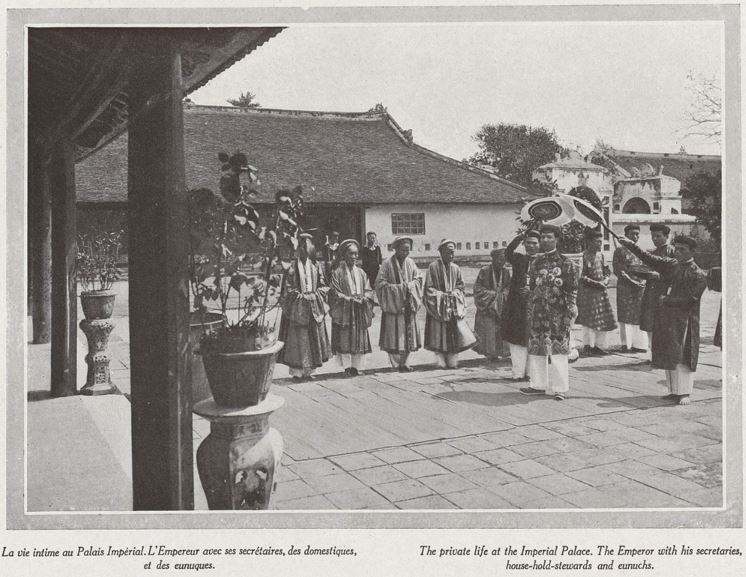 Emperor Khai Dinh and his court.Source: manhhai/flickr, public domain Emperor Khai Dinh and his court.Source: manhhai/flickr, public domainThe French authorities decided to alleviate the situation by producing cash coins with modern methods, by striking instead of casting. The struck coins were modeled after the existing cast cash coins that emperor Khai Dinh had produced earlier and considered to have a value of 6 old zinc cash coins (or 6 van). The Chinese/Vietnamese text says "Khai Dinh - circulating currency". Like the cast coins, the struck cash coins were considered local Vietnamese currency and without the status of legal tender. To what degree the emperor was informed or involved in the project is unclear. Struck cash coin, Vietnam/Dai Nam, emperor Khai Dinh, 1921-22. Brass, 2.5 g, 22 mm. 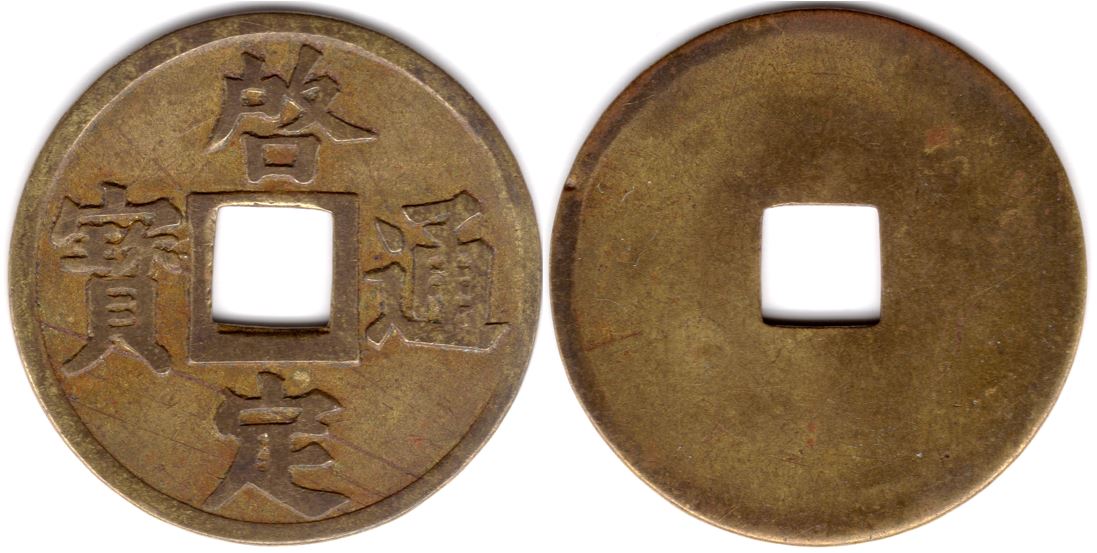 Unlike the colonial coins, these were not to be minted in Paris. Since there was no modern minting equipment available locally, a local mechanical workshop was contracted to produce 200 million coins. The Societe de constructions mecaniques in Haiphong had large facilities where they constructed and produced, among other things, steam engines, cars, and even locomotives. What equipment they used to strike the coins is not known. 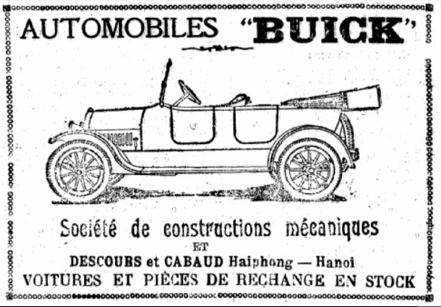 A 1918 advertisement for the mechanical workshop that struck the cash coins.Source: Les entreprises coloniales françaises A 1918 advertisement for the mechanical workshop that struck the cash coins.Source: Les entreprises coloniales françaisesAgain, the sensitive locals recognized the coins as not being quite right and not quite what they were used to. Only with hesitancy did they accept the coins, to begin with. Later however, in the 1930s, it was reported that the struck Khai Dinh coins were in full circulation and apparently readily accepted. 5 centièmes, French Indochina, 1925. Copper-nickel, 5.0 g, 24 mm.   In 1923 a new denomination was introduced: 5 cent(ième)s. Its design was in total contrast to the struck cash coin, with a classical French Marianne in a Phrygian cap, above two cornucopias from which various foodstuffs pour forth. It looks very Republican French, and is very similar to earlier 25 centimes French coins - also holed, with the same size and weight, and in fact it has the same engraver (A. Patey). There is even a ribbon with the Republican motto LIBERTe eGALITe FRATERNITe - "Liberty Equality Fraternity". As bringers of freedom and equality the French were perhaps not perceived by all Vietnamese. I also wonder if the cornucopias symbolize bringing riches to or taking riches from Indochina ... The reverse shows rice, at least that was something recognizable. There was no fixed exchange rate for cash coins vs the piastre, but the typical rate was 6 ligatures (= 600 brass cash coins) per piastre. Thus there would go 30 cash coins on the 5 cents coin. A 5 cents coin at this time would be enough to buy ½-1 kg (1-2 lb) of rice. Next timeWe move along, into the 1930s.
|
|
Moderator
United States
196944 Posts |
Very interesting! |
|
Pillar of the Community
Sweden
2124 Posts |
Post #8: The Last Cast
or
Honey, I Shrunk The CoinsAs described in my parallel thread on the piastre, the 1930s may have had more drama to it in the high end silver based economy. There were a few developments in the low end copper economy as well, though. 1 centième, French Indochina, 1938. Bronze, 5.0 g, 26 mm.  The first coin, however, does not show much development, it looks exactly like the 1900 coin presented in post #5. Only smaller - 5.0 g instead of 7.5 g. The shrink took place already in 1908. Better, or at least alternative, uses for the copper were available already back then. The design is the same, this coin was minted until 1939. ½ centième, French Indochina, 1939. Bronze, 4.0 g, 21 mm.  The ½ cent(ième) was a new denomination, minted 1935-40, and even smaller than the shrunk 1 cent of course. It filled a gap in the colonial denomination range, after the French sapèques of 1902 and 1905 - with a value of 1/5 respectively 1/6 cent - had been demonetized in the early 1930s. The local Vietnamese cash coins were there, of course - some of them even minted by the French authorities - but they were not part of the official economy. The depression of the 1930s also reached Indochina and there was an increased need for small values. This was France's way of marking a financial presence also at the very low end of daily transactions. The design looks familiar, if you recall the French 25 centimes coin I showed in post #5. Those coins were minted until 1937, and this ½ cent is simply a copy of that design, hole and all. The text on the reverse has been changed, and the original olive branches have been replaced with rice stalks. It is interesting that the Chinese inscription is gone on the ½ cent while it remains on the 1 cent coin. Did the French authorities expect everyone to have learnt French by now, or did they just not care any longer?  The local cash coins The local cash coinsAnyhow, the local cash coins were still around. As late as 1926 (possibly later), the new emperor Bao Dai cast cash coins with his name and the usual thông bao. These are in fact the last cast cash coins, anywhere. China had abandoned the technique long ago, but the Vietnamese cherished the tradition. It could of course have been an element of silent protest against the colonial power in sticking with the traditional Vietnamese coins. Cast cash coin, Vietnam/Dai Nam, emperor Bao Dai, 1926? Copper alloy, 3.4 g, 24 mm.  Like for the previous emperor Khai Dinh, the French authorities also struck cash coins for Bao Dai. This was done in 1933. They had the same design as the cast ones, but were considerably smaller (and were of course not liked by the locals). Struck cash coin, Vietnam/Dai Nam, emperor Bao Dai, 1933. Brass, 1.4 g, 18 mm.  The mechanical workshop employed in 1921 for the striking of cash coins for Khai Dinh was still around, but the cost for manufacturing those coins had been high. Alternative options were sought out, and the commission landed with another Haiphong firm, Poinsard & Veyret. Poinsard & Veyret was a factory with various operations. In their own words, they made "furniture, paints, coins" among other things. They had a machine suitable for manufacturing coins by punching them from a sheet of brass, see picture below. Not a new method for striking coins for sure, but maybe the only time it has been employed to make cash coins? It was cheap and efficient but had its shortfalls. The coins near the edges tended to be weakly struck and slightly bent. They had to be manually checked and straightened with a light mallet.  A sheet of struck Bao Dai cash coins (see Note 1).Source: NumisBids A sheet of struck Bao Dai cash coins (see Note 1).Source: NumisBidsAs mentioned, the reception was tepid. One can understand that when placing the new, small coin next to a cast one (including also a coin struck for Khai Dinh):  Struck Khai Dinh cash (1921-22), cast Bao Dai cash (ca 1926), struck Bao Dai cash (1933).Next time Struck Khai Dinh cash (1921-22), cast Bao Dai cash (ca 1926), struck Bao Dai cash (1933).Next timeThe next and last post will look at the coinage during World War 2. NotesNote 1: Sold at an auction in 2014 for 14,000 Swiss francs (same in USD).
|
|
Moderator
United States
196944 Posts |
Fascinating! |
|
Pillar of the Community
Sweden
2124 Posts |
Post #9: Times Of War
or
The Last Cent Image based on material from https://www.histoire-et-philatelie.frLetter found in the estate of a Mme Duval in Toulouse, 1968. Some parts left out. (See Note 1.) Image based on material from https://www.histoire-et-philatelie.frLetter found in the estate of a Mme Duval in Toulouse, 1968. Some parts left out. (See Note 1.)
Hanoï le 25 octobre 1943
Chère maman,
I am writing to you to bring you all my news and because I love you and adore you. I hope this letter reaches you and finds you all well. Me and Rene are fine, despite the troublesome conditions.
...
Do you have little Paul there? Give him a hug from me! I have some new coins for his collection, I know how much he cherishes his coins and sits and looks at them, thinking of what it is like where they come from. I wish I could send him the coins, but I dare not trust the mail. Instead I am sending a photo of them, I hope he will be glad for that one until I can bring them to him!

The first one I am sure he already has, that's just a common 1 cent from before the war. But the one next to it is new. I understand it is actually made here in Hanoi (difficult to send them here from Paris, I guess). It was hard to find a good one, they are not so good at making coins here, I had to search for a long time before I found one that wasn't too badly struck. It is made from zinc. The copper they want for other purposes now. Too bad we have to use the copper to shoot at each other instead of handing money to each other, don't you agree?
The next one is so strange. I got it just the other day. I have never seen such a tiny coin before! And it is so light, weighs nothing it feels like. It is made of aluminium. Why they made such a small coin I don't know. If I sneeze it will fly away I think!
But the last one is really the strangest. ¼ of a cent, who has heard of such a coin? It is made of zinc and I think it is actually the Japanese who have made it. It sounds strange, but a friend of mine with connections told they came on a Japanese ship just a couple of weeks ago. Maybe they want to replace the sapèques? They melt those down for the copper, I have heard, and they are rarely seen nowadays, at least here in Hanoi.
Oh, I sometimes wonder what old grandpa Auguste would have thought of all this. You told me he actually made coins when he was stationed in Saigon in the 70s, or at least he said so. It was those old French centimes they made a hole in. How many was it he had made, single-handedly? Hundred thousand? It was more every time he told the story I think. Maybe he made it all up!
...
Kiss everyone from me.
Your devoted ColetteThe War Reaches Indochina ...In September 1940 Japanese troops entered Tonkin. (see Note 2 for a timeline). It was done in accord with the French Vichy government, in exchange for allowing (Vichy-)France to keep its territorial sovereignty over Indochina. Nevertheless, skirmish fighting took place (possibly initiated by the Japanese to demonstrate their military superiority over the badly equipped and trained Indochinese troops; France had also transferred many of the troops to Europe when war broke out in 1939). Japan exerted pressure on France, and in 1941 all of present Vietnam was in practice occupied by Japanese forces and France had been forced to give Japan concessions for mining and agriculture. That gave Japan access to for instance tin, rice and rubber, which was an important reason for the Japanese interest in Indochina. The politics and administration of the colony did not interest them too much, and they were happy to let France continue dealing with that. ... but minting continues!Thus minting could continue under French direction. That meant the French Vichy government, or etat Français - French State - as it was called. Just like during World War 1, minting of silver coins was canceled, everything above 10 cents was replaced with banknotes (there were even 5 c and 10 c banknotes during the war - see further down). The same for copper coins, but for the lowest denominations new coins in zinc and aluminium were minted. With transport routes not functioning, minting had to take place locally, in Hanoi, instead of Paris as had been the case before the war. There was also an exceptional issue of coins for French Indochina minted in Japan. 1 centième, French Indochina, 1941. Zinc, 5.2 g, 28 mm. Minted in Hanoi.  The last 1 cent bronzes were minted in 1939 and by then it was high time to change the design anyway. The image of France protecting Annam was replaced by a more neutral motif, very similar to the ½ cent issued a few years earlier. A Phrygian cap with a revolution cockade on it (mandatory on French Phrygians  ), olive branches on the obverse, rice on the reverse. No Chinese/Vietnamese text. And made of zinc. The coins were minted 1940-41. The very first issues (or maybe just the patterns) were minted in Paris but soon minting was transferred to Hanoi due to the problems of transporting money across the oceans during war. Note that the coins kept the inscription Republique Française also after the French republic had been dismantled by the Germans and replaced by the Vichy etat Français in June 1940 (see Note 3). The need for small change led to pragmatism before adherence to formalities. That is probably also a factor behind the common half-bad striking of many of these coins (my example above has some interesting die cracks, which is very common on these coins). Quantity before quality. 1 centième, French Indochina, 1943. Aluminium, 0.5 g, 17.5 mm. Minted in Hanoi.  While the first replacement for the pre-war 1 cent was slightly larger and heavier, the next one compensated for that by being the most tiny and light coin that has been minted for French Indochina. Made in aluminium and now with etat Français. The design is reduced to a near minimum: Two rather simple rice stalks. Noteworthy is that the reverse inscription has been reduced to Indochine only; the Française part is removed (why I don't know). This is the last 1 cent coin issued for French Indochina. The lowest post-war denomination was 5 cents. Speaking of which, the war version of that denomination looked as below. Also very small, same overall look as the 1 cent, only slightly more elaborated rice stalks. 5 centièmes, French Indochina, 1943. Aluminium, 0.8 g, 20 mm. Minted in Hanoi.  And then we have the odd ¼ cent, the only coin with such a denomination ever issued for Indochina. It may have been in line with the valuation of the cash coins/sapèques in relation to the piastre at the time, that is, 400 cash coins per piastre. Maybe even more odd is that France requested these coins to be minted by the Japanese. They were minted in Osaka, Japan, and shipped to Indochina (see Note 4). The Japanese of course knew that holes should be square, but again, that takes some special measures to achieve by striking, so a marked square around a circular hole had to do. Other than that, the same austere design with two rice stalks. ¼ centième, French Indochina, 1942. Zinc, 2.6 g, 20 mm. Minted in Osaka.  ... and more emergency notes ... and more emergency notesAs mentioned above, no silver was minted during the war. In fact, silver minting (10 cents and upwards) had ceased already a few years before the war. It was replaced in part by copper-nickel issues and in part by notes emitted by the Indochinese Treasury. A pre-war 10 cent treasury note is shown in the piastre thread, post #9. During the war, there were also tiny 5 cent notes emitted by the Treasury, as shown below. Compared to the rather elaborate pre-war emergency notes, the war notes are more strict and stylized. And they are no longer exchangeable into specie. Similar to the pre-war notes, the obverse is in French, while the reverse has the denomination in Vietnamese, Khmer, Laotian, and Chinese (and some details about what forgers can expect). 5 centièmes treasury note, French Indochina, 1942. 78 x 50 mm.   After the war After the warNo denominations below 5 cents were minted after the war. The etat Français coins were demonetized. Cash coins were officially no longer valid after the war, but it seems they remained in use for some time in remote areas. Thus here ends the posts of coins from me, in this Indochinese small change thread. Don't let that stop you from posting your coins! And of course, if you have questions, I will be happy to try to provide an answer - not that I can guarantee I have one! Or if you have additional information, or corrections, please let me know. The documentation for these issues is sometimes sparse. There will still be a couple more posts in the piastre thread before everything on the high end economy has been dealt with. NotesNote 1: Postal services between France and Indochina were of course affected by the war. The pre-war Air France air mail service was not operational. At times mail delivery was completely suspended, at times it could use irregular and sometimes improvised routes. Delivery times could be very long, several months, and private letters were regularly opened and inspected by military authorities. Note 2: Timeline for events affecting French Indochina during World War 2: - 1937: Japan invades China. The Chinese Nationalist government continues resistance from central and parts of southern China. - Early 1939: Japan demands that French Indochina stops material and weapons transports from (British) Burma to the Chinese Nationalists over the Yunnan railway (see post #4 in the piastre thread). The demands are not met. - Sept 1, 1939: Germany invades Poland, which is the start of World War 2. - June 22, 1940: France surrenders to Germany. Northern France is occupied, in the south the Vichy government is allowed nominal indepence in return for cooperation with Germany. - Aug 30, 1940: The French Vichy government agrees to cooperate with Japan and allows Japanese troops in Tonkin. - July 29, 1941: Japanese troops are allowed in all of French Indochina. - 1943: The Allies begin bomb raids on Indochina. - Aug 25, 1944: Paris is liberated by the Allies. The Vichy government falls. The French and Japanese troops in Indochina are now enemies. - March 9, 1945: The Japanese troops overthrow the colonial government and formally occupy Indochina. - Aug 15, 1945: Japan surrenders to the Allies. Indochina is handed over to emperor Bai Dai, who is soon overthrown by Viet Minh. Eventually France regains control, but their time will be up in the end. Note 3: There are also domestic French coins with the date 1941 and inscription Republique Française. The Vichy government did not begin minting coins with etat Français until 1941. While preparing for that, minting of the existing coin types continued. Note 4: According to sources, the mintage of these coins during 1942-44 was more than 500 million. It is uncertain how many that actually reached Indochina, since shipping of coins had lower priority than most other transport needs.
|
|
Valued Member
United States
238 Posts |
I have enjoyed reading each post. I have a nice essais piece from the era but it is in a bank vault so I can't share a picture right now.
Thanks for posting the series!
|
|
Pillar of the Community
Sweden
2124 Posts |
I am glad you enjoyed my posts, @joewobblie!
Please do post your essai when you have an opportunity!
|
|
Pillar of the Community
United States
882 Posts |
It's curious how the same patterns continually recur. In a volume of Selections from "The Numismatist" I encountered a note from the American minister in Spain, in the middle of the 19th century, describing how the only currency really circulating there was little battered pieces of copper, sometimes carried by the wagonload when large sums of rent or tax had to be paid. Centuries of striking vast quantities of silver coins had left no impression at all on the day-to-day economy.
|
|
Moderator
United States
108675 Posts |
Thanks erafjel for pointing this out to me. Some study papers I need to read now.. So far, the only thing I did actually know was the country group that made up French Indo-China.  |
|
Page 2 of 2
|
Replies: 23 / Views: 3,722 |
Page 2 of 2
|
To participate in the forum you must log in or register.
Disclaimer: While a tremendous amount of effort goes into ensuring the accuracy of the information contained in this site, Coin Community assumes no liability for errors. Copyright 2005 - 2026 Coin Community Family- all rights reserved worldwide. Use of any images or content on this website without prior written permission of Coin Community or the original lender is strictly prohibited.
Contact Us | Advertise Here | Privacy Policy / Terms of Use
|
| Coin Community Forum |
© 2005 - 2026 Coin Community Forums |
| It took 0.61 seconds to rattle this change. |
 |
|




 First Page


 Posted 05/08/2023 4:24 pm





