| Author |
 Replies: 19 / Views: 1,788 Replies: 19 / Views: 1,788 |
Page 2 of 2
|
|
|
|
Moderator
 United States
108458 Posts |
Very cool lamination find!
|
|
Moderator
United States
196702 Posts |
Nice find!  |
|
Bedrock of the Community
United States
79756 Posts |
Great find! Errers and Varietys.
|
|
Moderator
United States
56855 Posts |
Any chance it is a struck through? Why or why not please. John1  |
|
Valued Member
United States
140 Posts |
Very cool .. if it was a lamination issue there wouldn't be the lettering inside the indent would there?
|
|
New Member
 United States
15 Posts |
Thank you everyone for your replies. I'm encouraged to hear so many people identified as a lamination issue. I must admit however I side with the last couple comments I too thought it was a strike through originally, especially as the last person commented because it seems like the lettering is present in the wound. Either way I'm pretty convinced that it is an error coin and I'm going to see if I can figure out what it might be worth and consider getting a graded. Thank you and I would also welcome any opinions on it's value.
|
|
Pillar of the Community
United States
6909 Posts |
EricH has a point. If it's a struck-through or a lamination problem, then why are the surface letters smeared into the hole? A strike through that deep would be an object between the planchet and the die face. No lettering in the hole. A lamination problem would flake off a chunk of metal. Again, no lettering in the hole.
To me there seems to be an undulating structure to the trough. It is also tapered at the ends. Maybe an image looking down the trough from one end might shed some light. My guess is that you could find a dime, quarter, half dollar with a thickness that is the same height as the trough, and the reed pattern will match the wavy surface.
|
|
Pillar of the Community
 United States
9023 Posts |
Quote:
Any chance it is a struck through? Why or why not please.
You have me staring at it now and questioning my first thought. I wonder if it could be both? You can have a loss of lam before the strike. What if part of what we see is some of the pre-strike loose lam mashed back into the void? Not sure. You have me scratching my head now....  Trouble maker!  -makecents-
Edited by -makecents-
07/07/2023 5:04 pm
|
|
New Member
United States
15 Posts |
My original thought was that a die chip or piece of another coin found it's way either on to the planchet or onto the dye from somewhere else. That would give it the characteristics you noted and still be a die error! Everybody's happy!
|
|
New Member
United States
15 Posts |
So for those still following, this is a picture taken at about 25° angle. I had to do a composite image because the microscope wouldn't focus on the entire defect at one time. That is a series of I believe five shots that I stitched together so you can see the entire defect. In my opinion, based on the shallowness of the defect that it may in fact be a lamination issue. I don't see the characteristics that would lead me to believe that it was a strike through by a die or another coin piece 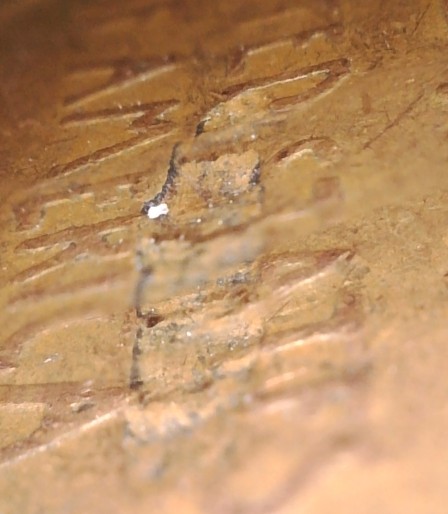 |
|
Pillar of the Community
United States
6909 Posts |
Yeah, that looks much shallower than I thought. Definitely shallow enough for the die strike to push up metal into those leaky letters. Seems like the lamination theory is the right one.
|
|
Pillar of the Community
United States
7174 Posts |
Lamination. Whatever you decide it is, DO NOT GET THIS GRADED. It's only worth a dollar or 2
|
|
Moderator
United States
108458 Posts |
I'm with the lamination folks (have been from the start.) it was, for me the sharp edges around it that made me think it was 'torn'
Edited by Dearborn
07/07/2023 10:03 pm
|
|
Pillar of the Community
United States
2376 Posts |
It is a lamination or struck through a laminated fragment. There are crosswise striations that are typical of the internal structure of a copper cent present in the anomaly. That ghosts of the design are present confirms that there was initially coin metal there for the design to transfer through. Here was my example of a lamination and its bark that delaminated in my hand. It shows how the design transfers through a lamination. 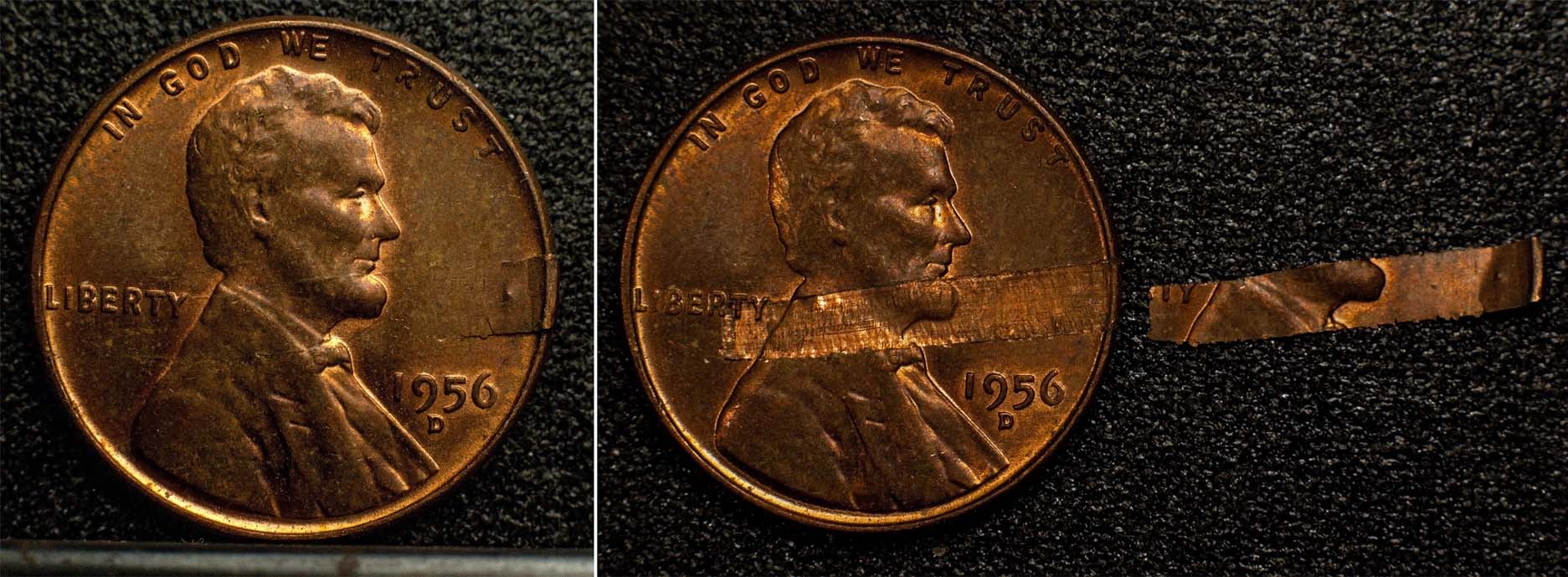 |
|
Valued Member
United States
270 Posts |
You have joined the lamination nation.
|
|
Page 2 of 2
|
Replies: 19 / Views: 1,788 |
Page 2 of 2
|




 First Page


 Posted 07/07/2023 11:55 am





