







 First Page
 Previous Page


 Posted 06/05/2024 6:07 pm


= 19th-20th Centuries =
1 livre = 20 sous = 80 liards = 240 deniers. Such was the French monetary system until 1795, when the franc was introduced as part of the reforms initiated by the French Revolution. For practical reasons, the old coins remained valid, but were successively phased out. The old liards were valid until 1856, at a value of two centimes, 2/100 of a franc. Of course there were no new coins minted for the old system, only francs and centimes.
That was a problem for the two Bailiwicks in the English Channel, Guernsey and Jersey. Contrary to what one might think, these two possessions of the British monarch did not use British currency, but French. Preferably pre-revolutionary French. The islands traditionally had close ties with nearby France, being the last remnants of the Duchy of Normandy. English king Edward III had, in the 1340s, granted the Channel Islands certain rights, including the right to pay rents and dues to the crown "in the same money as is used by the inhabitants of Normandy". When the Normans began to use French coin, so did the Channel Islands. When the French revolutionaries shifted over to the franc, so did the islanders, after a few years and with some hesitation. All accounts continued to be kept in livres, though, with regular updates of the exchange rate to French francs, British pounds, Spanish dollars, and other currencies that were used on the islands.
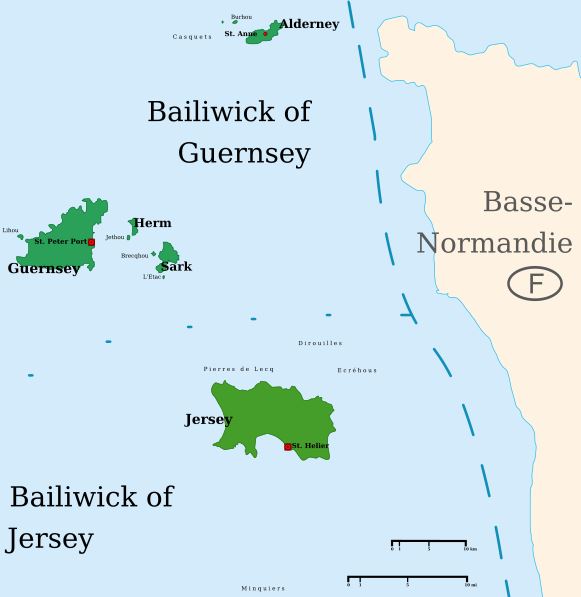
Guernsey and Jersey in the English Channel.
Source: By Hannes2. Wikimedia Commons. Creative Commons Attribution-Share Alike 3.0 Unported license.
In the 1820s, it was becoming difficult to fill the need for coins from the old sous-deniers system, and the ones that were available were quite worn. Other copper pieces besides French circulated as small change as well: English farthings, Dutch and Spanish coppers of various denominations, the odd uniform button too. The new franc system didn't help much, because copper small change was scarce in France too (as usual, the French found other, more belligerent uses, for their copper - not least during the Napoleonic wars which raged until 1815). France had restored the monarchy after Napoleon but did not seem to have any plans to restore the old money system. Something needed to be done.
To an ignorant foreigner like me, a natural course of action seems to have been to introduce British money on the islands. After all, that too used the same division: 1 pound = 20 shillings = 240 pence. Precisely that was actually suggested to the Guernsey authorities by the British home secretary in 1826. He got an extensive answer, that referred to the grants made by Edward III and later kings about the right to use French coin, as well as the recent instability of the British currency (brought about by the many years of war) and the detrimental effect it would have to force it upon the inhabitants of the Bailiwick. Then no more was said about that. Clearly, Guernsey wanted to have its own monetary system, not tied to that of the Realm. And it was probably useful to stay on par with the existing stock of (more and more worn) French 18th century coins. Guernsey came up with a solution to meet both requirements.
The Double (and the "Guernsey Penny")
All sorts of old French coins circulated in Guernsey in the beginning of the 19th century. Common smaller denominations were 2 sous, 1 sou, ½ sou, and 1/4 sou. The last one of those, yes, that's the liard. In Guernsey, those were called doubles (I elaborate on the name further down).
The new system was based on the liard/double, the smallest coin that circulated, and the denomination officially became double. The first coins, 1 double and 4 doubles - corresponding to 1/4 sou and 1 sou - were issued in 1830. An 8 doubles - 2 sous - coin came in 1834. 8 doubles were thus equal to 1/10 French livre (French currency continued to be valid, if you managed to find any). The 8 doubles coin eventually became known as the Guernsey penny. 12 of those made a Guernsey shilling, 20 of which made a Guernsey pound. In 1829 the exchange rate was set to 1 franc = 10 Guernsey pence (which matches the 8 doubles = 1/10 livre, ignoring the 1.25 % difference in value between livre and franc). The British pound (sterling) was worth 25.50 francs (defined by the gold content of the two currencies' coins), which made 1 £ sterling = 1 £ 1 s 3 d Guernsey.
That is perhaps enough numbers for now, let's look at a coin! Here is the first coin minted in the new system, a 1 double - or liard, if you like:
1 double, Guernsey 1830, Soho. Copper. 2.48 g, 19 mm. Spink 7202.
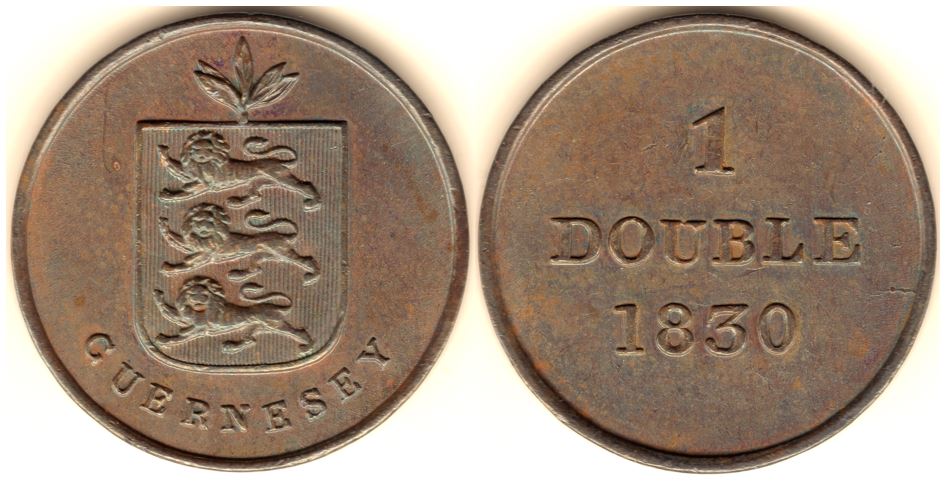
Obverse: GUERNESEY. Guernsey coat of arms.
Reverse: 1 DOUBLE.
Not much to see here.
 French spelling of Guernsey. The three lions are the same three that roam the English coat of arms. That was created for Richard the Lionheart, king of England until 1199, and it reached the Channel Islands probably in 1279, when king Edward I granted them his seal for local use. (To a heraldist, these lions passant guardant are leopards, by the way.) The shield is topped by a sprig of what at least originally was broom, Latin name Planta genista, a symbol of the Plantagenet kings, the royal line to which Richard and Edward belonged.
To mint the coins, the Soho mint in Birmingham, UK, was contracted. The single 1830 issue of about 1.6 million 1 double coins and ca 650,000 4 doubles coins, complemented with a single issue of ca 220,000 8 doubles coins in 1834, was considered sufficient. The next issue did not come until 1858.
The Absolutely Last "Liard"
In 1870 British coins were made legal tender, with a rate of 1 British shilling = 12½ Guernsey pence. In 1921, the Guernsey pound was made equal to the pound sterling, with 21 Guernsey shillings to the pound. The 1 double coin was minted now and then until 1938. That year the last of this minute denomination - corresponding to ½ farthing - was made.
1 double, Guernsey 1938, Birmingham. Bronze. 2.27 g, 19 mm. Spink 7220.
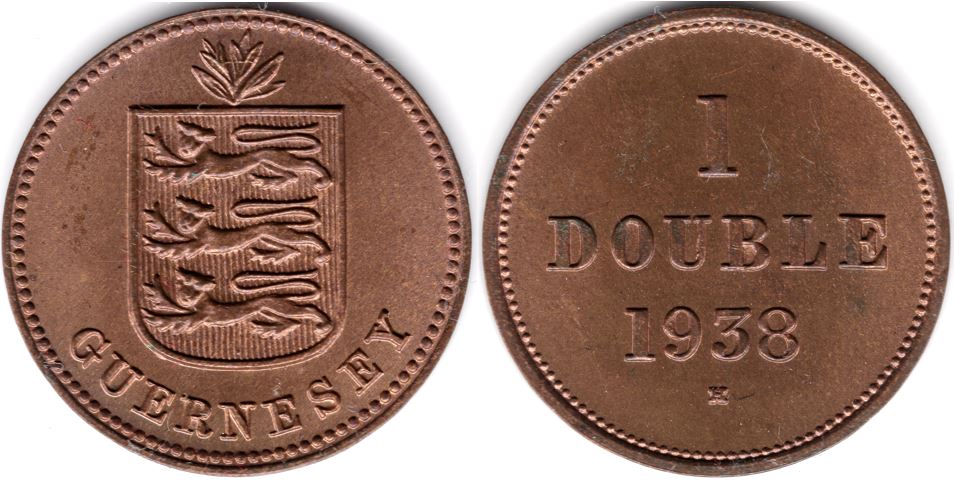
Obverse: GUERNESEY. Guernsey coat of arms.
Reverse: 1 DOUBLE. Mintmark 'H' for Heaton & Sons, Birmingham.
No need to change a winning design . . . The lions/panthers have been updated to a more modern look, and the mint has been bestowed with a letter. (Heaton & Sons, also known as Birmingham Mint, was located not far from Soho Mint. When the latter closed in the mid 1800s, Birmingham Mint took over some of its equipment.)
I think we can call this the last coin minted with a value of one liard.
The name double continued to be used, though. Here is a 4 doubles (corresponding to a halfpenny) from 1956.
4 doubles, Guernsey 1956, London. Bronze. 4.81 g, 25.5 mm. Spink 7226.
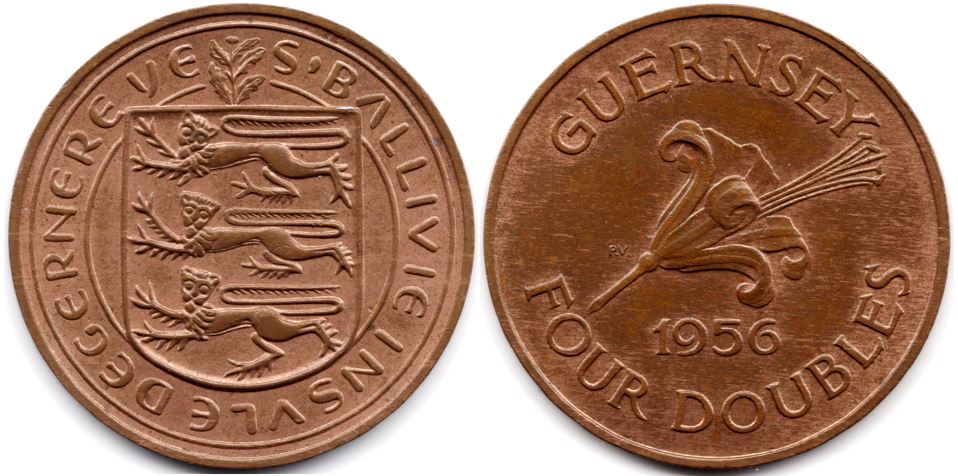
Obverse: S'BALLIVIE INSVLE DEGERNEREYE (Sigillum Ballivie insule de Gernereye / Seal of the Bailiwick of the Island of Guernsey). Guernsey coat of arms.
Reverse: GUERNSEY // FOUR DOUBLES. Guernsey lily. Initials 'P.V.' for engraver Paul Vincze.
Now this one looks different. The coat of arms is still there, but the lions have become even more stylized. My first thought when I saw this coin was "Hm, nice 1950s model on those lions, and the text, what is that, something on the local Guernsey dialect?" A bit of research showed that it is a slightly modernized rendition of a seal closer to the 1250s.
 The original is shown below.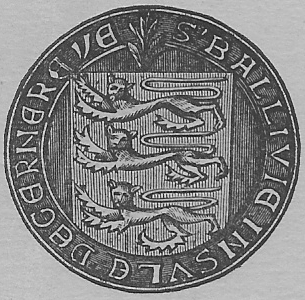
13th century seal used by the Bailiwick of Guernsey.
Source: From Note-Book of Pierre Le Roy (1600-1675). Wikipedia. Public domain.
The lions have been modernized a bit . . . And it is all Latin, Ballivie and Gernereye are just Latinized forms of the local words at the time.
The red Guernsey lily has been cultivated on the island for centuries. It originates in South Africa and the legend has it that bulbs from a sunken ship floated ashore in 1659, took root and flourished.
The very last regular coin for circulation with a denomination in doubles was the 1959 8 doubles, with a design similar to the 4 doubles.
Some Irregular Latecomers
While the 8 doubles issued in 1959 was the last coin put into circulation, there were a number of 4 and 8 doubles proofs, with the same design, issued in 1966. There is also a commemorative coin, issued 2012-2015, with the 8 doubles design used 1914-1949, but in silver and with the real denomination of 2 pounds.
Why "Double"?
In France the liards were valued at 1/4 sou in the 18th century, but in Guernsey the rate liard to sou varied. In 1763 the Guernsey authorities set the rate to 6 liards per sou, that is, a value of two deniers. Liards from France (and similar sized coins from other countries) were named grand doubles (maybe to differentiate them from ordinary double deniers, which may have been around too). The reason for the undervaluation was to attract silver coins to Guernsey - the calculation was that the islanders would take their copper liards to France, where they were still worth 1/4 sou and could be exchanged into silver coins at a better rate. I am not sure how well that scheme worked, but a value of 1/6-1/7 sou remained until the 1820s, and so did the name double. At the introduction of the Guernsey coinage in 1830, however, the value of the double again corresponded to 1/4 sou.
What About Jersey?
Jersey had the same issues, of course, using the French livre-sous-deniers system, and running out of useful coins. Like Guernsey, they were not too keen to simply move to British currency. But using the same system as the neighbor bailiwick - well, that was just not going to happen. Despite - or because of - the fairly short distance between Jersey and Guernsey - 43 km/27 mi - the two islands have been rivals about most things. Calling the inhabitants of the other island "toads" respectively "donkeys" gives an idea of the level of mutual appreciation. Guernseys being considered as strongheaded on Jersey, while Guernsey sees Jerseys as too lenient towards the English Crown may have its roots in the two islands taking different stands during the English Civil War. That the inhabitants of the other island were seen, overall, as a bit backward, goes without saying.

In any event, Jersey came up with its own solution. It was decided to make the British pound legal currency, and likewise for the British shilling. The shilling, however, was divided into 13 "Jersey pence", the official name being "1/13th of a shilling". The pound was defined as equivalent to 26 French livres, which made the Jersey penny equal to 2 French sous. That is, the same value as the Guernsey penny or 8 doubles coin. Coins were minted with values of 1/13th, 1/26th, and 1/52nd of a shilling, but no 1/104th of a shilling, which would have equaled the 1/4 sou or liard.
Epilogue
600 years of existence in various forms - from 1368 to 1966 (if we take hardi, liard and double to all mean the same) - silver, billon, copper and bronze, English, French, Flemish and Dutch, thin and tiny, thick and sturdy. Not bad for a small coin.
I am also a bit marveled at the fact that the last doubles/liards were issued under a monarch who was with us until very recently. Although her name was not included on the Guernsey coins until the 1960s, Elizabeth II (and her predecessors) was head of state and ultimately responsible for the minting. Going back to the first hardi of 1368 - presented in Chapter 1 - we have another English royalty, Prince Edward, who minted those for his Duchy of Aquitaine (and it was his father, Edward III, who granted the Channel Islands their rights). We have come full circle.


