| Author |
 Replies: 16 / Views: 513  |
Page 2 of 2
|
|
|
|
Pillar of the Community
 United States
1787 Posts |
I want to work Sintered Planchets into my IA 2027 paper but the problem is we may not have the scientific technology out there at least in the TPG world to make a correct assessment that something is sintered based on past blunders. Specifically, ''everything" once called sintered has either been proved to be improperly annealed, environmental damage (i.e., just some strange oxide formations on the coin's surface) or improperly cleaned. Its bonded contaminated metal on the surface that is then diffused into the metal surface say with a temperature rise in the annealing oven (i.e., some call it drums) which I concur but to verify this definition to a SINGLE COIN incredibly I still can't confirm just one example. This must occur IMO thru the manufacturing of planchets but it remains elusive. JPL |
|
Moderator
 United States
110206 Posts |
As far as I know a sintered planchet and an improperly annealed planchet are actually different names for the exact same coin mint error, with sintered actually an incorrect term for what happens to a planchet. In metallurgy, sintering is the process of compacting and fusing metal powders together under intense heat. Coin experts later realized this wasn't technically accurate because coin blanks are not made from powdered metals Planchets go through an annealing furnace to soften the metal so it can be struck properly. When something goes wrong in that oven (such as excessive heat, lingering metal dust in the drum, or the wrong atmosphere) Exposure to residual heat and oxygen oxidizes these surface layers, turning the coin strange colors—such as deep red, copper-orange, smoky purple, gunmetal gray, or pitch black (Black Beauties) As for labeling on TPG slabs, Older coin slabs or vintage collector notes may still say "Sintered Planchet", whereas modern grading certificates will designate it as an Improperly Annealed error. |
|
Pillar of the Community
United States
1787 Posts |
100% correct IMO Dearborn. There was in an old CCF thread where the writer in this scenario gave this scenario: we have Cents being made in this furnace annealing oven (drum). The process is completed. Then quarters are put in there to be annealed but the drum is still dirty from the cents so copper or more specifically lingering copper dust then adheres to the quarter surface via contamination and then in the SECOND step gets diffused (i.e., via a high temperature) into the quarter surface with copper dust creating this reddish surface. The writer forgot the second required diffusion step. Anyway = Theoretically - consider then If copper-rich dust from a previous cent-production run contaminated the drums before quarter blanks were introduced, the resulting quarters would likely show isolated copper-rich stains, patches, or streaks on the surface rather than a uniform color change across the entire coin if contamination occurred along with diffusion via high temperature environment. After annealing, these localized copper deposits could oxidize preferentially, producing reddish, brown, or dark spots on an otherwise normal copper-nickel clad surface.
In contrast, a true improperly annealed quarter would be expected to show a more continuous and systematic color progression, reflecting oxidation of the entire clad layer rather than localized contamination. So to me this is possible as a possible error coin. I guess then if possible can someone show me a numismatic item under this scenario. A sintered surface is characterized IMO if one exists by a rough, porous, granular, often orange-peel-like texture containing microscopic pits, voids, and evidence of incomplete bonding between metal particles rather than a smooth, fully consolidated metallic surface as in a IA coin. One dilemma that is a possibility is that these zinc cents with the the zinc core could also possibly create an orange peel type surface thru environmental exposure - possibly. The zinc core cents IMO may not be the best candidates to illustrate a sintered planchet. I guess what I am looking for is to bring a high confidence sintered planchet candidate in the analysis pool with some Black Beauties and other candidates in 2027 for this IA paper. It looks grim and dim at this point. Just reaching out for a strong candidate. JPL
|
|
Pillar of the Community
United States
6968 Posts |
|
|
Pillar of the Community
United States
1787 Posts |
Improperly annealed. This will be scientifically verified in 2027 in my paper.
|
|
Moderator
United States
198004 Posts |
Very interesting.   |
|
Pillar of the Community
United States
6968 Posts |
Quote:
Improperly annealed. This will be scientifically verified in 2027 in my paper. Hm. If you want us to go looking for "true" sintered planchets, perhaps you can briefly describe how to visually distinguish between a sintered planchet and an improperly annealed planchet. |
|
Pillar of the Community
United States
1787 Posts |
Sintered Planchet (Visual Diagnostics): Theoretically - A sintered planchet typically displays a rough, granular, porous, or "orange peel" surface texture that does not appear uniform across the coin. The affected areas may show irregular patches, streaks, or localized deposits with a distinctly different color from the surrounding metal. The surface often appears matte or dusty rather than reflective, and the boundaries between affected and unaffected areas can be abrupt and uneven. In many cases, the anomaly appears as a foreign coating or deposit sitting on top of the normal coin surface. Improperly Annealed (IA) Planchet (Visual Diagnostics): An improperly annealed planchet generally exhibits smooth, continuous color changes that are part of the coin's original surface rather than appearing as an added deposit. Colors may range from gold to red, brown, dark gray, or black, frequently blending gradually across the coin. The surfaces are often lustrous, glossy, or satin-like and retain normal strike characteristics despite the unusual coloration. Unlike a typical sintered appearance, improperly annealed coins usually lack obvious porosity, granularity, or foreign-looking surface accumulations. I use the word theoretically for a sintered planchet since as of today I still need to isolate one from circulation that is not IA, Environmental Damage or Improperly Cleaned. What I am asking for I guess is something like a Washington quarter with copper spotting or a Cent with silver spotting, etc. ... I guess this is the correct direction? I would then bring it into this IA group for this 2027 study and see if it holds up to its category. Perhaps this category should never have been introduced into U.S. Error Coinage or perhaps a few examples do exist? I believe they would have to be confirmed with high end instrumentation perhaps even more than just XRF? For Sintered Planchet = Obviously copper particles adhering/diffusing onto a cent could exist but it would be more visually dramatic if you have copper particles diffused onto/into a clad layer - obviously. Edited by colonialjohn
10/19/2026 3:23 pm
|
|
Valued Member
United States
276 Posts |
Amazing information @colonialjohn - thank you for posting.
|
|
Pillar of the Community
 United States
1345 Posts |
 ...Interesting !! |
|
Moderator
United States
110206 Posts |
Nice additional info ColonialJohn
|
|
Pillar of the Community
United States
1787 Posts |
Roger Burdette in a PCGS Forum on May 5, 2019 at 2:59PM said this - The word "sintered" has no meaning in US numismatics, except as applied to Gould private pattern pieces. There, it is part of a normal industrial practice for powdered metal technology. John Lorenzo agrees 100%! Already being built into my 2027 Improperly Annealed Paper Draft. Of course still waiting for that one exception ... slabbed or raw. JPL Insider 2 - same post: I'm on your side! No one is arguing. The term is incorrect! However, I stand by the REASONS I disagreed with Roger's post. It is going to take time for that to be corrected. Until that happens, you guys will need to live with the improper use of the word as applied to discolored coins. Copper wash ... Fired ... TPG examples ... the point is the U.S. Mint never used sintered technology. RB: Finally - to be completely clear, copper dust on a planchet during annealing does not make it "sintered." It is merely superficial oxide commonly called "fire scale." Edited by colonialjohn
Yesterday 5:37 pm
|
|
Pillar of the Community
United States
5925 Posts |
I'm not sure if this helps but early this year, I picked up 60 OBW rolls of 1983P Lincoln cents & I'm still going through them. I found these 16 pieces all in one roll. I'm not sure what "it" is or what caused "it" but some looked "burned". Some are more dramatic than others and some do have the black spots on the reverse that early zinc cents are known for. Some of the discoloration has a repeating spotted pattern and some is more linear encompassing up to half the coin. Hope this helps or at the very least you can set me on the path to figuring out what caused this. ps. They are grouped in 4 flips with four coins in each flip for ease of imaging. Let me know if there are any you'd like better images of. 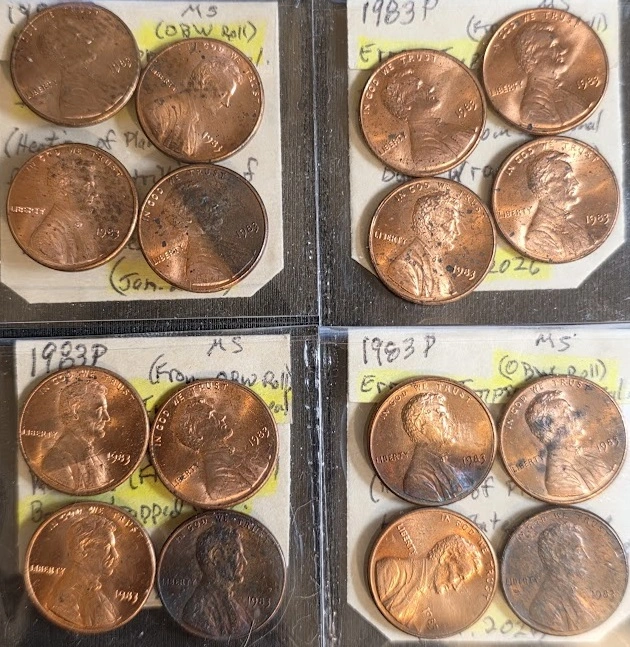 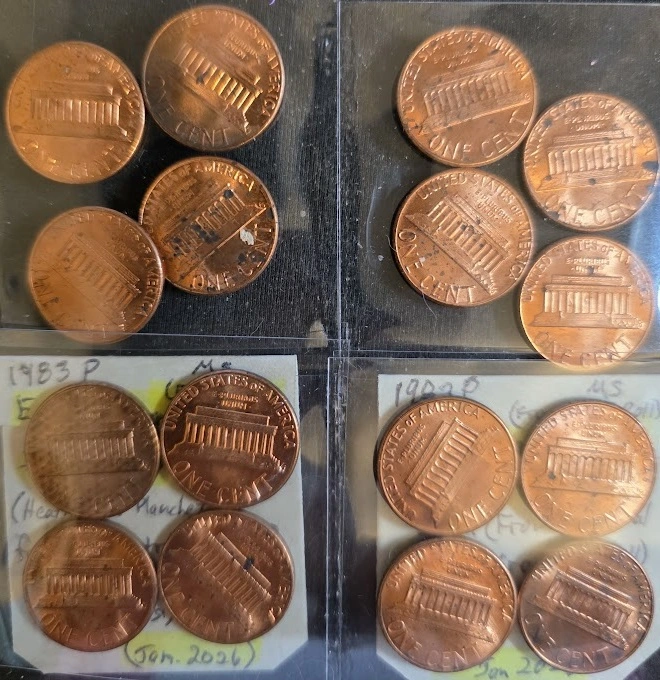 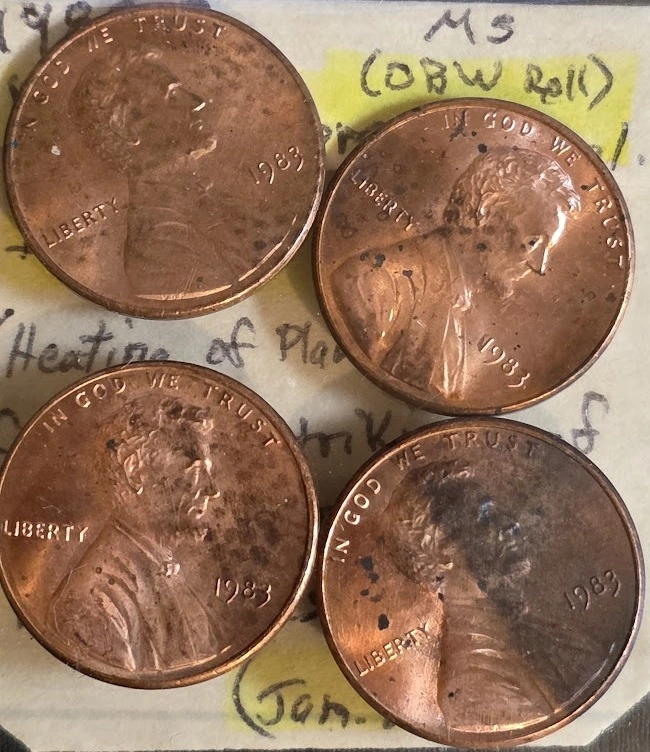 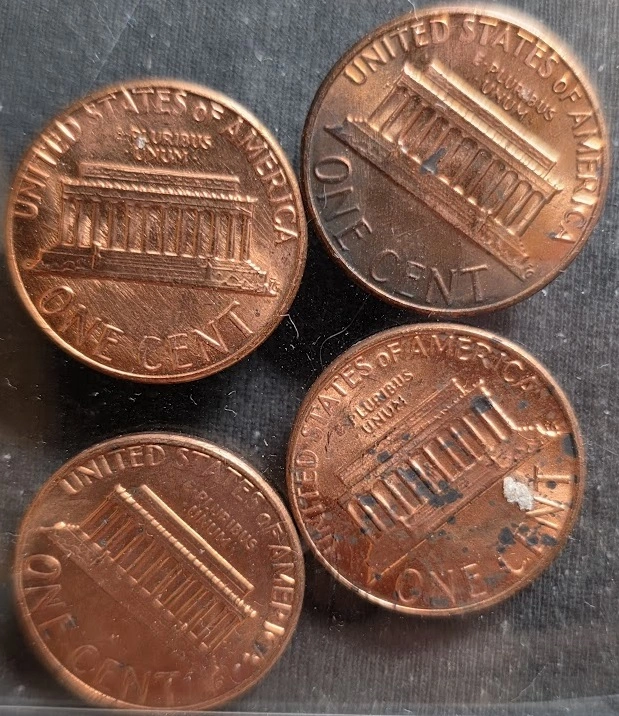 Words of encouragement are one of the major food groups.
We need to consume them regularly to thrive and grow.
|
|
Pillar of the Community
United States
1787 Posts |
This phenomenon is out of my study with IA planchets but this is probably an analysis scheme you can use with a simple hand held XRF gun. As an example the Bad Metal author Winston Zack owns an XRF gun, is a numismatist, and does triplicate surface analyses for $5/coin! Having said this this would be my approach if I was you and you want to say analyze just 4 pieces for $20 ($5 x 4) plus P&H = An XRF study could quickly help distinguish between a zinc-related planchet issue and a simple surface discoloration. The most important comparison would be between a normal red area, a dark "burned" area, and one of the black spots. If all three locations produce essentially the same Cu/Zn ratio expected for a copper-plated zinc cent, then the discoloration is likely a surface-state phenomenon affecting the copper plating rather than a compositional change (i.e., copper plating may have undergone changes in oxidation, crystal structure, roughness, or reflectivity that alter its color and appearance without significantly changing its elemental composition as measured by XRF). However, if the dark or spotted regions show consistently elevated zinc relative to the normal areas, that would support the hypothesis that zinc is influencing the surface appearance through plating porosity, zinc migration, or a plating-related defect.
Because most handheld XRF guns cannot reliably detect light elements such as sulfur, chlorine, or oxygen since you need a vacuum chamber to measure these so-called environmental contaminants of S & Cl, the focus would be on changes in copper, zinc, and trace metallic impurities. If the dark regions show elevated levels of elements such as iron, nickel, lead, tin, or other metallic contaminants compared with normal areas, that could indicate a strip-production or plating-bath anomaly. Conversely, if the only significant difference is an increase in zinc in the discolored regions, the results would argue for a zinc-related mechanism rather than random environmental corrosion, especially given that all 16 coins reportedly originated from a single original bank-wrapped roll and display similar repeating patterns. JPL
Edited by colonialjohn
Today 3H 29M ago
|
|
Pillar of the Community
United States
5925 Posts |
Thank you ColonialJohn and I'm sorry they weren't any help in your study.
I have reached out to Mr. Zack to see if he might be able to help.
Thanks again and best of success/luck with your research.
PP55
Words of encouragement are one of the major food groups.
We need to consume them regularly to thrive and grow.
|
|
Page 2 of 2
|
Replies: 16 / Views: 513 |
Page 2 of 2
|





 First Page


 Posted 10/18/2026 7:12 pm


 Uncirculated American Silver Eagles


