| Author |
 Replies: 21 / Views: 5,747 Replies: 21 / Views: 5,747 |
Page 2 of 2
|
|
|
|
Pillar of the Community
 United States
1156 Posts |
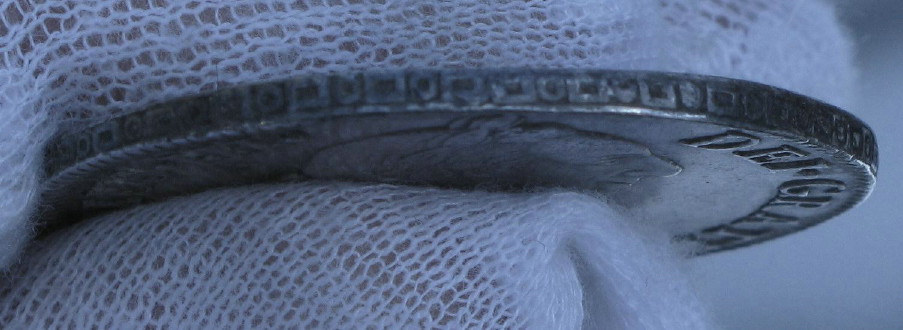
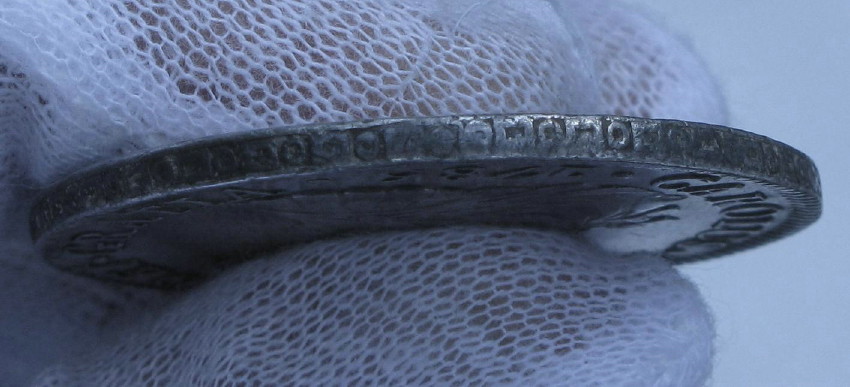
I think I've been able to spot the overlap on the edge on opposite sides. Here are the best shots I could get. 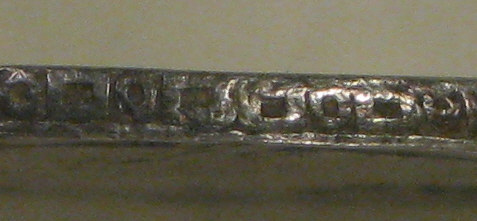 -- two rectangles butt against each other 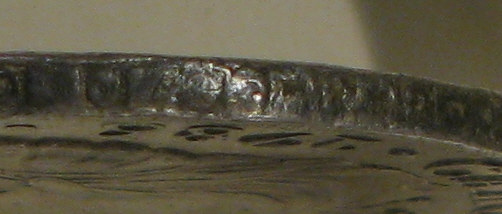 -- at the opposite side, two circles are adjacent and the one on the left seems to be enclosed within the hint of a rectangle Edited by jgenn
02/24/2010 11:02 pm
|
|
Pillar of the Community
United States
3499 Posts |
jgenn- Nice pics of the edges. I must say the edging is the proper type and it does have the "wobble" that one wants to see, but there is just something about the edging seen on the bottom pic that does not look quite right- it's a bit too blurry. Is this coin sea-salvaged or is it damaged on this part of the edge from some other way? Or is it just that the lighting is not the best in this pic?
|
|
Pillar of the Community
United States
1156 Posts |
Hi Archraz. Thanks for your response. I think the main problem is the lighting -- I took them indoors. This weekend I'll try some natural lighting to see if I can get them to come out better. This point on the edge is somewhat disfigured (from the overlap, maybe?). The coin is not sea-salvage, you can make out some of the obverse details in the bottom picture and they appear pretty sharp.
|
|
Pillar of the Community
United States
5362 Posts |
jgenn - Nice to have another 8R collector around. You are off to a good start by checking out the subject first.
Edges are my favorite part of a coin. They are the least observed part and the one most forgers get wrong. So learn your edge types and you will not be caught as often.
You did spot the edge laps correctly - and they seem ok from what I can see. Just be sure there are only two and that they are exactly opposite one another.
On the subject of multiple dies - there were not just a few but literally hundreds of pairs per year. The Mexico City operation did a remarkable job with spacing given the production numbers involed. The later issues by Republican Mexico get much more variable with many more errors.
If you have any specific questions just write to me.
|
|
Pillar of the Community
United States
1156 Posts |
|
|
Pillar of the Community
United States
5362 Posts |
jgenn I think you have the overlaps propery identified and to my eye they appear 180 degrees apart and they are the same length.
Nice coin - original and not too bad off for such an old item.
|
|
Pillar of the Community
Mexico
1304 Posts |
WoW, I just learned something that could have saved me a lot of headache a while back. Great job guys!
|
|
Pillar of the Community
United States
3499 Posts |
jgenn- Very nice 8! I agree that this guy appears to be real. Congrats!
|
|
Pillar of the Community
Australia
585 Posts |
|
|
Pillar of the Community
United States
1523 Posts |
Don't know anything about the old coinage but you have a great camera.Wanna trade? HarHar
|
|
Pillar of the Community
United States
1156 Posts |
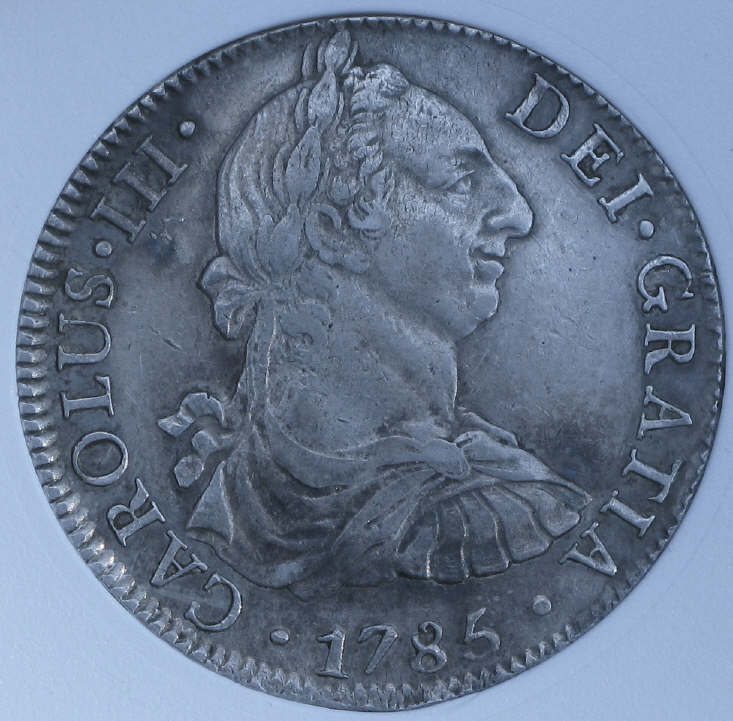
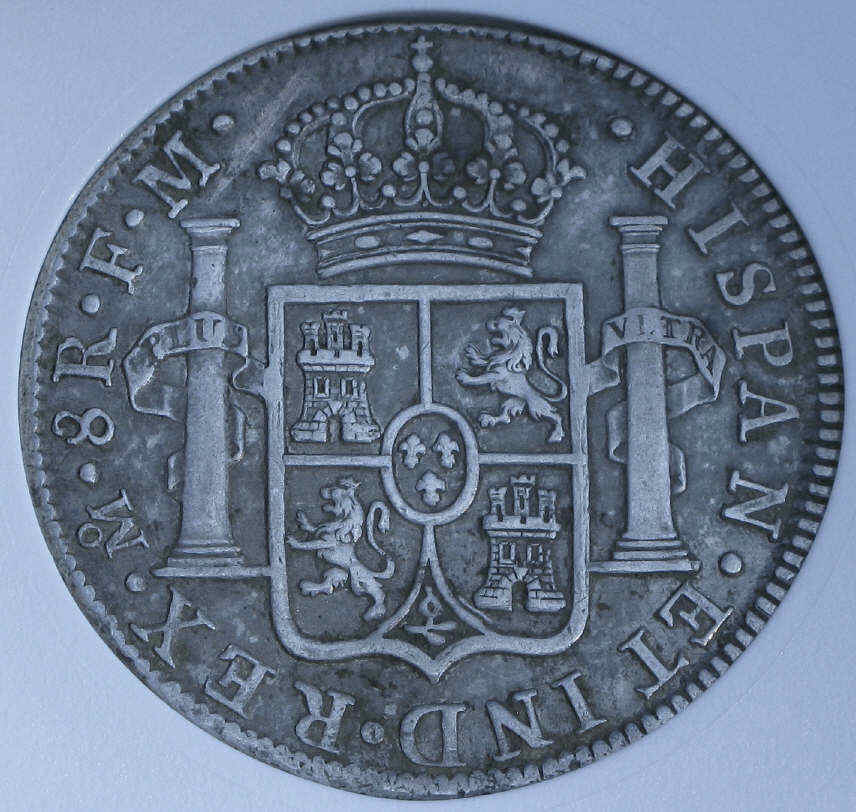
Ok, I had a little trouble getting a .01 gram digital scale via mail order but it arrived this weekend and I was able to weight and measure the specific gravity of the pictured 1785 Mo FM 8 Reales. Weight: 26.94 g Specific Gravity: 10.36 I used the method of measuring/calculating specific gravity described here http://www.coincommunity.com/forum/...PIC_ID=39666This seems slightly high as a 90% silver 10% copper alloy should be 10.34. I also did tests on several other 8 reales in my collection and found that they fell within 10.31 to 10.19 range. I'm thinking those coins at the low end are probably not genuine (they also have some edge detail and/or toning problems). What's the point at which the specific gravity would rule out a genuine 8 reales? |
|
Pillar of the Community
United States
5362 Posts |
jgenn You are asking a really difficult question to answer simply.
The simple answer is that most real 8Rs will have an actual SG rather NEAR the "technical" value for 0.903 fine silver. The range I have observed having tested at least 1,000 "real" coins is 10.25 to 10.38. The range tends to be wider on the low side than on the high side. There can be some cases of "real" 8Rs outside this range but most on closer inspection have extenuating factors. By this I mean that there are many reasons for slight variations in SG. For example, gold as a trace contaminant did occur in amounts as high as 0.8%. There were times before the advent of mercury extraction methods when gold traces were simply left in the silver. This adds to the SG. Air can also get trapped in the ingots (as can other extraneous items) which results in a lower SG. Then there is surface dirt - oil and material clinging to the coin in protected areas. Most of these factors tend to lower the SG (slightly).
When looking for a forgery, most are going to be far wide of the mark - 9.9 to 10.1 is a very common range for early forgeries but far lower densities occur after the advent of German Silver in the 1840's.
The numbers you have look fine to me 10.36 is getting up there but woul not make me say "this is fake."
The silver forgeries made for the China trade in the 1890s will usually be a bit higher (10.4 or so). I have seen 0.999 fine silver used in a very few instances. There I suspect the reason was that blanks were make from ounce rounds.
Another thing to consider are historical reports that some branch mint facilities produced "sub-standard" coins with the correct dies. These will normally run under 10.2. They were 0.600 to 0.800 fine and the alloy varies with odd mixes of trace elements.
|
|
Pillar of the Community
United States
1156 Posts |
Thank you, swamperbob. I highly value your expert opinion. I will use the SG as one of the many other criteria in evaluating the 8 reales coins.
|
|
Pillar of the Community
Australia
585 Posts |
Does anybody know about a book dealing just about 8 Reales? Looks like a complex and fascinating field.  |
|
Pillar of the Community
United States
1801 Posts |
For the Spanish Colonial Mints there is "Compendium VIII Reales" by Gabriel Calbeto. Quite difficult to find and expensive (and in Spanish)
For the Mexican "Cap and Ray coins" there is "Resplandores" by Dunigan and Parker. Readily available and a great source of information.
For the Pillar Dollars there is "Columnarios of Central and South America" by Gilboy (covers smaller denominations as well as the "8s") but it is really hard to find and usually very expensive. It was a limited run of 500 when published.
|
|
Page 2 of 2
|
Replies: 21 / Views: 5,747 |
Page 2 of 2
|








 First Page


 Posted 02/25/2010 5:22 pm