| Author |
 Replies: 118 / Views: 8,980 Replies: 118 / Views: 8,980 |
|
|
|
|
Pillar of the Community
3660 Posts |
Terry, you have effectively tied together everything that I have been talking about for quite a while now. Forensics is another word for unfounded speculation when it comes to these coins. Without any knowledge of annealing, the forensics expert does not understand that each and every die is unto itself, unique. Some are good hard dies that will last 100,000 strikes or more. Others break on first strike. Some are soft in the middle, and sink with striking, some are brittle at the edge, and a Cud is the result, some crack laterally, some radially, some don't crack at all. Annealing (heating and cooling at exact temperatures and time durations) is only one factor in the life of a die. Initial grain density, quality of grain ore, alloy mixture, clashing, strike wear, basining, and polishing are other, but far from all other factors. If a person does not understand annealing, that person has no idea what a die actually is. Most folks don't even know what a die 'looks like' for crying out loud, but feel competent to talk trash about what is possible and what is not. These Morgan dollar dies were fit into a press, but not just 'any' press. The Morgan & Orr used to strike these silver dollars was unlike (significantly unlike) any other press on the planet in their time of use. The infamous tilting of the dies......the misaligned dies.....and all of the other things that the experts see on other coins and naturally assume that a press is a press, and if it is possible on my 1834 half dollar, it is certainly possible on a Morgan. Without knowledge of this particular press, it is impossible to determine what it is capable of and what it is not. The processes of minting coins.....'hubbing' and 'die polishing' for example....will give each die a distinct personality. How many hub strikes is necessary for each die to achieve the exact relief of the previous die or the next die? How many turns of the polishing plate, at what speed and pressure setting will offset any inconsistencies in hubbing? Is the press adjusted to compensate further? Without knowledge of the processes, what sort of basis for understanding just what happened could there be? Then there is the dreaded clash.....just how frequent are these earth shaking occurrences? How much pressure is applied to the dies at impact? Is it really pressure, or what that causes the impressions from clashing? How far downward would the upper die travel if the lower die was not present? If a person cannot answer these questions, then "forensics" is a joke. So, clashing is it then, caused by tilted dies, the same cause as so many other die abnormalities. I am tired. |
|
Pillar of the Community
United States
709 Posts |
Yes Z, [big grin] I have put it together and it is all about physics. The 1891-O VAM 1A1, VAM 1A2 and VAM 1A3 is a good study because we can see the die progression. I think the biggest stumbling block for most people is visualization. It is difficult for people to visualize the mechanics of the Morgan and Orr press that is important, that and understanding of the dies, the placement and clearance of the dies. It was the denticle impressions thread where I questioned the answers and realized the answers given were a phyical impossibility and yet the answers were accepted as gospel as if spoken from the prophets. We operate under a lot of assumptions without questioning the basis of those assumptions. Like I have said before, this hobby forces you to think. That's why I coined the term 'nusmismatic forensics'. You very nicely outlined your premise. You went through the logical physical processes involved and drew the relevant conclusions. Logic dictates that if the first premise is correct and the second premise is correct, then the conclusion by necessity must also be correct. Edited by Ozland
09/16/2010 5:02 pm
|
|
Valued Member
United States
380 Posts |
The "old no.1" press is still around, though modified a bit from its original use condition... at the end of the day, the mechanics and everything else can still be studied. I have been fortunate to have seen in person an original retired die set from an 1899-P (pretty sure that was the date) Morgan. It is at the Smithsonian. I have also seen Old no. 1. I have read about the process via authors who have studied the design via Mint archives and GSA released information. But this makes me no more an "expert" than the next guy. (not that anyone is claiming to be an expert)
|
|
Pillar of the Community
3660 Posts |
Good grief Remmy, I am not accusing you guys of that claim. I do however accuse other of it.
I feel the need to take my leave from here, at least for a while, but I know that you guys visit Site X frequently, and since clashing seems to be the main focus and cause of everything, I would be remiss if I did not equip you with a wee bit of clashing information so you will know more than they do, and truly, that won't take much.
Keep in mind that the main duty of the press operator was to keep the planchet tube from running empty. The tube held 100 planchets, so at the rate of 80-90 strikes per minute, it was a full time job in itself. The simultaneous duty of the press operator was to keep one foot at the ready over the clutch pedal to stop the press from continued striking if a malfunction were to occur.
Do you guys remember when you were boys running around with your BB guns shooting at kitty cats, sparrows, and other innocent animals? Sure you do....you would fill your gun tube with BBs and shoot til the BBs were all gone. How did you know that they were all gone? You pulled the trigger and nothing came out. As it is with a clash, no more planchets, no more coins dropping from the press, only clashes. Don't let that feed tube run out of planchets......it 'might' be hard on the dies, (but then, maybe not)....here's why:
What is considered a malfunction? A clash, you might think, as you have no doubt been schooled by the experts. Negative......clashing is a 'very' common event. VERY common. (I felt that this needed to be repeated). What is the ratio of clashed dies versus unclashed dies? Consider this: Why are the clash marks on some coins more pronounced than on other coins? Die wear you say....correct, but only partially. The other correct answer is die placement in the press. Just as all of the things that can be factors (that I partially mentioned in my last post) all interact with each other, and become combined variables in the cause and effect of those marks on your coins, so too is press and die set up.
How do you set up the dies in the press? How do you adjust the dies? How do you align the dies? How do you cause a weaker strike? How do you avoid clash? This is all very simple, I will make it short for you guys step by step in exact order (this cannot be accomplished out of order):
1.) Place the lower die in the die stake.
2.) Rotate manually the flywheel to bring the die field flush with the top of the collar that surrounds it. (This is coin eject position).
3.) Rotate the die until the setscrew in the stake body aligns with the flat on the die body.
4.) Tighten said setscrew.
5.) Rotate manually the flywheel until the lower die is now at maximum recess in the collar. (This is strike position).
6.) Place the upper die in the die stake, and allow the die face to rest upon the lower die face.
7.) Rotate the die until the die flat aligns with the setscrew in the die stake.
8.) Tighten the setscrew.
The dies are now aligned and set firmly in place simply by use of the setscrew/ dieflat setup.
To avoid clashes as well as cause a weaker strike, loosen the upper die setscrew, place a 1/32" (or any such thickness of your choosing) spacer between the two die faces. Retighten setscrew. Rotate manually the flywheel in either direction. Remove spacer.
Got it? Now you know something the 'experts' don't.
It is my belief that nearly all dies are clashed, but the physical make up of the particular dies coupled with the adjustment of those same dies at clash provide differing results than will be achieved on different sets. I feel that most clashes are undetectable visually. Clashes do not occur with the full force of a strike as the upper die travel is limited by the setscrew. There are other methods of adjusting upper die travel used by maintenance technicians, but this would be the most common used by the operator.
Okay take all of that and think about it, and then think again if you still feel that clashes were uncontrollable, violent mishaps that scared the doo-doo out of the press operators like I was told over at Site-X. Rethink all that we have said in this thread. Reread that which I had written earlier, as it seems as though some of you did not understand it.
Terry, all of the questions that you asked earlier, I have already answered elsewhere in this thread.
Later Dudes,
Lou
|
|
Moderator
 United States
23522 Posts |
I'm gonna want to think about this for a bit.
First questions (in my head): Do the setscrews come to a point, or is there a flatness at the contact point with the die? What happens if, in his haste, the operator improperly tightens the screw? What happens if it breaks?
Rotated dies are not unknown with Morgans, but are certainly a whole lot rarer than other issues. I have an idea why now, and on it's own it posits a theory that strike variances might be more pronounced with rotated dies than normally-aligned ones.
Furthermore, it would indicate that this setscrew might (has to?) play a role with stronger clashes.
Thank you for a short, succinct, knowledgeable and most of all accessible block of instruction, zeewool.
|
|
Pillar of the Community
 United States
1551 Posts |
Zee, That is one of the best explanations I have ever heard. It is simple and to the point. Mint workers where not rocket scientists, and ease of set up would be what " upper management would what"
Edited by twohawks
09/17/2010 12:46 am
|
|
Valued Member
United States
380 Posts |
No tension here Lou. I do not perceive what you said as an attack on me.. just stating the obvious that these presses can and are still studied... thats all. :)
|
|
Pillar of the Community
3660 Posts |
Thanks Russ. Nice for me to know who is interested in this type of thing. Intuition told me that you might be, as I knew Dave was. Dave, the full length item that you mentioned will be done, but I am not sure when. It would be quite dry and really wouldn't make much sense without illustration though. A couple of CU folks have made similar orders and maybe one will help out. I will have to regain the prints to accomplish that also. And yes, you were right Dave, (obviously), and so was I, (obviously). As promised: THANK YOU  Same here Remmy, same here. Edited by zeewool
09/17/2010 6:09 pm
|
|
Pillar of the Community
United States
3076 Posts |
While many think upon this subject, I must point out one thing...OR MANY THINGS....when we first thought of why.........and why be interested........AS MANY points of vamming and the sub-issues are being condenced like no other threads online..
Pro's and con's are tossed around like jelly... and all of the sub-issues are surfacing so fast that others who know little of this subject can be confused.... AS much as I would like to expand on this point........I'm ready for bed......SO those of you who have been participating in this thread....FOREGOING, the high minded and behind the seen conspiracies, step up TO THE PLATE.. and announce why you like
Vamming,,,,,,DESPITE all of the possible hidden insider/behind the seens
they are out to RIP ME OFF ideas.......
Let us here from those who like vamming from it's basic form....
ASIDE from its political possibillities.......and get to the very "heart" of why vamming means anything......there is a light that is shining....lets hear yours.....
|
|
Pillar of the Community
3660 Posts |
Quote:
Rotated dies are not unknown with Morgans, but are certainly a whole lot rarer than other issues. I have an idea why now, and on it's own it posits a theory that strike variances might be more pronounced with rotated dies than normally-aligned ones.
Furthermore, it would indicate that this setscrew might (has to?) play a role with stronger clashes. Yes, you've got it Dave. Rotation, (despite the fact that the die faces are virtually flat) would change the rendezvous of the device drop offs, and subsequently cause greater impact at certain drop off intersections. Die placement could be done either visually or by feel; operator's preference. Logic tells me that the setscrew (which I have never seen by the way) would be flat at business end. If it were otherwise, there would be less surface contact at the die flat. Points can break, a broken point would leave a gap between screw and flat; loose die, rotation or worse. Being flat at contact end, I can only imagine, the the rotation of the setscrew 'could' cause a bite or grab of the flat and bring the entire die 'slightly' downward, unless the threads were reversed (left handed), in which case the bite might cause an upward tendency of the die (but I have no reason to believe that was the case). The setscrew was merely the anchor, a means to prevent rotation as well as upward and downward movement of the die in the stake (cup). Upper die placement is what actually controls depth of clash and strike. The TPGs call the phenomena 'rotated reverse', but I would think they should reconsider which die actually was more likely to rotate. Not that it really matters, (as the effect is the same). |
|
Pillar of the Community
United States
2669 Posts |
Quote:
why you like Vamming Simply put, I like varieties. I like die cracks, clashes, Cuds, split planchets and a whole host of other interesting things that happens during the process. Another coinage subset I find fun is the Canadian Large Cent series - lots and lots of varieties there.. large/small leaves, die cracks, repunched letters, etc. I like their character and I also like learning how & why they happened. A lot of similarities exist between vamming and the Canada large cents - the supposed experts are deified and have their own 'in' crowd, and anyone outside their glorious circle is automatically wrong and stoned as a heathen if you dare question them or their findings. However, that does not affect the relationship between my coin and I, and it sure isn't going to keep me from asking, learning, or sharing any knowledge I may have or gain to help someone else. I do NOT like politics nor hidden agendas. When I absolutely need to swim in shark-infested waters, I try to swim below the radar and carry a big harpoon.. but that's after having a few chunks taken out of my hide. I'd really rather learn things on my own than have them read by rote to me, spoon-fed like a baby (besides, I learn better by doing.. the lesson seems to last longer). So it's ok for Dave to laugh at me, and Chuck to say I should know better, because in the end I'll eventually grasp the concept(s) I'm going for. Discussion is good for the soul. Politicians, selfish knowledge-hoarders, and people who just plain think you aren't good enough/smart enough for them, have no place in my world... life is too short to deal with stupid people. |
|
Pillar of the Community
3660 Posts |
Edited by zeewool
09/19/2010 7:50 pm
|
|
Pillar of the Community
 United States
2797 Posts |
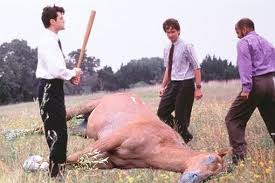
OK Zee ... I see you've been photoshopping again! That's supposed to be a printer/copier they are about to whomp!  But yes, it is appropriate here. |
|
Pillar of the Community
3660 Posts |
It seems as though Don is trying to put a little distance between CU and Dan. Twelve threads locked on the same subject. Interesting that it went on 'this' long. He should have known that pit bulls never release until it is too late.
|
|
Pillar of the Community
3660 Posts |
Quote:
That's supposed to be a printer/copier they are about to whomp! Oh Dave, you vammers are all alike......That horse doesn't look like a printer/scanner any more than an ovaloid looks like a clash. I can just imagine what you think Cuds are caused by. As a matter of fact, I was told by the experts that it was definitely cow related. |
|
|
Replies: 118 / Views: 8,980 |
|
To participate in the forum you must log in or register.
Disclaimer: While a tremendous amount of effort goes into ensuring the accuracy of the information contained in this site, Coin Community assumes no liability for errors. Copyright 2005 - 2026 Coin Community Family- all rights reserved worldwide. Use of any images or content on this website without prior written permission of Coin Community or the original lender is strictly prohibited.
Contact Us | Advertise Here | Privacy Policy / Terms of Use
|
| Coin Community Forum |
© 2005 - 2026 Coin Community Forums |
| It took 0.34 seconds to rattle this change. |
 |
|








 First Page
 Previous Page

 Posted 09/16/2010 4:56 pm