| Author |
 Replies: 27 / Views: 14,436 Replies: 27 / Views: 14,436 |
Page 2 of 2
|
|
|
|
New Member
 United States
10 Posts |
Quote:
you manage to identify it as a 1916 from the coins features as the head ,shield,drapery
You still have a Poor condition 1916 type 1 with no date and I doubt anyone will slab it .
ANACS does and so does ICG. Or at least ANACS did. I confirmed that ICG still does. I've never sent one in to ANACS but I've seen them. Here's one: http://cgi.ebay.com/1916-STANDING-L...em19bf746fc2I think a small slabber could make some good money slabbing genuine Type Is and last digit partial date pre-1925 Type IIs. Since they can all be positively identified it should be good enough for trade. Let the free market decide. |
|
Pillar of the Community
United States
958 Posts |
How do you know anacs didn't run it under a 20x loop and see a partial outline of a 6
not visable to the human eye.
the guys comments on the bottom have nothing to do with how it was graded unless he was the grader
The discription does not say anything but damaged,cleaned.
Let the "free market decide" , thats great if the free market covers your slabbing cost if it does not then your outta luck
|
|
Pillar of the Community
United States
958 Posts |
so ICG misgraded that 17 for a 16 ? Yet your telling me that's who you would send a dateless 16 to ? what if they claim its a 17 ? Also what a POOR graded 16 worth ? Sure they are on ebay does anyone purchase them? The grade books show G3 readable date $2900 Most other coins the value drops a huge amount as the grade falls with a partial date by 1/2 value usually Average with a worn first or last digit , then agian by half when down Fair with to 2 readable digits , But no readable digits would be Poor esp if the head,shield are worn so bad you cant make out its a 16 with out a huge forensic scientific effort to decipher its details Edited by coppertop5150
12/21/2010 9:40 pm
|
|
Pillar of the Community
United States
958 Posts |
nevermind the experts spoke , I wont even try to give advice anymore
Edited by coppertop5150
12/22/2010 12:41 am
|
|
Rest in Peace
United States
4849 Posts |
Quote:so ICG misgraded that 17 for a 16 ? Yet your telling me that's who you would send a dateless 16 to ? what if they claim its a 17 ? Also what a POOR graded 16 worth ? Sure they are on ebay does anyone purchase them? The grade books show G3 readable date $2900 Most other coins the value drops a huge amount as the grade falls with a partial date by 1/2 value usually Average with a worn first or last digit , then agian by half when down Fair with to 2 readable digits , But no readable digits would be Poor esp if the head,shield are worn so bad you cant make out its a 16 with out a huge forensic scientific effort to decipher its details Thunderchops is absolutely correct. The ICG coin is not a 1916, it is a 1917. I have seen this seller post this coin in the past, and it have informed both him and ebay, all to no avail. I think there is an earlier thread on here about it. Occassionally they either are misidentified, or its possible that the slab has been tampered with or is counterfeit. I have used ANACS to send in 2 dateless 16s, and they correctly identified them both as 1916 and graded them FR02. I kept one and sold the other for $1100 as an ebay BIN. Anyways, dateless 16s can be identified and they do have substantial value. PR01s go from $600-$800, so they are definitely worth finding and identifying. Quote:
I'll let you in a a way to get a date on the silver coins.
I tried it on a worn SLQ x92x when I was done the date was readable to a 1922
Start with one of your later date SLQ that you dont care about ,
I am no scientist so I cant explain it in detail other then basic instructions.
What i'll try to explain is metal warping/seperation/toning all in one.
Metal expands and contracts with hot or cold.
Its not a lot to be seen with the naked eye but it does.
When the die comes in contact with the coin during minting the lower areas on the coin have been minted with more force then the highr areas, or more metal has been compressed mashed down.
The higher area we want to focus on is the date, in the date the letters have been minted with little pressure but the fields around them have been compressed around the date aka outline.
the coin is 90% silver , 10% copper. The copper will darken and oxidize.
The process of heating and freezing over and over will cuase a slight oxidation and discoloring of the copper inside the coin.What will appear is a slight darkining of the copper fields around the old date It will kind of leave a mirror shadow around the old date.
The date will be lighter and the fields around it darker. Making a date some what reappear.
Take the SLQ and expose it to butane lighter fluid hold it with some tongs. Spray the coin with fluid till it ices over. Then dunk into hot boiling water, wait a few seconds. Freeze agian , then dip inside out water
freeze dip .
It might take 10-20-30 times.It will help the coins metals warp from with in forcing the high point in the dates exapnd outwards
Then take the quarter on a ceramic plate place it inside the over around 350 deg for 30 minutes this will further cuase the copper to darken.
what will happen is the coin will darking and the date should appear in a ghostly witish look, You will prob have to turn the coin in the light back and forth and the date might be really faint.
Also with the expansion contraction you might get the digits to slightly reraise off the surface , I'm talking 100th's of mm here just enough to catch the light to reflect a date.
I had so/so sucess with this , hopefully someone with a scientific background will red this and explain it better Great idea! You should run some more experiments and post pictures of the results. Edited by johnny54321
12/21/2010 11:03 pm
|
|
Bedrock of the Community
United States
12437 Posts |
Quote:
I'll let you in a a way to get a date on the silver coins.
I tried it on a worn SLQ x92x when I was done the date was readable to a 1922
Then your method is completely worthless, there weren't any quarters minted in 1922 so you only saw an artifact and not a real date. The 1916 obverse die is noticeably different than the 1917 die, that point cannot be argued. The markers have been posted here on the forum by several individuals who have cherrypicked dateless 1916s and had them sucessfully slabbed. The markers are also well known to SLQ specialists and visible down to the PO1-FR2 levels. |
|
Rest in Peace
United States
4849 Posts |
Since we are somewhat on the topic of dateless quarters, I'm wondering if I can get your opinions on this beat to death "slick" from these images:  |
|
Valued Member
United States
462 Posts |
Wow. Did you really find another one?
|
|
Rest in Peace
United States
4849 Posts |
Well, possibly. It's kind of funny though as everytime I find one, it's been in progressively worse shape than the previous one. If I ever find another one in the future, it will be a blank that will require coppertop's baking method just to verify the diagnostics...lol
|
|
Pillar of the Community
United States
1534 Posts |
Wow, I think you've got another one! Everything from that scan seems to match up with the diagnostics, congrats!  I guess there is a minimal chance the scans might be showing the rivets lighter than they are in hand but from the image it looks pretty convincing. Quote:
Anyways, dateless 16s can be identified and they do have substantial value. PR01s go from $600-$800, so they are definitely worth finding and identifying.  Edited by wheatguy
12/22/2010 10:55 am
|
|
New Member
United States
10 Posts |
Quote:
How do you know anacs didn't run it under a 20x loop and see a partial outline of a 6 not visible to the human eye. Valid argument. I don't buy it but I'll certainly admit that is my opinion that they date "no date" 1916s using only diagnostics, since it would certainly a lot easier than using a microscope. You can see a 1916 from 2 feet just by looking a the head. I don't think ICG is in the wrong on the 1916. I think it was tampered with or the slab is fake. The number is right but that seems to be all, unless there something I don't know about 1916s and their distinct pattern. And I agree on the slabbing costs. That's why I figured a small outfit could do them affordable and create a market for certified no dates. Just because a pre-1925 doesn't have a date doesn't mean it is heavily circulated and poor quality. It was just a bad design, like the Buffalo nickel, and I think even post-1924 fines look the same as a no date pre-1925 everywhere except the date. Dave |
|
New Member
United States
10 Posts |
Quote:
Since we are somewhat on the topic of dateless quarters, I'm wondering if I can get your opinions on this beat to death "slick" from these images: I'm 100% sure it is a 1916 from every example I've seen. You can see it easily in the right arm wear pattern and the right foot. Congrats! |
|
Rest in Peace
United States
4849 Posts |
Thanks. This one I'm sure has no shot on God's green earth for anything higher than a PR01, but they sure are fun to hunt for. I'll post some better pictures in a while.
|
|
Rest in Peace
United States
4849 Posts |
Something occurred to me that might be fun is to put together a low ball grading set. Since I have this ANACS FR02 now: 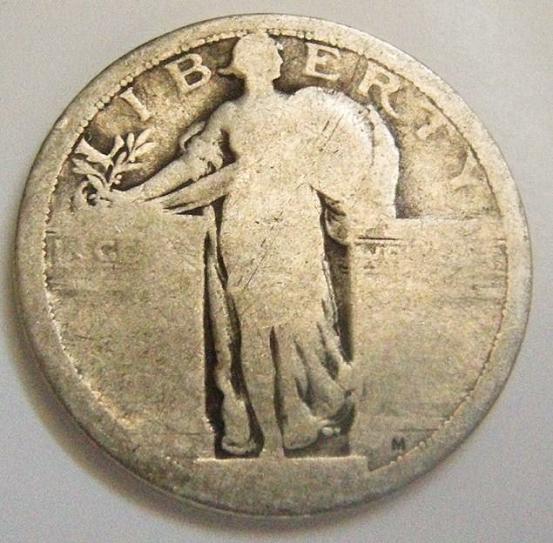 the FR02(included pictures) 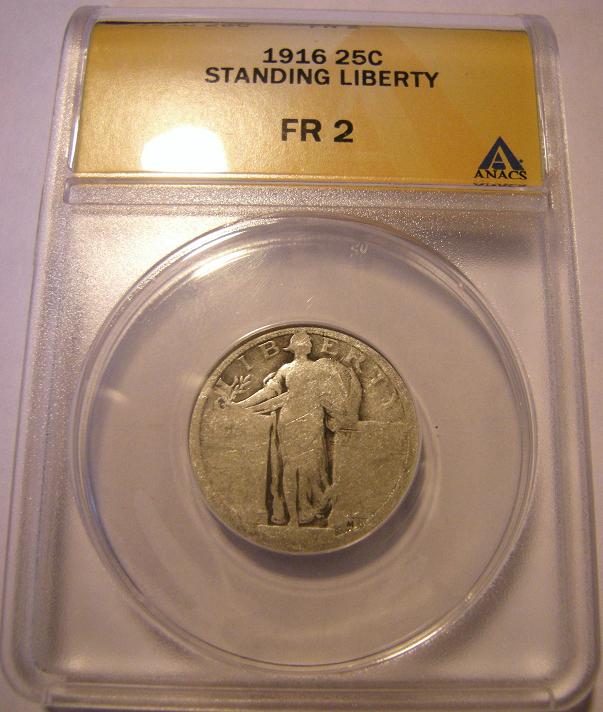 Hopefully, the one I previously posted will be a genuin PR01. And then I can purchase something like this. http://cgi.ebay.com/ws/eBayISAPI.dl...TRK:MEWAX:ITIt looks great for the grade and seems fairly priced. So I would have a PR1, FR2 and AG3 and be able to better study how the diagnostics are affected at various grade levels. So, what do you all think? Would a graded lowball set be cool, or should just evenutally trade them all in for a G-VG coin? |
|
New Member
United States
10 Posts |
I think it's an excellent idea and would be a valuable resource. I've really kept my eye out on ebay for potential 1916s. You may have some competition. ; ) Dave |
|
Page 2 of 2
|
Replies: 27 / Views: 14,436 |
Page 2 of 2
|





 First Page

 Posted 12/21/2010 9:22 pm


