| Author |
 Replies: 35 / Views: 4,078 Replies: 35 / Views: 4,078 |
Page 3 of 3
|
|
|
|
Pillar of the Community
 United States
844 Posts |
Awesome information on the minting process! Why wasn't it made a sticky thread? More people could really benefit from this. I'm going to print those off for future reference!
|
|
Pillar of the Community
United States
601 Posts |
I love that some people here are truly hungry for knowledge!
|
|
Pillar of the Community
United States
4000 Posts |
Jaymon, your post above is what prompted me to bring those up again. I was afraid if I just put it here, you'd be the only who seen it.
We have enough new members that I felt it was warranted to bring up again.
The first time I brought it up, I also voted for it to be a sticky.
|
|
Pillar of the Community
United States
601 Posts |
This is an excerpt from a thread by well known authority, BJ Neff. In it he describes what I believe is the same phenomenon. He has worded it better than I was able to convey, though it's the same principle. He's referring to a cent in this case, but we can assume that the same occurs with on the nickel dies.
"This is a bleed through of a design element. It occurs at during the later stages of the die, when after continuous striking of planchets, the force from the hammer die is transferred through the planchet and onto the anvil die. This creates a die dent on the anvil die, in this case, the out line of Lincoln's bust. One big clue in detecting this anomaly is that there is no corresponding die clash marks on the hammer die. The reason why is that the force generated from the hammer die strike is downward, through the planchet and anvil die, where it is dissipated into the base where the anvil die sits."
This makes perfect sense to me, anyone else?
|
|
Pillar of the Community
United States
844 Posts |
Liveandievarities, Ok, I don't understand the part about a "die dent on the anvil die" wouldn't that leave a raised area on the said coin instead of a "crease" ? I reread the minting process and didn't see mention of the "anvil die". Maybe I just missed it cause I'm tired? Forgive me, I'm still new to the minting Knowledge! By the way, much to my wife's dismay, I do want to learn as much as I can about errors, varieties and everything in between!
Scooby Due, I'm glad that you did! I'll have to read it a few more times to absorb the information, but I'll get it. Thanks again!
|
|
Pillar of the Community
United States
4000 Posts |
Interesting excerpt by BJ.
But, the area in question is almost all field on field. The die dent from relentess striking does make sense, but this doesn't seem to be a design element bleeding through.
I'm certainly not arguing with him, just more food for thought.
|
|
Pillar of the Community
United States
601 Posts |
And I'm certainly not insisting I'm right, nor that his explanation pertains, but it makes sense to me. Not so much a design element bleeding through, but a stress point anvil die.
|
|
Bedrock of the Community
United States
62064 Posts |
Jason: You came came to me today. And guess what? It is something different than all have imagined as to what caused it. Some thoght it was damage. Some thought it was a clash. Some didn't know. But after looking at the coin, I've figured it out. The mark that appeared to be a crease is really the surface of the normal die. The area to the right of it was removed to remove a clash. They used something that took a wider swath than what we figured be necessary. In other words they abraided the die in the area to the right of the crease and all coin after that would have now a raised area. I have images that may help to see what happened: 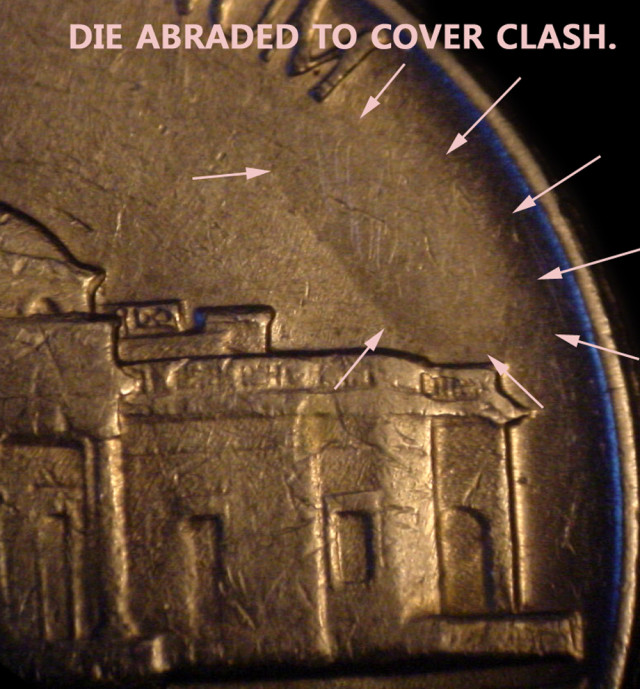 This shows the area that was abraded circled and the crease is present. 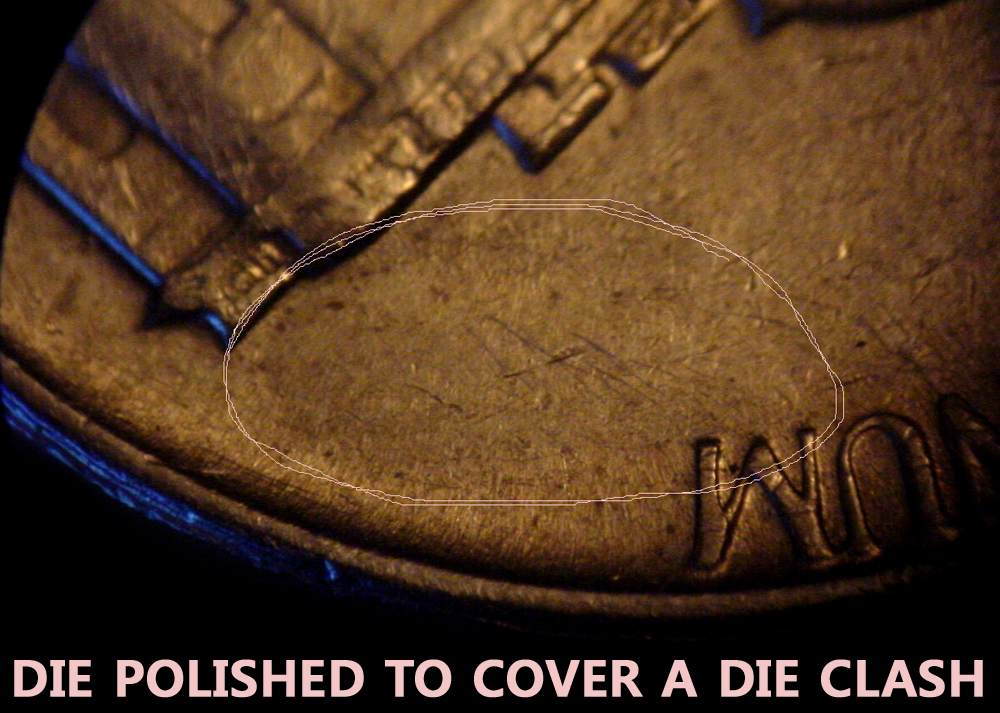 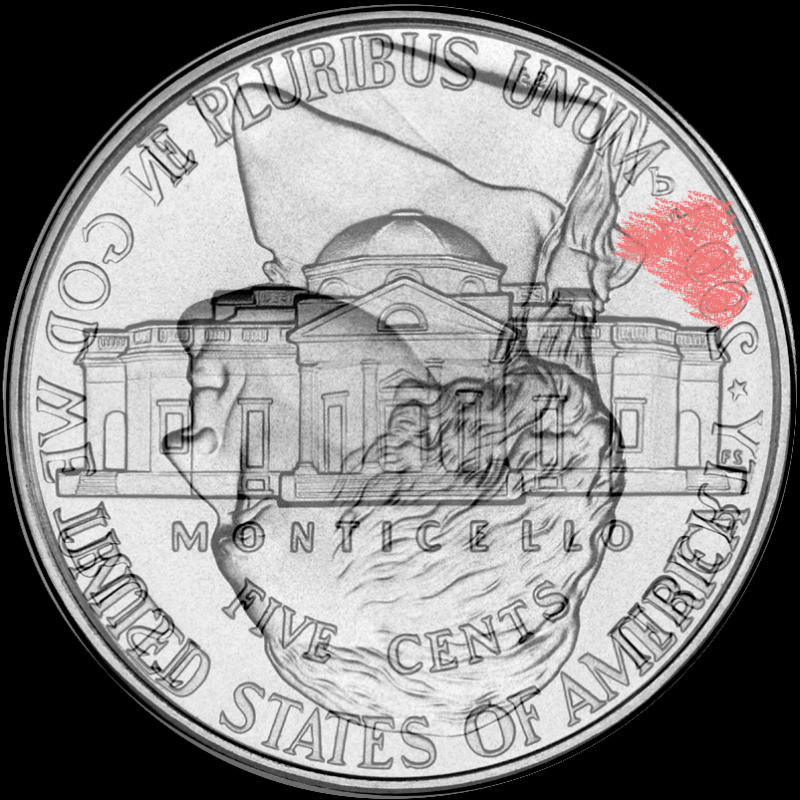 This is the area where the concentrated polishing took place. Hope this helps. |
|
Pillar of the Community
United States
844 Posts |
Awesome! So I was right to say not PMD? That may be a first for me on here! (being correct) Great explanation of how it happened also. Ok. Here's another question. Would this be considered a variation then? It was a modified die correct? It was modified and then continued production so they knew about it. That would make it a variation instead of an error? Edited by Jaymon74
03/25/2011 8:31 pm
|
|
Bedrock of the Community
United States
62064 Posts |
It is just a worked over die. Just a phase that most dies go through. Now we know what caused it. It fills in a new chapter in what happens to dies and why. Thanks for sending it to me. It's headed back your way tomorrow.
|
|
Pillar of the Community
United States
844 Posts |
Ok Coop. Thank you very much!
|
|
Bedrock of the Community
United States
62064 Posts |
It was one of those coins that a hand on approach was the only way to tell for sure what was going on. Images are just one dimensional. It was a learning experience for me as well. Glad to help out.
|
|
Pillar of the Community
United States
601 Posts |
Thread was fun to read Coop, thanks.
|
|
Pillar of the Community
United States
4000 Posts |
Cool! That's awesome coop. We all learned something today! Good eye Jaymon.  |
|
Pillar of the Community
United States
844 Posts |
Thanks for the "Good eye" Scooby. Like I had mentioned earlier though, I've seen them on other occasions. I'm thinking maybe one in every 4 boxes that I roll search. That's why I mentioned it was common. Not sure if many people ever gave it much thought. That's why I brought it up. Maybe some will start noticing them now? I guess the question now is, does that had any value to it? Probably not is my guess. I'm not sure that a worked over die is much to get excited over, but it was a learning experience on my part too.  Coop, it looks as though you have some more visual aids to help you in the future when this comes up! It was really nice of you to help me and everyone else on here. Thank you!  |
|
Page 3 of 3
|
Replies: 35 / Views: 4,078 |
Page 3 of 3
|






 First Page
 Previous Page

 Posted 03/21/2011 1:01 pm





