| Author |
 Replies: 12 / Views: 2,250 Replies: 12 / Views: 2,250 |
|
|
New Member
United States
12 Posts |
Does any one know of a good web site with Indian cent error and variations?  *** Edited by Staff to remove YELLING *** *** Edited by Staff to remove YELLING *** |
|
|
|
Pillar of the Community
United States
1081 Posts |
|
|
New Member
 United States
12 Posts |
thanks for the web hookup, I was wondering... I cant post pics right now but if some one has { THE Cherry Pickers Guide, 4TH EDITION VOLUME ONE } please look on page 82. There are 2 different 1899 double die coins. the dates shown appear to be different, like a closed 9's and open 9's. the date on the top is flat and the bottom is more curved. does any one know of a date variation for this year? |
|
Pillar of the Community
United States
3552 Posts |
Davidz, thx for url to the snow variety site for IHCcool mdpmedia |
|
New Member
United States
12 Posts |
here is the first of the two coins, 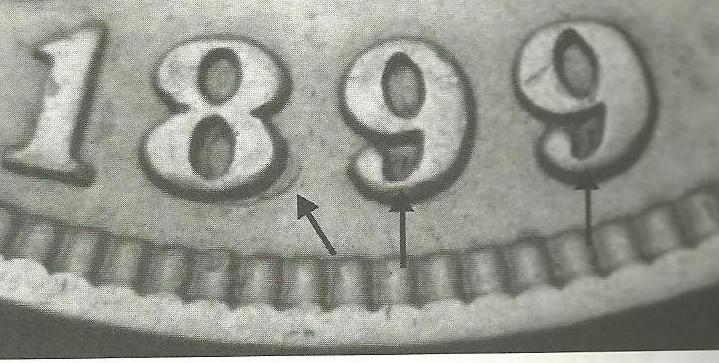 |
|
New Member
United States
12 Posts |
here is the second coin, 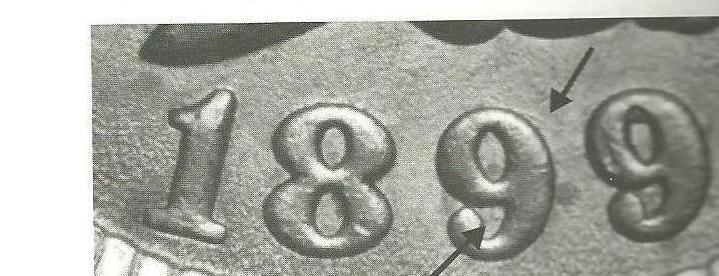 do you see the 9's being different? can any one explain? |
|
Bedrock of the Community
United States
10045 Posts |
The two pictures are of RPDs, or repunched dates.
They aren't doubled dies, since the date is added after hubbing.
This happens when the date punch is pressed into the die, repositioned and impressed again.
Later, the fields are polished down to remove the underlying digits, but often traces remain as pictured above.
|
|
New Member
United States
12 Posts |
thanks for your comment. the pictures were used from the Cherry Pickers Guide as they, for the discussion of the dates are easier to use as they are obviously documented. the one coin shows rounder nines and the bottom hook of the nine touches the top loop of the nine. the second date is flatter and and the bottom hook is gapped from the top loop. I have a 1899 unc and a 1899 au with the flat and rounded date. would your explanation of the process account for the flat-rounded surface and the bottom hook of the nines touching and gapped? not trying to argue here just looking for some help. example might be the 1873 open and closed 3 variations. thanks in advance for any more thought. |
|
Bedrock of the Community
United States
10045 Posts |
Yeah...in 1873, two different date punches were used, resulting in the close and open varieties.
As for the 9 digits touching or gapped, that usually is a result of die wear; they close up over time.
Are you talking about the "flat" bottom on the first 9 in the first picture? That may be due to overlap of punched digits.
|
|
New Member
United States
12 Posts |
Hey again, As you stated that in 1873 2 different date stamps were used. I was wondering if in 1899 that was the case with these 2 coins? when looking at the 2 pictures at the same time I see the rounded surface on the top coin on the whole date and flat surface on the second coin on the whole date with the effect of the open and closed hook of the bottom of the 9's.
thanks for your help.
|
|
New Member
United States
12 Posts |
or the other way around, fat then rounded.
|
|
Bedrock of the Community
United States
10045 Posts |
Yes--two different date punches for 1873 are well-documented. There is also 1865 with "fancy 5" and "plain 5" varieties. And as far as I know, those are the two documented date varieties--does anyone know if Rick Snow found more? Then there are minor varieties within each year, where broken date punches were used and sometimes later repaired, creating a lot of variations. Since I haven't heard of style varieties for 1899, my opinion is the "open" vs. "closed" 9s are due to 'die state', or wear of the die which changes the shape of the digits. If you post pictures of the dates on your coins, I'll try to comment further.  Edited by DVCollector
01/06/2013 2:33 pm
|
|
Pillar of the Community
United States
9811 Posts |
I think they never made any 9 punches they just turned the 6 puch over!  The 9 or 6 would close up as the die was stressed through use and then polished over it's life, there is a big difference from new fresh dies and old worn dies, especially in areas on the die like the loops of almost closed numbers. The famous 1868/9 looking 2¢ piece I collect. the key beyond the diecrack on my Two Cent is the closing of the 9 loop. If it doesn't have the closed loop you can quit looking. It came about from die wear as the overdate was roved not to be only a die break and die wear that caused ti to look like an 8 underneath. when actually it was the 9 loop closing up from worn dies along with a small die crack going through the date as the die was pushed to the end of it's life. I'm sure the last coin struck before it shattered was pretty cool looking! "Buy the Book Before You Buy the Coin" - Aaron R. Feldman - "And read it" - Me 2013! ANA Life Member #3288 in good standing since 1981, ANS, Early American Coppers Member (EAC), Colonial Coin Collectors Club member (C4), Conder Token Collector Club member (CTCC), Civil War Token Society (CWTS) member, Liberty Seated Collectors Club (LSCC) & Numismatic Bibliomania Society member (NBS), USMex, Member in good standing, 2¢ variety collector. See my want page: http://goccf.com/t/140440 |
| |
Replies: 12 / Views: 2,250 |
|










 Posted 12/26/2012 8:42 pm


