1791 Washington Large Eagle Cent
O: WASHINGTON PRESIDENT, George Washington left facing bust, 1791
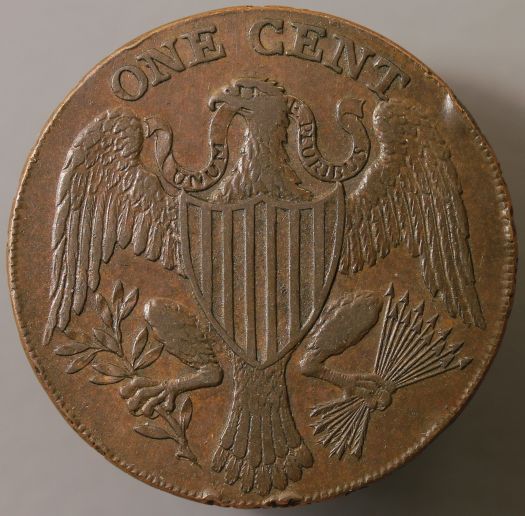
Rx: ONE CENT, eagle holds a scroll, "UNUM E PLURIBUS" in its beak, 13 arrows and an olive branch clutched in its talons
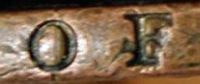
Lettered edge: UNITED STATES OF AMERICA . X .
Mint: Obadiah Westwood ‘s, Birmingham, England
Wt: 11.97 grams. Actual Wt.: 12.5 grams. Diameter: 30.0 mm. Reverse die alignment: 180°
Q. D. Bower Rarity Rating: URS-11: 500 to 999
"On the obverse there is a small die break, as a dot, to the left of the foot of the A... In the date the initial numeral 1 was recut so that the top appears doubled. On the reverse note the Large American eagle with dropped wings holding a scroll in its beak that gives the national motto in its less familiar form. (
http://www.coins.nd.edu/ColCoin/Col...LECent.html)




I have had my eye on this cent for some time and have been saving for several months. I usually buy lower end coins, but have been disciplining myself to afford this purchase. And finally I am the keeper of this little piece of history!

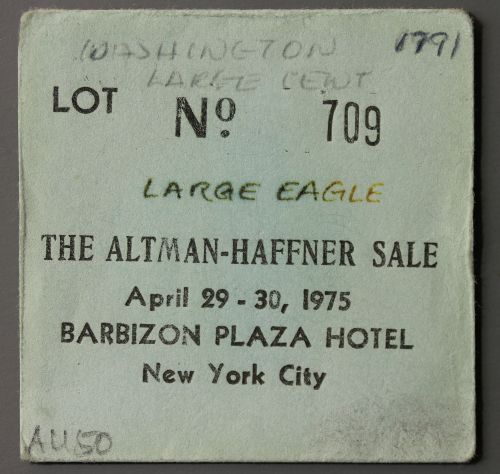
It came with the auction holder that gives providence. I have been researching this cent for a while. Below is some info and links.
This1791 Washington Cent has a rich history with an interesting cast of players. The obvious major player is George Washington himself, and bears meaning because they were made during his Presidency. He declared this coinage with his image "monarchial" and rejected it. He also rejected and the idea of contract minting of Americas coinage. As I understand it, Washington's refusal of his own portrait on
US coinage is the precedent against living Presidents being on
US coinage. (As a side note, I have wondered what the United States of America history may have been if good old George W. had been the type to like his picture on his countries coins.)
When this 1791 Washington Cent was minted it was not know that George W. did not want contract coinage with his image. English merchants, W. and Alexander Walker bet that the United States of America would welcome this coinage. Small denomination copper was scarce in Europe and America at this time in history. The beginnings of industrialization and steam power made it possible for private industry to fill the void with copper tokens and coinage. Conder tokens give a us a prime example of the wide variety of private "coinage" produced at the time. Boulton's eventual approval to mint the 1797 cartwheel pence and two pence give us an example of government coinage produced during this time period. W. and Alexander Walker desired to be the United States provider of coinage and hired one of the foremost diesinkers of the time, John Gregory Hancock to make their coinage. Hancock made the dies and the cents where struck at the mint of Obadiah Westwood in Birmingham, England. See
http://www.wnccoins.com/0029.htm for a list of John G. Hancock and others Conder tokens.
While originating from England these Washington cents did see the shores of America. "The Walkers had a cask of these cents shipped to his American associate, the firm of Thomas Ketland and Son, in Philadelphia. They were to distribute the coins to cabinet officers, senators and congressmen in the hopes of securing a federal minting contract. It has been assumed the cask was a a normal size hundredweight barrel, which would accommodate 112 pounds or about 4,000 coppers. It has been further conjectured about 2,500 of the coppers were the Large Eagle variety and about 1,500 were Small Eagle cents." (
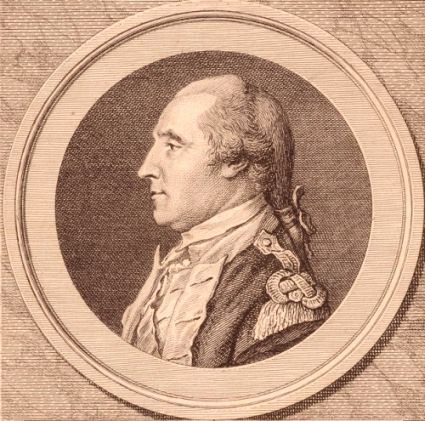
http://www.coins.nd.edu/ColCoin/Col....intro.html)For the obverse Hancock did not generate his own portrait of George Washington's but instead used the popular portrait produced by Pierre Eugene Du Simitiere to model his die from. The likeness of Washington in this left facing bust in military uniform is a striking image on both paper and cent. Although Hancock's version is not exact to that of Simitiere's the portrait most similar. Compare below. Simitiere has a numismatic story all his own. He is highlighted in Dr. Joel J. Orosz's book, "The Eagle that is Forgotten, Pierre Eugène Du Simitière, Founding Father of American Numismatics". I am in the process of reading it now
"Du Simitière was an artist and antiquarian of Swiss origin whose collection of ancient and modern coins was on public display in his home in Philadelphia at the time of the Revolution. George Washington visited there in 1779 and sat for three-quarters of an hour for the portrait sketch from which this engraving is derived."
(
http://rbsc.princeton.edu/capping-l...n/item/2929) Author Q. David Bower ('09, p. 262) states that the "motifs and inscriptions are pure American". I agree, the eagle clutching arrows and an olive branch on the reverse is a common America theme in
US coinage and the Great Seal of the USA. The eagle together with the obverse Washington shouts USA in a classic early American artistry that I cannot resist!:)
http://en.wikipedia.org/wiki/Great_...nited_States Pierre Eugène Du Simitière. "George Washington. Plate 1 from Collection des portraits. . . . First state, Paris, 1781." See Below:
Here are some other cool links:
http://www.britnumsoc.org/publicati...BNJ_69_8.pdf ; This PDF is pretty neat and very detailed. If anyone has an opinion on this article, please share. It seems to be well researched but I do not have a lot of the sources. I need to get that Dalton and Hamer book!
http://mappingbirmingham.blogspot.c...hancock.htmlhttp://www.mullencoins.com/blog/11-...-eric-newmanhttp://sohomint.info/index.html





 Posted 07/03/2013 9:12 pm





