| Author |
 Replies: 18 / Views: 8,979 Replies: 18 / Views: 8,979 |
|
Pillar of the Community
United States
567 Posts |
I love the Egyptian kingdom and its history, and if there are any coins or types of money from that time period I would love to have some, but I have only ever seen Roman coinage from Egypt, and I was wondering if there were any coins before that period. Thanks for the help guys.
|
|
|
|
Pillar of the Community
3772 Posts |
There are coins from the Ptolemaic Kingdom prior to Egypt becoming a Roman Colony. This kingdom was founded by Ptolemy I Soter one of the lieutenants of Alexander the Great in 323 BC and ended with the famous Cleopatra (VII) - there are plenty coins from most of the rulers, not only from Egypt but from associated places as well - I have some from Cyprus and Cyrene (in current Lybia) as well as Egytpian issues.
|
|
Moderator
 United States
23731 Posts |
Ancient Egypt did not use coinage, however there is supposedly one coin type that the was struck under the rule of Nektanebo II 359-340 BC. There is one shown on Wildwinds that sold for $18,000 in 2002. Most coinage that we associate with being Egyptian are those struck under the Ptolemaic rulers. They where not true Egyptians but where Greeks that ruled Egypt after Alexander the Great conquered it. Their rule ended with Cleopatra VII. Egypt than came under the control of Rome.
|
|
Pillar of the Community
 United States
567 Posts |
That's unfortunate that there are no true Egyptian coins, except apparently for incredibly expensive ones, did they use any kind of proto-money? I assume a kingdom that large would have some sort of currency. Thanks for all the help guys.
|
|
Pillar of the Community
3772 Posts |
quoting from the British Museum:
Before coins started to circulate in ancient Egypt around 500 BC, there was a system of values based on weights of gold, silver and copper. Metal measured in units of weight known as deben (around 90 g) could be used to settle bills and to trade. Records from the Eighteenth Dynasty (1550-1295 BC) show that often the actual metal did not change hands; instead it was used to value goods for exchange. Egypt had no easily accessible source of silver, but the Egyptian word for silver, hedj, came to mean something close to 'money'.
These ingots and metal rings date from the fourteenth century BC and were found at el-Amarna. They give us rare archaeological evidence for Egypt's earliest money system. The complete ingots weigh around 3 deben (265-286 g) and the rings seem to be fractions of the deben.
if you google for it you can find pictures of those ingots as well
and an on-link to the oldest african money - from the 5th century BC
|
|
Pillar of the Community
United Kingdom
2121 Posts |
There are pre-Ptolemaic coins attributed to Egypt. One such type is illustrated below with a small historical write-up. Egypt, Athens Imitative, Silver tetradrachm Obv:â€" Head of Athena right, droopy eye, crested helmet with olive leaves and bent-back palmette, wire necklace, round earring, hair in parallel curves. Rev:â€" Î'ΘΕ, right, owl standing right, head facing, erect in posture, olive sprig and crescent left, all within incuse square; Minted in Egypt from . B.C. 420 - 380. Reference:â€" cf. SNG Cop 31 ff., SGCV I 2526 (Athens), The metal did not fill the die completely on the obverse resulting in the rough flat high area near Athena's temple. A test cut on the reverse was filled with pitch in antiquity. Ex Forvm Ancient Coins. From the Harald Ulrik Sverdrup Collection. Ex CNG. From a small hoard of 5 Athenian and 4 Athenian imitative issues. Athenian tetradrachms with this droopy eye and bent back palmette have been identified as Egyptian imitative issues because they are most frequently found in Egypt and rarely in Greece. Early in his reign the Egyptian Pharaoh Hakor, who ruled from 393 to 380 B.C., revolted against his overlord, the Persian King Artaxerxes. In 390 B.C. Hakor joined a tripartite alliance with Athens and King Evagoras of Cyprus. Persian attacks on Egypt in 385 and 383 were repulsed by Egyptian soldiers and Greek mercenaries under the command of the Athenian general Chabrias. Perhaps these coins were struck to pay the general and his Greek mercenaries.  Regards, Martin |
|
Pillar of the Community
United Kingdom
4208 Posts |
If you want a coin that looks egyptian, there is a rare issue of coins from the late roman empire which have egyptian motifs. They all have the legend VOTA PVBLICA. Heres one with Anubis:  |
|
Pillar of the Community
United States
2480 Posts |
I bought one thinking is was the "sole pharonic issue", Pharaoh Nektanebo II. Some auction houses are still attributing the coin to Nektanebo but that seems to be wishful thinking or marketing. Current scholarship points away from this. It is more likely from Syria and of a much later date. My coin as attributed by the auction house last year: 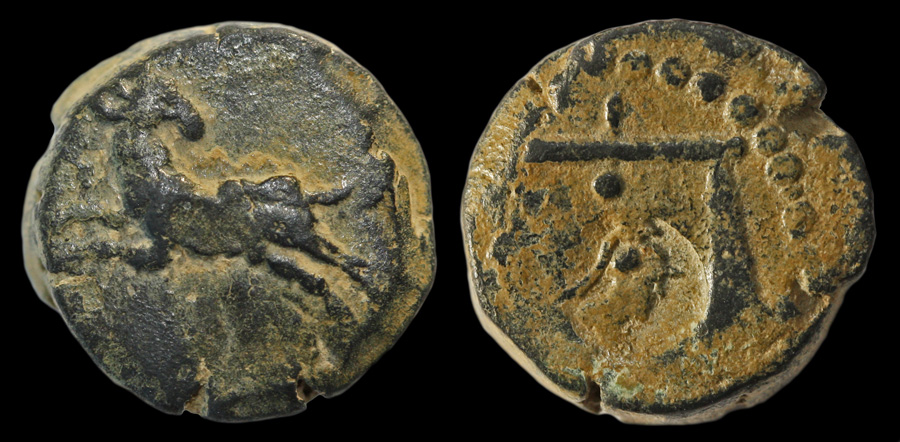 PHARONIC KINGS OF EGYPT, Nektanebo II PHARONIC KINGS OF EGYPT, Nektanebo II
360-343 BCAE, 15 mm (4 mm thick), 4.4 gm Obv: Ram leaping left, head reverted. Rev: Scales of Ma'at; countermark with helmeted bust right. Ref: Weiser 1 A more current example of the attribution, copied from the same type of coin recently sold by by CNG: The Nektanebo DebateSYRIA, Uncertain. 3rd century AD. Æ (15mm, 2.77 g). Ram leaping left / Scales; three pellets in central field. Butcher, p. 405, 11; Weiser 1 (Nektanebo II of Egypt). VF, dark brown patina, smoothing in fields. Weiser's attribution of this type to the Egyptian Pharaoh Nektanebo is primarily based on a loose typological similarity to an issue of gold coins that are Egyptian. While this attribution is still followed by some, more recent evidence has almost certainly shown this to be incorrect. All of these bronze coins seem to originate from sources outside of Egypt, particularly the northern Levant, which would not likely be in the circulation pattern of a 4th century BC bronze issue of Egypt (an argument that these may have been struck while Nektanebo was active in Syria during the Satrapal Revolt is completely implausible). Also, with the exception of the Athenian tetradrachm imitations that were likely struck in Egypt for external trade, there was no internal monetized economy that would be necessary to support such a bronze issue. In his book on the coins of Roman Syria, Butcher notes that the style of the leaping ram is very similar to 3rd century AD issues of Antioch, but also notes that it is a common type at Damaskos. Furthermore, Butcher notes that Newell had attributed two of these in the ANS to an uncertain mint in Commagene, although his rationale is unknown. Thus, Butcher attributes these to an uncertain mint in northern Syria in the 3rd century AD. CNG's description of the same type of coin as recently as last year: The Sole Pharonic IssuePHARONIC KINGS of EGYPT. Nektanebo II. 361-343 BC. Æ 15mm (2.80 g, 12h). Ram running left, head reverted / Scales. Weiser 1; Howgego pl. 9, 192. VF, green patina. Extremely rare. Nekht-her-hebet, or Nektanebo II as he was known to the Greeks, was the nephew of Pharaoh Tachos (Djed-her). Placed in command of the Egyptian army in Syria during the Satrapal Revolt, he turned his troops against his own king and took Egypt by force. In 351-350 BC he repelled a Persian invasion but was driven from his throne in 344-343 BC by a second assault. He fled Egypt, found refuge in Ethiopia, and retained control of Upper Egypt for another few years. ............. Naturally, the prices have dropped considerably for the type. What we think we know changes from time to time as more coins are found and further research undertaken. Edited by ThisIsFun
09/29/2014 7:20 pm
|
|
Pillar of the Community
United States
5155 Posts |
Jeeze TIF, I knew they would eventually give in. I read about this 2/3 rd century Syrian theory quite a few years ago. I am glad that these auction house and these well learned folks have finally come to grips that a Pharonic bronze was near impossible. All in all that does not make the coin any less interesting.
|
|
Pillar of the Community
United States
567 Posts |
Wow guys! Thanks for all the help, this has been super informative and helped me a ton, I really love this community, especially the ancient section.
|
|
Pillar of the Community
United Kingdom
2121 Posts |
The Ptolemaic coinage can be quite interesting if you put the effort in to it. Here is one example from my small Ptolemaic silver collection. Ptolemaic Kingdom, Ptolemy VI Philometor, Silver Tetradrachm Obv:â€" Diademed head of Ptolemy I right wearing aegis Rev:- PTOLEMAIOY BASILEOS, eagle standing left, head left, on thunderbolt, wings closed Minted in Alexandria, B.C. 180-145 Reference:â€" Svoronos 1489, SNG Cop 262 14.031g, 27.3m, 0o Ptolemy VI became king in 180 B.C. at the age of about 6 and ruled jointly with his mother, Cleopatra I, until her death in 176 BC. From 170 to 164 B.C., Egypt was ruled by Ptolemy, his sister-queen and his younger brother Ptolemy VIII Physcon. In 170 BC, the Seleukid King Antiochus IV invaded and was even crowned king in 168, but abandoned his claim on the orders from Rome. In 164 Ptolemy VI was driven out by his brother. He went to Rome and received support from Cato. He was restored the following year. In 152 BC, he briefly ruled jointly with his son, Ptolemy Eupator, but his son probably died that same year. In 145 B.C. he died of battle wounds received against Alexander Balas of Syria. Ptolemy VI ruled uneasily, cruelly suppressing frequent rebellions.  |
|
Pillar of the Community
Netherlands
1204 Posts |
amzazing coin maridunum, like new! Interesting info TIF, dont you feel a little bit 'deceived' after you bought it for quite some money?
|
|
Moderator
United States
23731 Posts |
Last of the Ptolemy's. Struck under the rule of Ptolemy XII and Cleopatra VII. Second regin 80-58 BC AR Tetradrachm 13.77 grams x 24.2mm, Svoronos 1867. 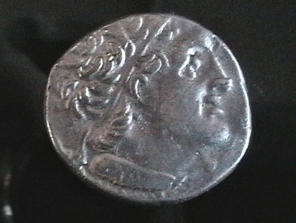 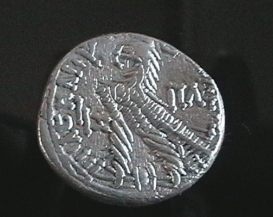 |
|
Pillar of the Community
United Kingdom
2121 Posts |
The later we go through the Ptolemaic kingdom the more stylised the portrait and eagle become. Ptolemaic Kingdom, Cleopatra III and Ptolemy X Soter, Silver tetradrachm Obv:â€" Diademed head of Ptolemy I right wearing aegis Rev:- PTOLEMAIOY BASILEOS, eagle standing left on thunderbolt, wings closed, L I (year 10 of Cleopatra's reign) left, PA right; Minted in Paphos, B.C. 110 Reference:â€" Svoronos 1668, SNG Cop -, Noeske -, 14.258g, 24,1mm, 0o After the death of Ptolemy VIII in 116 B.C. Cleopatra III ruled jointly with her mother Cleopatra II and her son Ptolemy IX. Cleopatra III expelled Ptolemy IX 110 B.C. and replaced him as co-regent with her second son Ptolemy X. Ptolemy IX regained the throne in 109 but was again replaced in 107 B.C. In 101 B.C., after 6 years of joint rule Ptolemy X had his mother Cleopatra III murdered.  |
|
Pillar of the Community
United States
2480 Posts |
Quote:
amzazing coin maridunum, like new! Interesting info TIF, dont you feel a little bit 'deceived' after you bought it for quite some money? Yes, Dutch... I didn't feel warm and fuzzy after learning of this. It's not the first mistake I've made nor will it be the last :D As Noob pointed out, it's still an interesting coin but I certainly overpaid. |
|
Pillar of the Community
3772 Posts |
Congratulation to Quote:
maridvnvm for the wonderful specimens shown. Quote:
Ptolemaic Kingdom, Cleopatra III and Ptolemy X Soter, Silver tetradrachm. Can't compete with the quality provided by the rich people but here is another tetradrachm from the same pair just a few years later: 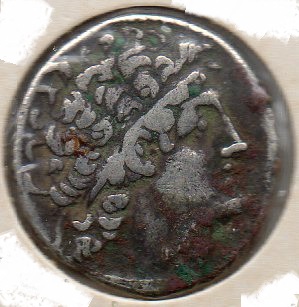 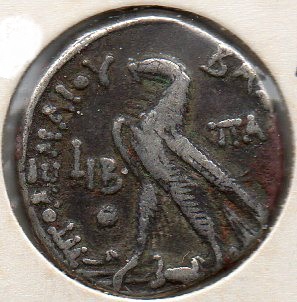 This one is in fine condition and is double dated: LIB = Year 12 of Cleopatra III and below 'theta' = Year 9 of Ptolemy X. Svoronos#1728 / SNG Cop#359 / Sear#7938var Edited by Medieval
10/01/2014 10:12 am
|
| |
Replies: 18 / Views: 8,979 |







 Posted 09/29/2014 03:14 am


