Coin Community Family of Web Sites Join Thousands of Coin, Bullion, & Money Collectors
Royal Canadian Mint products, Canadian, Polish, American, and world coins and banknotes. Royal Estate Auctions - $1 Coin AuctionsJoin Thousands of Coin, Bullion, & Money Collectors Vancouvers #1 Coin and Paper Money Dealer 300,000 items to help build your collection! Specializing in Modern Numismatics Coin, Banknote and Medal Collectors's Online Mall


Username:
Password:
Save Password
Forgot your Password?


This page may contain links that result in small commissions to keep this free site up and running.

Welcome Guest! Registering and/or logging in will remove the anchor (bottom) ads. It's Free!

A Look At Historical Conservative Grading

To participate in the forum you must log in or register.
Author Previous TopicReplies: 3 / Views: 1,604Next Topic  
Pillar of the Community
1cent's Avatar
Canada
1051 Posts
 Posted 01/29/2015  8:10 pm Show Profile   Bookmark this topic Add 1cent to your friends list Get a Link to this Message Number of Subscribers
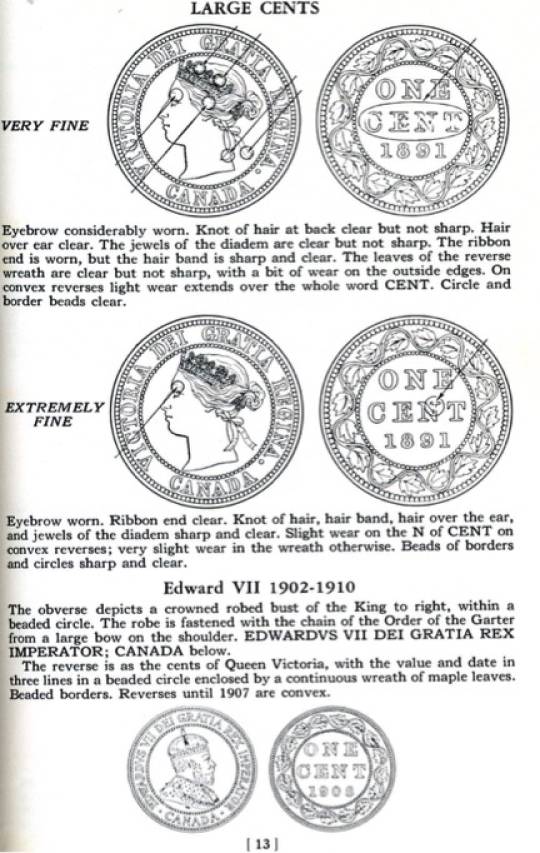
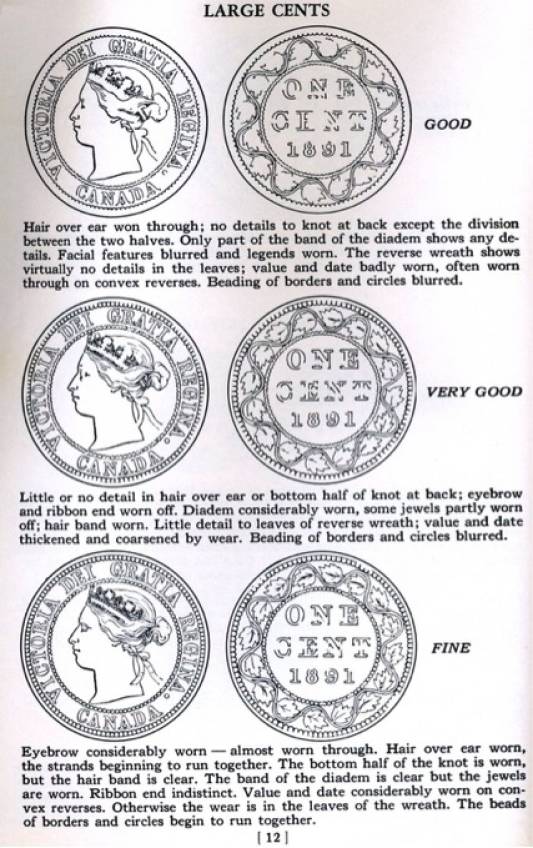
Flipping through some old Charlton guides revealed just how much looser Canadian grading standards really have become.

The 1964 coin guide describes the following:

Poor - badly worn
Good - not defined
Very good - Much wear, but main features of design and legend clear
Fine - More wear on higher parts than VF
VF - Slight wear on higher points of design
EF - Slightly circulated with only very little evidence of wear
AU - not defined. It was not deemed necessary. Next grade was UNC.

1965 Standard Grading Guide to Canadian Decimal Coins:

"An 'extremely fine' coin shows slight wear on the high spots, with all other details sharp and clear."

"The term 'about uncirculated' is not listed in standard catalogues, although widely used in price lists. The term really means a good 'extremely fine', and it frowned upon by conservative collectors."

It makes me think about the current grading of AU-50, 53, 55, 58...and whether or not we really need that level of resolution in grading. If someone can repeatedly demonstrate the difference between, say, and AU-53 and an AU-55, I'd love to see it. PCGS can't reliably tell the difference, but you're welcome to try.

I mostly feel bad for newer collectors who accept what the holder says without question. I remember seeing a 1913 Broad Leaves 10 cent at the RCNA a few years back that PCGS had called "XF-45". It was without a doubt no better than VF-30. Whoever bought it paid double what it was really worth.

It also makes me think to myself, if I can take one of my truly rare coins that's an ICCS EF or EF-45 and get PCGS to call it an AU or AU-53, I could be looking at thousands of dollars in value increase on that coin. What would I accomplish by doing so? I could make more money when I choose to sell, but it's only because the next guy is paying too much for a coin that's over graded, and that doesn't sit well with me.

I guess I'm just being overly conservative in the way I think about things, but every day in this forum I see the effects of grade creep, and I know in the end it hurts collectors because you're paying higher prices for a coin than the coin actually warrants.

That is all

/whining

Pillar of the Community
fourmack's Avatar
New Zealand
1679 Posts
 Posted 01/29/2015  8:39 pm  Show Profile   Bookmark this reply Add fourmack to your friends list Get a Link to this Reply
Different Queens or Kings change the conditions of grading also age
A-Look-At-Historical-Conservative-Grading

A-Look-At-Historical-Conservative-Grading

cheers Don
Cheers Don

Vickies cents and GB Farthings nut.
"Old" is a figure of speech and nothing more
Edited by fourmack
01/29/2015 8:40 pm
Pillar of the Community
Learn More...
Pacificoin's Avatar
Canada
5404 Posts
 Posted 01/29/2015  8:41 pm  Show Profile   Check Pacificoin's eBay Listings Bookmark this reply Add Pacificoin to your friends list Get a Link to this Reply
@1cent Grade Creep is a reality and here to stay. The philosophies of the USA TPG and the Canadian TPG are different. It bears repeating buy the coin not the holder. When you are really comfortable with grading yourself and knowing what the current standards are , you can be very successful. Go to any large coin show these days and if you listen very, very carefully, You will still here the crack of plastic or the snipping of scissors accompanied by loud chuckles or shrieks of delight. Play the game and be a winner !
Bedrock of the Community
sel_69l's Avatar
Australia
21788 Posts
 Posted 01/31/2015  07:51 am  Show Profile   Bookmark this reply Add sel_69l to your friends list Get a Link to this Reply
1cent: What you are looking at here is the pre Sheldon grading system that has been (and still is) used in British numismatics.
Sheldon 1-70 has it's advantages, but I prefer the older, more conservative and tougher British system of grading. If you wish to buy from a British dealer that is the grading system you still have to learn.

I think the older system is much more suited to the grading of ancient coins, where a lot more factors than just condition come into assessment, to give an overall grading of the coin.

It is more subjective than the Sheldon system, and that is one of the major reasons why North American collectors prefer the more absolute approach of the Sheldon system.
  Previous TopicReplies: 3 / Views: 1,604Next Topic  

To participate in the forum you must log in or register.


Disclaimer: While a tremendous amount of effort goes into ensuring the accuracy of the information contained in this site, Coin Community assumes no liability for errors. Copyright 2005 - 2026 Coin Community Family- all rights reserved worldwide. Use of any images or content on this website without prior written permission of Coin Community or the original lender is strictly prohibited.
Contact Us  |  Advertise Here  |  Privacy Policy / Terms of Use

Coin Community Forum © 2005 - 2026 Coin Community Forums
It took 0.21 seconds to rattle this change. Forums