My new book (Forgotten Coins - 2017) addresses some of these pieces. My limited experience has been with Isabel II issues and earlier issues and as Gurney mentioned the Columbia Mint. South America and Russia were the two principal platinum centers.
See the Schaumburg Collection by Stacks/Bowers of the Mike Ringo Collection of Spanish/Amercan Counterfeits. 2008 I believe. See a recent paper I did for a private get-together.
I never seen/heard of an XRF confirmed gold gilded platinum issue for France and England. Gold like silver has been found with mercury amalgam issues but is more rare in numismatic items.
It could also be my pocketbook. I own about 10 gold counterfeits.
I will try to locate that SAP reference.
I was going to say I can offer you free XRF services but Australia is $50 round trip for a registered package. Too costly FOR YOU.
John Lorenzo
Numismatist
United States
Sorry no pictures ...
Metallurgical Overview of Twelve Contemporary Counterfeits
Introduction
Most descriptions of current coins in terms of their alloy compositions particularly for contemporary counterfeits of any period sometimes fall short of a proper alloy classification. Due to lack of records, the sophistication particularly of the Modern Chinese counterfeits entering the market today and for most collectors the lack of availability of any type of advanced scientific material analysis devices the descriptions and interpretations are normally wrong or fall short of their full true character whether the contemporary counterfeit is being exchanged privately or is up for auction at a major auction house. Some examples recently have been in the Kleeberg Counterfeit Two Reales Spanish American Mint series with certain pieces which were classified originally as brass (Cu/Zn) which were actually bronze (Cu/Sn) and items which were termed as silvered which were actually mercuric silver amalgam washes over a underlying debased alloy composition such as copper, brass or bronze. Twelve examples were chosen including a modern Chinese counterfeit to be XRF analyzed and were presented at this gathering. The twelve examples below will be described by their description, their full XRF analyses and with any overall comments on the piece from other similar examples analyzed from this author's or other information retrieved from other outside sources from previous investigators or researchers.
XRF Analyses
X-ray fluorescence (XRF) is the emission of characteristic "secondary" X-Rays (or fluorescent) from a material that has been excited by bombarding with high-energy X-rays. The instrument used was a Spectro Midex which is able to perform spot analyses of several millimeters on any surface spot. For this study obverse and reverse surfaces were shot and pre-alcohol wiped and compared and if any significant differences existed. Differences such as a difference of 0.25% for a minor constituent that was less than 1% or if not detected on the obverse and found on the reverse analysis further X-Ray fluorescence spot analyses was performed on the specimen. The analysis reported here is the representative analysis of the surface. Iron is a common contaminant and if found in trace quantities at levels of 1% or below it was not considered a situation to repeat the analysis. For contemporary counterfeits of bi-layer nature such as a silver wash over debased alloy normally if there was a break in the wash area both these areas were analyzed and were reported. It must be mentioned here since wash may or may not be visible to the naked eye these readings must be considered just as a qualitative observation since accurate levels of the under layer alloy are not possible, since there could be for example silver wash trace particles mixed in the copper alloy. So when we have a reading of 90% silver for the wash and then a silver reading of 25% silver and 70% copper with other elements for the under layer to the "naked eye" we can make a statement this contemporary counterfeit is a silver wash over a copper debased alloy contemporary counterfeit (i.e., bi-layer alloy counterfeit). It's almost universal to see the wash or in case of a plated alloy "within the results" of the under layer XRF spot analyses from observations of 1,000 or so bi-layer counterfeits. There is no way to accurately separate these results other than cutting the coin and doing a central core reading and a surface reading. This of course is prohibitive in this study and actually not required as the numismatist only wishes to class a contemporary counterfeit to a particular class or general description and accurate quantitative numbers of its alloy make-up at the surface and the under layer is not necessary.
It should be mentioned for the Chinese counterfeit the investigator has analyzed over three dozen Chinese counterfeits primarily of a single manufacturer Jinghuahsei Coins (
http://www.jinghuashei.com/) which are considered in my opinion the best made Chinese counterfeits on the market being made in Iron/Nickel, German Silver (Cu/Zn/Ni) or in brass (Cu/Zn) with a small percentage of silver alloy in the mix to give it more of a real silver look appearance.
Metallurgical Overview of Twelve Contemporary Counterfeits
Coins for Analysis
Specimen #1
Description: 1744 Rubel Czarina Elizabeth. Contemporary Counterfeit. German Silver Composition. Elizabeth, 1709- - "62, Czarina of Russia (1741- - "62), daughter of Peter I and Catherine I. 39.8 mm. 23.6 grams. She gained the throne by overthrowing the young czar, Ivan VI, and the regency of his mother, Anna Leopoldovna. Her coup was made possible by her popularity with the imperial guards, who hated the German favorites of Anna Leopoldovna. Elizabeth herself, armed, led the bloodless revolution. Guided in her foreign policy by her chancellor, A. P. Bestuzhev-Ryumin, Elizabeth sought to rid Russia of German influence. She victoriously sided against Frederick II of Prussia in the Seven Years War, but her death and the accession of her nephew, Peter III, took Russia out of the war and made Frederick's ultimate victory possible. During her reign the nobles acquired more power over their serfs and gained a dominant position in local government, while the terms of service they owed the state were shortened. The Moscow Univ. (now Moscow State Univ.) and the Academy of Fine Arts in St. Petersburg were founded during her reign.
XRF Surface Analysis: Copper (64.78%), Zinc (28.6%), Nickel (5.1%), Iron (0.35%0. Silver (0.39%), Arsenic (0.04%), Tin (0.35%), Gallium (0.03%), Iridium (0.027%), Yttrium (0.003%), Indium (0.02%).
Comments: Probable much later counterfeit being of a german silver composition. Probably 20th century or later. Sharp edges with rim not showing much wear. Possible Chinese counterfeit but inscribed as the regal issue as Chinese counterfeits are not normally edge inscribed but simply plain or milled. Modern Chinese counterfeits normally come in three alloys: Fe/Ni, german silver (Cu/Zn/Ni) and brass (Cu/Zn) with trace silver being added to the alloy.
Specimen #2
Description: 1690 France Ecu Contemporary Counterfeit. Louis XIV. 10 Sol. 1690L. 38.23 mm. 21.9 grams. Chinese Counterfeit. Modern. One of the typically seen modern counterfeits with this alloy being brass with silver being added in a low percentage to help the coin look like a real silver piece. Interesting mix of metals.
In the 17th and 18th centuries, the name écu was applied exclusively to a large silver coin (introduced by Louis XIII in 1640) initially worth three livres tournois. From 1690 to 1725 rates were unstable and new écus were issued, and existing écus revalued.
XRF Surface Analysis: Copper (66.93%), Zinc (30.92%), Silver (1.8%), Iridium (0.04%), Arsenic (0.03%), Nickel (0.02%), Gallium (0.02%), Germanium (0.02%), Yttrium (0.02%).
Comments: One of the more commonly seen Chinese counterfeits on the market with that bell tone or lower pitch coin ring than silver. Non-magnetic properties unlike Fe/Ni if the iron content is normally greater than 40% in composition. As with the other seen alloy german silver the pieces look too new yet appear worn in spots. The sharp rims and new appearance of these rims usually are other tell-tale signs. On any suspect coin check with a magnet, look at the edge - - " is it properly aged and of course check its coin ring and memorize the high pitch of silver to these other alloys. These are very well made counterfeits as the picture illustrates for this specimen.
Specimen #3
Description: POLAND. Lithuania. Taler, 1585-NB. Stephen Bathory (1576-86). Dav-8457a; Kopicki-10505. 38.86 mm. 26.1 grams. Contemporary Counterfeit. Probable 16th Century Contemporary Counterfeit or later. Mercury/Silver amalgam over a copper alloy.
XRF Surface Analysis: Copper (50.7%), Silver (30.9%), Antimony (5.24%), Lead (5.2%), Nickel (3.9%), Mercury (2.4%), Molybdenum (0.46%), Tungsten (0.31%), Osmium (0.24%), Yttrium (0.19%), Tin (0.16%), Platinum (0.11%), Bismuth (0.06%), Germanium (0.05%), Zinc (0.04%), Indium (0.01%).
Comments: Very aged rim and of a mercury silver amalgam. Vlachou (1) has shown that most mercury amalgams whether silver or gold prefer being spread over a quaternary alloy of copper, silver, tin and lead during his roman coin study in terms of how well mercuric amalgams form and sustain on different types of alloys from binary to quaternary type compositions. This writer confirms this study as in this piece we see a silver mercuric amalgam over copper, silver, antimony (rather than tin) and lead.
Specimen #4
Description: 1798 Charles IV One Reale Contemporary Counterfeit. 20.02 mm. 50.9 grains. Silver wash over a copper alloy with low zinc (4.9%) and not technically a brass composition.
XRF Surface Analysis: Copper (50.46%), Silver (43.56%), Zinc (4.9%), Lead (0.3%), Arsenic (0.18%), Gold (0.13%), Bismuth (0.08%), Tungsten (0.05%), Yttrium (0.02%), Palladium (0.02%), Gallium (0.01%), Germanium (0.01%).
Comments: Confirmed with several surface spot XRF analyses as not to contain mercury in the alloy mix and therefore the silver wash being not of a mercuric nature. Some silver washes appear to not be of an amalgam nature but these tend to be more uncommon based on present population data kept by this author. The instrument being used has a detection level for Hg of 0.001% so it's by chance that it may be present but unlikely after six different location analyses on the present coin. Lower denomination Spanish American Mint Reales are all rare. In terms of increasing rarity its: Eight Reale, Two Reale (currently (9/2012) there are 73 known Kleeberg varieties but there are many debased silver or billon (Cu/Ag) type specimens known which are excluded from the counterfeit family - - " only off-metals such as brass, bronze and copper incorporate the Kleeberg CC2R's), 4 Reales predominantly those being dated 1808 - - " all others dates are rare, and then the other two denominations (1/2R & 1R being of equal rarity). Further XRF analysis that all washes are of a silver nature and not german silver. German silver is only found as a host alloy and not as a wash. Silver plated Counterfeit 2 Reales are rare as most are either debased silver (billon) or wash specimens as this ex. Richard August - - " Clem Schettino specimen.
Specimen #5
Description: France. Henry I 1550 - - " Lyon Mintmark. Teston. 28.1 mm. 8.5 grams. 131.1 grains. Contemporary counterfeit. Silver plate (not wash) over a copper based alloy.
XRF Surface Analysis: Silver Plate: Silver (93.73%), Copper (4.2%), Molybdenum (0.64%), Lead (0.39%), Gold (0.26%), Arsenic (0.11%), Bismuth (0.1%), Iron (0.08%), Platinum (0.06%), Tungsten (0.06%), Palladium (00.4%), Zinc (0.03%), Mercury (0.03%), Nickel (0.02%), Germanium (0.02%), Gallium (0.01%), Yttrium (0.01%). Debased Alloy: Copper (97.13%), Zinc (1.65%), Tin (0.43%), Antimony (0.28%), Silver (0.28%), Lead (0.12%), Indium (0.06%), Arsenic (0.03%), Gallium (0.006%), and Iron (0.002%).
Comments: Silver plating never involves mercury amalgamation such as the case with the Sheffield Contemporary Counterfeit 8 Reale. The mercury level here is sometimes seen as coming form ore sources. It's interesting to see silver plating this early on a 16th Century piece and we would expect it to have the same type of fusion adhering process as English Sheffield ware. We tend to see high levels of antimony in many medieval contemporaries and this writer is currently exploring the reasons for this anomaly - - " if this is an anomaly or an intentional reason by the counterfeiter. Ex. Joel Caillaud, France.
Specimen #6
Description: Contemporary Counterfeit 2 Reales. Kleeberg 08H-L42. Unique. New Variety. 27.82 mm. 81.8 grams. Medal Turn Die Axis. Lima Mint. Assayer: JP. Silver Mercury Amalgam wash (traces) over a brass alloy host coin composition. Holed and filled in repair mark.
XRF Surface Analysis: Analysis of trace silver seen on the obverse: Copper (68.48%), Zinc (29.81%), Silver (0.43%), Mercury (0.2%), Arsenic (0.14%), Iridium (0.12%), Iron (0.11%), Nickel (0.1%), Germanium (0.04%), Yttrium (0.04%), Indium (0.012%).
Comments: Here is a good example of how XRF surface analysis picks up metals in this scenario of a trace silvery wash on a brass host contemporary. The X-Ray beam for XRF usually penetrates around 10um so at times it will penetrate through the silver wash and pick up the debased alloy composition. So here we see the brass composition with trace silver and mercury being revealed in the analysis. Sometimes visual analysis of the spot area to analyze will pick up more of the debased alloy. The mercury here being normally two powers of ten (100X) above normal ore background levels for this metal. Mercury is boiled off after the treatment process of applying the silver wash but remains due primarily due to its amalgamation of the compounds it has formed with silver rather than it not being efficiently evaporated off during the coin making process. These silver mercuric amalgamated compounds are what is revealed in the XRF analysis.
The use of quaternary alloys for the production of the coins and their contribution to the plating process is a new evidence for the technological knowledge of the workers in the Roman mints. This information is crucial because it provides an alternative theory as to why there were low silver concentrations (1 - 5%) in the coins although it did not affect the alloy color. Numismatists believed that these small quantities of silver gave intrinsic value in the coins but the results from this work showed that there were also key technological issues for the silver content (1). The four elements found in this study are present: copper, zinc, lead and nickel in this example. This could be accidental or intentional by the counterfeiter.
Specimen #7
Description: Circa 1574-1589 Contemporary Counterfeit Henry III France Teston. 29.25 mm. 7.8 grams. 120.3 grains. Lead/antimony alloy. V. rare 16thCentury antimony/lead contemporary.
XRF Surface Analysis: Lead (86.17%), Antimony (12.2%), Copper (0.65%), Iridium (0.5%), Zinc (0.12%), Bismuth (0.12%), Mercury (0.02%).
Comments: There was an instance in modern times were Antimony type coins were made in Kueiyang, the capital city of Keichow Province, before 1933. Beside this trial China has and had never produced coins in Antimony and perhaps it would be the mere instance in worldwide. I suspect the alloy in this highly prized China coin made of antimony to be similar in composition to this contemporary counterfeit as antimony and lead are metals seen with one another in one or two other medieval coins by this writer but never at this level (12.2%). An interesting alloy coin begging for further study on why antimony was used in the mix!
Specimen #8
Description: 1771 Contemporary Counterfeit 8 Reale. Pillar Type. 38.71 mm. 27.3 grams. Debased silver alloy (billon) composition. Ex. Peter Gregory, England.
XRF Surface Analysis: Silver (58.7%), Copper (38.6%), Lead (N.D.), Gold (0.07%), Zinc (0.13%), Arsenic (0.9%), Mercury (0.03%), Antimony (0.38%), Tungsten (0.19%), Platinum (0.11%), Bismuth (0.07%), Nickel (0.06%), Iron (0.04%), Indium (0.03%).
Comments: Original period contemporary counterfeit 8 Reale pieces are quite scarce. Specialist know that there is a significant "decreasing" rarity from pillar/portrait/cap and ray. There are many Chinese counterfeits of the pillar types so I would look for strictly a billon (Ag/Cu) type alloy, regal type edges, aged edges and surfaces and buying from a reputable world coin dealer and not a Chinese location or Far East E-Bay geographical location on E-Bay. Further XRF spot analysis did pick up trace lead. It's an important trace element as we always see lead with regal pieces since its part of the generic cupellation process and a required contaminant in the alloy.
Specimen #9
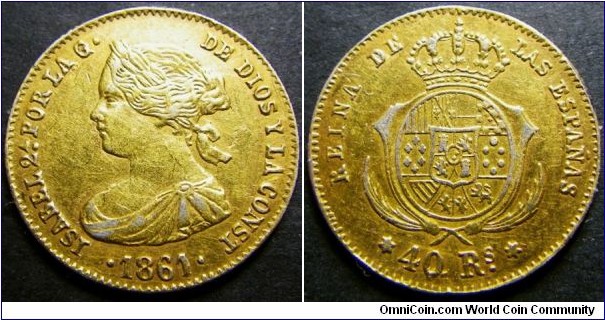
Description: 1865 Spain Isabel II Gold/Platinum Contemporary Counterfeit 4 Escudo. Barrera 846 (2). AU. 18.03 mm. 52.5 grams.
XRF Surface Analysis: Gold (58.29%), Platinum (38.27%), Copper (1.27%), Iridium (0.6%), Germanium (0.43%), Mercury (0.4%), Arsenic (0.13%), Zinc (0.13%), Gallium (0.1%), Selenium (0.13%), Silver (0.11%), Yttrium (0.1%) Nickel (0.01%), Iron (0.005%).
Comments: There was a time- - "just a few hundred years ago, in fact- - "when platinum was neither an industrial metal, nor a strategic metal, nor a precious metal used for high-end jewelry. In fact, during the 17th century in South America, the Spanish Conquistadors thought the metal was a nuisance because it interfered with their gold mining operations. It's for this reason that in the Mike Ringo coin's in the Schaumburg Sale of his Spanish American counterfeits all had primarily South American mint designations is no coincidence and the pieces from Isabel II made in platinum or have platinum as the debased host alloy such as in these amalgam gold/platinum counterfeits like this illustrated example. It's hard to believe that platinum would be treated like brass and copper and be used in a contemporary 19thCentury counterfeit as a debased alloy - - " but such is the case with these examples.
What a difference a century or two can make! In the early 1800s, platinum was found in the gold fields of the Ural Mountains in Russia and the Russian government decided to take that rare element and turn it into a monetary metal by producing platinum rubles. Over the next 18 years, the Russians minted nearly half a million ounces of platinum rubles and transformed the metal from a mere commodity into a precious metal that was and is, like gold, a store of value.
Barrera does fall short as all pieces described in his catalogue use a one metal type alloy classification to describe the contemporary counterfeit alloy. As in this case he would call this example gold when in fact it's a gold/mercuric amalgam over a platinum host coin - - " a bit of a difference. Nevertheless Barrera gives us a good overview in the beginning and does make us aware that counterfeits of pure platinum and gold with copper or with different ratios of gold and platinum weigh close to the regal weight. Copies in brass (Cu/Zn) will generally have weights 25% less or so these of course take on a less of a premium when at auction. Weight is the critical diagnostic used by coin dealers when selling a piece as gold or brass. How much lead, copper or even platinum may be in a Isabel II gold escudo counterfeit is something that may be of a mystery until analyzed but if the weight is similar to a regal you have a good chance of obtaining an rare alloy combination such as this illustrated example. In some ways this is probably the most expensive alloyed counterfeit ever produced these gold/platinum counterfeits of Spain from these South American mints. An eight Escudo in pure platinum as seen in the Schaumberg Sale offering should indeed be considered a treasure. Platinum has never been detected in a Spanish American Mint contemporary counterfeit and is limited only to the coins of Spain in the 19th Century and primarily under Isabel II seeing the highest frequency as illustrated in Barrera.
Specimen #10
Description: 1784 France Contemporary Counterfeit Silver French Ecu. 40.61 mm. 21.8 grams. Bronze Alloy. Edge filing marks. Ex. Thetis Numismatics, 2010.
XRF Surface Analysis: Copper (81.45%), Tin (10.8%), Lead (3.9%), Zinc (1.09%), Mercury (0.9%), Antimony (0.43%), Arsenic (0.33%), Nickel (0.19%), Bismuth (0.1%), Tungsten (0.16%), Iron (0.11%).
Comments: Probably the most desirable contemporary counterfeit to come from France from the 18th Century to present. French contemporary counterfeits come in brass, bronze and silver washed brass and bronze. They very seldom come even with more than 20% silver wash and any specimen regardless of grade with more silver washing on its surfaces is an unquestionable rarity after a five year analysis of this series in the open coin market.
Specimen #11
Description: 1766 France Contemporary Counterfeit Silver French ½ Ecu. Bayonne Mint. 33.0 mm. 14.0 grams. 216 grains. Silver plate (92.84%) over high silver billon (Cu/Ag) alloy with silver XRF surface reading of 96.51% . The high reading due to silver surface enrichment (3).
XRF Surface Analysis: Base Alloy - - " Silver (96.51%), Copper (3.0%), Lead (0.04%), Gold (0.11%), Platinum (0.04%), Bismuth (0.03%), Tungsten (0.01%), Indium (0.02%), Yttrium (0.02%0, Zinc (0.004%), Iridium (0.006%).
Comments: The surface enrichment of silver copper alloys has been recognized for many years. In a typical regal example if made with silver say at ~ 90.0% as with this coin the surface layer can achieve levels in the 96-98% range and within the core of the coin it's been reported to levels as low as 74-76%. This is a regal coin but with time, surface corrosion and the cooling down annealing process during the blank making process, silver tends to the surface of the blank and copper forms copper rich areas throughout the interior of the coin. A silver-copper alloy coin is NEVER homogenous in all its areas. The current research paper on this phenomenon is explain in L. Beck "Silver Surface Enrichment of Silver-Copper Alloys; A limitation for the analysis of ancient silver coins by surface techniques (June, 2004). In short this is a regal coin with typical "elevated" surface silver enrichment readings. This is a strange coin in terms of a silver plated coin over another high silver billon alloy with silver readings higher than the silver plate. A coin still under study and evaluation. Perhaps nothing more than a counterfeiting accident of some sort.
Specimen #12
Description: 1787 CAROLUS III Spain Contemporary Counterfeit ½ Escudo. Barrera 318 type. 14.3 mm. 1.0 gram. 15.427 grains. Gold/Mercuric amalgam over a debased copper alloy.
XRF Surface Analysis: Gold (78.38%), Mercury (16.1%: very high), Copper (2.5%), Silver (0.84%), Molybdenum (0.79%), Germanium (0.54%), Lead (0.31%), Antimony (0.16%), Platinum (0.12%), Titanium (0.1%).
Comments: Refer to the comments of specimen #9. Very high mercuric values on the surface and gold being high over a piece with low amounts of copper in which based on this analysis how much profit was the counterfeiter making - - " the numismatist I suspect would anticipate a greater differential of gold from the regal 90-92% escudo standard.
Conclusion
Certainly the gold and gold/platinum issues of Spain in the 19th Century are noteworthy for any collection. The Chinese counterfeit alloys of Fe/Ni, german silver and brass with trace silver and their diagnostics when "in hand" should be studied and memorized if purchasing raw coins. When purchasing a counterfeit pillar dollar you need to ask yourself is this a billon (cu/SN) or a debased silver type alloy? We do see antimony in large percentages in medieval coins and the full reason why remain a mystery but is currently under investigation by this collector. German silver does not exist as a wash in the Kleeberg CC2R series but does exist as a host coin alloy and with much less frequency than brass. In terms of increasing alloy rarity for the Kleeberg CC2R series I would say: brass, copper, bronze/german silver (equally), then lastly silver (the two Ringo specimens in Schaumburg - - " as examples). We see mercury silver amalgam washes over brass as the primary bi-layer alloy and billon and silver plated issues are not considered of this counterfeit family. So to be clear a Sheffield CC2R is of another maker and non-KLeeberg. The arena of world contemporaries is wide open for study and this collector can make arrangements for any collector to XRF analyze your finds.
Happy Hunting!
References
1. Experimental investigation of silvering in late Roman coinage. C. Vlachou, J.G. McDonnell, R.C. Janaway. Department of Archaeological Sciences, University of Bradford, BD7 1DP, U.K..
2. Luis Barrera Coronado. Catálogo General de la Moneda Falsa Española: Desde los Reyes Católicos a Juan Carlos I. Published 2000 by Artis Traditio S.A.. 200 pages.
3. L. Beck "Silver Surface Enrichment of Silver-Copper Alloys; A limitation for the analysis of ancient silver coins by surface techniques (June, 2004).
John Lorenzo
United States











 Posted 04/18/2015 8:38 pm


