|
This page may contain links that result in small commissions to keep this free site up and running.

Welcome Guest! Registering and/or logging in will remove the anchor (bottom) ads. It's Free!
To participate in the forum you must log in or register. | Author |
 Replies: 8 / Views: 26,223 Replies: 8 / Views: 26,223 |
|
|
New Member
Norway
3 Posts |
This is driving me slightly mad, and bald. Can someone please help me identify these Chinese coins, and maybe also point me to somewhere online where I can identify these rascals in the future? The image with one coin is the front and back of the same coin. 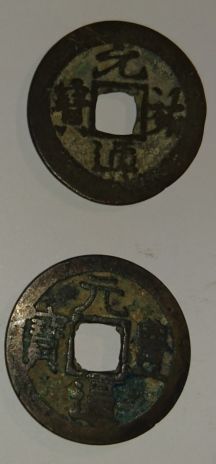   |
|
|
|
Rest in Peace
10197 Posts |
Not sure of first two, possibly a different Chinese dynasty but suspect Japanese. #3 & #4 are of Ching dynasty, 3 is reverse says from Kwangtung mint ( Board of Revenue) in squiggles, other says in Manchurian " Fountainhead of Currency". Obverse(4) is emporer Sheng Tsu(Kang His) 1662-1722.
Your alignments are correct, the emporer's name and title are the top and bottom characters(#4) while the dynasty notations are left and right. Notice differences in reign characters of #1+2?
Post reverse of other two, may indicate where from?
Edited by Crazyb0
03/27/2017 3:57 pm
|
|
New Member
 Norway
3 Posts |
#1 is so worn on the reverse side it's totally blank. #2 is not so worn, but doesn't seem to have had any writing om the reverse side. Some of the characters on them do look like characters from other Chinese coins, and Japan characters aren't the same as Chinese? Are there any other countries that used Chinese characters/alphabetical?
As for the #3/4, 1662 - 1722? It's in great shape for such an old coin, could it be a fake, or are there any chance it is real?
Oh, and Thank you very much for such a great and quick responsen. :-)
Edited by Bearthunder
03/27/2017 4:35 pm
|
|
Rest in Peace
10197 Posts |
Did some more research...try this site: www.calgarycoin.com/reference/china/chinaid3.htm Your top two coins are similar and has some character info. Your Ching coin is likely real. If it is quarter size its a 1 cash coin, not worth much then and @ $1 now if that, fairly common, possibly counterfeit, but why? #2 is T'ang rule(lower character?) AD 841 The other, think I'll give you the opportunity to discover.. (I googled identifying Chinese coins)  |
|
Rest in Peace
10197 Posts |
Bearthunder, you asked about Chinese and Japanese characters, I'm no language expert but have noticed similarities between the two...take for instance this 100 Mon Japanese coin, the lower symbol is for dynasty. 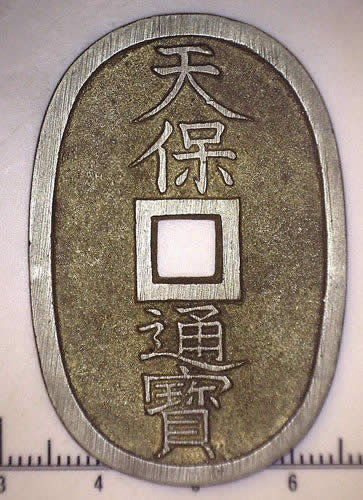 Seems a lot of countries in SE Asia through the Near East share some. |
|
Valued Member
Canada
53 Posts |
|
|
Moderator
 Australia
16982 Posts |
The third coin in the OP (the two bottom bictures) is, unfortunately, a modern replica, mass-produced for Feng Shui purposes.
The first coin is, as arok stated above, from the Song Dynasty and is roughly a thousand years old. This coin is from the Yuan You period (AD 1086-1093). It appears to be genuine (though see my final paragraph for a warning).
The second coin is indeed a Japanese "trade copy" of a Song Era design. The Japanese coins date from the mid-1600s.
As for your more general question: "Chinese cash coins" were produced throughout eastern Asia. Besides China itself, there are coins from Japan, Korea and Vietnam. All these coins have the same alphabet of "Chinese characters" on them; all these languages can be written in the same script, only they are pronounced differently. The second coin identified above, the Japanese trade coin, for example: the legend reads "Yuan Feng Tong Bao" if you are Chinese, "Genho Tsuho" in Japanese, and "Nguyen Phong Thong Bao" in Vietnamese. They all mean the same thing: "First Abundance Current Coin".
There are websites you can go to that identify the ones you're most likely to encounter: Chinese coins of the Qing dynasty (roughly AD 1600-1900). But there's a bewildering variety of "cash coins" out there if you consider all sources.
Vietnamese coins add a particularly confusing element to the mixture, as back in the 1700s, the king of Annam (central Vietnam) allowed the private production of cash coins. These "unofficial" coins had a wide variety of designs, and frequently copied older Chinese, Japanese and Vietnamese coins.
So your first coin may indeed be a "Vietnamese copy" of a Song Dynasty coin; the easiest way to tell is by size and weight. The Vietnamese copies are almost always much smaller and lighter than the originals. Indeed, some Vietnamese cash coins are nicknamed "floaters" because they're so light, they easily float on water.
Don't say "infinitely" when you mean "very"; otherwise, you'll have no word left when you want to talk about something really infinite. - C. S. Lewis
|
|
New Member
Norway
3 Posts |
Speechless! Thank you all! Crazyb0, Arok, Sap... you impress the heck out off me, and made me read and learn about Chinese coinage, history and culture. :-) Thank you all again.
|
|
Valued Member
United States
59 Posts |
The first two are japanese, the last one is fake.
|
| |
Replies: 8 / Views: 26,223 |
|
To participate in the forum you must log in or register.
 
- Counterfeit Detection: ANA Video - Introduction, With Brian Silliman And Jim Robinson Ep. 1
- Counterfeit Detection: ANA Video - Mistakes, Risk Factors, And Counterfeits & Alterations, Ep. 2
- Counterfeit Detection: ANA Video - Pimples And Pits, Looking At Cast Counterfeits, Ep. 4
- Counterfeit Detection: ANA Video - What Year Is That Cent? Key Date Coins, Ep. 5
- Counterfeit Detection: ANA Video - Diagnostics Of The 3, 5, And 10 Cent Coins, Ep. 6
- Counterfeit Detection: ANA Video, Counterfeit Quarter Dollar Diagnostics, Ep. 7
- Counterfeit Detection: ANA Video, Counterfeit Classic Commemorative Coins Diagnostics, Ep. 8
- Counterfeit Detection: ANA Video, Counterfeit Silver Dollar Diagnostics, Ep. 9
- Counterfeit Detectection: ANA Video, Classic US Gold Coin Diagnostics, Ep. 10
- Counterfeit Detection: ANA Video, Diagnostics Of Chinese Made Counterfeits Of US Coins, Ep. 11
- Counterfeit Detection: ANA Video - Wrap Up Recap With Brian Silliman And Jim Robinson Ep. 12
- 2026-P Jefferson Nickel Possible Die Chips, Die Cracks And Other Anomalies
- Commems Collection Modern: What If? 1993 Bill Of Rights Circulating Coinage - A 1990 Attempt
- Split Grading - An Idea That Would Drive Collectors Mad
- 1960 D Lincoln Memorial Cent (Small Date) BIE
- Is This 1888-S A VAM-10, 10A Or Something Else?
- 1994 Brazil 10 Centavo - With Die Clash
- US 1 Cent 1856 Altered From 1858?
- 2009-P Quarter, Puerto Rico, Reed / Edge Error Or PMD?
- 1937-D Walking Liberty Half Dollar. Set Upgrade.
- 20 Questions! (Forum Game) 11/04/24
- How Far Back Can We Go? Ninth Edition!
- Around The World With Coins - A Coin Geography Game
- 2026-P Jefferson Nickel Possible Die Chips, Die Cracks And Other Anomalies
- 1960 D Lincoln Memorial Cent (Small Date) BIE
- G L B 49's MS-70 Perfect Silver Coins
- Is This 1888-S A VAM-10, 10A Or Something Else?
- Post Your Coins With Hats
- Post Your Coins Depicting Weaponry!
- Post Your Coins With Coats Of Arms, Shields, Crests, Crowns, Etc.
- G L B 49's Random Silver Coins
- Continuing List To Show Everyones Latest Acquisitions
- Post Your Coins And Medals Featuring A Snake.
- Post Your Coins With A "five" Denomination
- Post Your Coins Depicting Beards!
- US 1 Cent 1856 Altered From 1858?
- Counterfeit Detection: ANA Video - Introduction, With Brian Silliman And Jim Robinson Ep. 1
- Counterfeit Detection: ANA Video - Mistakes, Risk Factors, And Counterfeits & Alterations, Ep. 2
- Counterfeit Detection: ANA Video - Pimples And Pits, Looking At Cast Counterfeits, Ep. 4
- Counterfeit Detection: ANA Video - What Year Is That Cent? Key Date Coins, Ep. 5
Disclaimer: While a tremendous amount of effort goes into ensuring the accuracy of the information contained in this site, Coin Community assumes no liability for errors. Copyright 2005 - 2026 Coin Community Family- all rights reserved worldwide. Use of any images or content on this website without prior written permission of Coin Community or the original lender is strictly prohibited.
Contact Us | Advertise Here | Privacy Policy / Terms of Use
|
| Coin Community Forum |
© 2005 - 2026 Coin Community Forums |
| It took 0.38 seconds to rattle this change. |
 |
|
| |
| |







 Posted 03/27/2017 4:34 pm


