The Cotton States and International Exposition opened in Atlanta, Georgia on September 18, 1895; it closed on December 31, 1895. The Exposition was the idea of William Arnold Hemphill, founder of the
Atlanta Constitution newspaper. He envisioned a showcase for the South and the latest technologies, as well as a means by which to attract US and foreign visitors to Atlanta to aid its economy and help continue its recovery. US President Grover Cleveland opened the Exposition remotely from his home in Massachusetts by flipping a switch - demonstrating the promise of that
newfangled electricity thing! Note: I made reference to this Exposition when discussing Booker T. Washington and his "Atlanta Compromise" speech leaflet - Washington gave the speech at the Exposition. (Link below.)
The Exposition's objectives were to promote the products, resources and potential of the revitalized and growing states of the Southern US, to encourage more trade between such states, to foster more trade between the countries of South America and the "Cotton States" and to showcase Atlanta's rebirth after the devastation it suffered during the US Civil War (via fires started by the Union forces under the command of General William Tecumseh Sherman).
An estimated 800,000 people paid to attend the Exposition during its 105-day run; the Exposition was closed on Sundays, however, which means it was open for 15 days less - 90 days. Admission tickets were $0.50 each. Though not an overall financial success, the Exposition was successful in attracting outside investment in Atlanta and the city went on to experience a true rebirth.
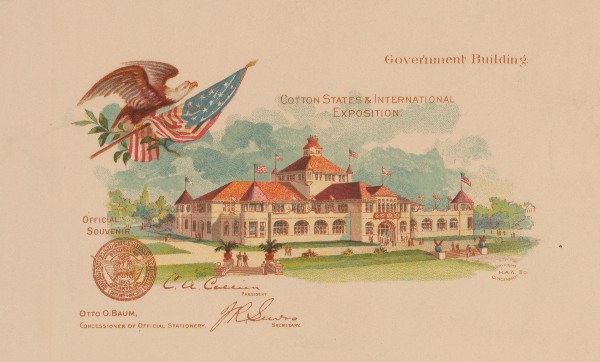
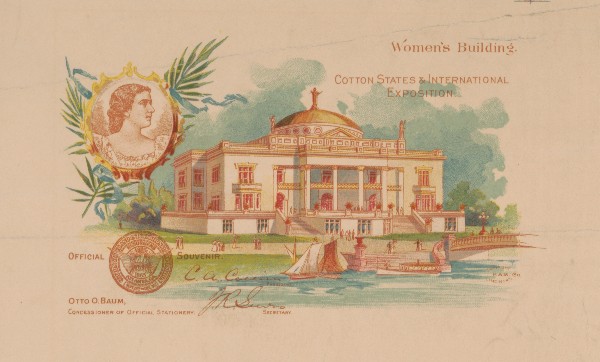
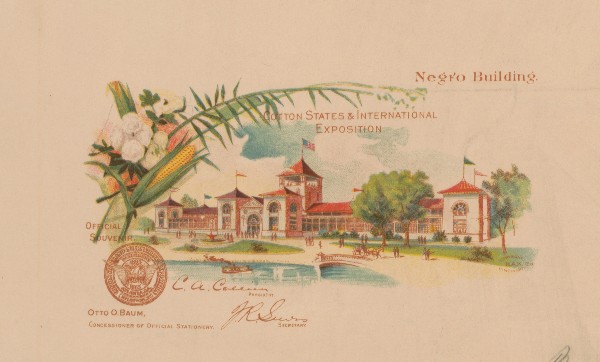
Congress authorized - and made appropriations for - the participation of the US Government in the Exposition, including the construction of a large US Government Building and display of exhibits (many were previously presented at the 1893 World's Columbian Exposition). Among its many other buildings - e.g., Administration Building, Agriculture Building, Machinery Hall, Electricity Building, Minerals and Forestry Building, etc. - the Exposition included a Women's Building and a Negro Building for exhibits by, and about, women and African-Americans, respectively. Congress' authorization for the US Government's participation and Building was included in the Sundry Civil Expenses Act for Fiscal Year 1895.
View of Cotton States and International Exposition - Looking North (US Government Building is behind Carillon to the right)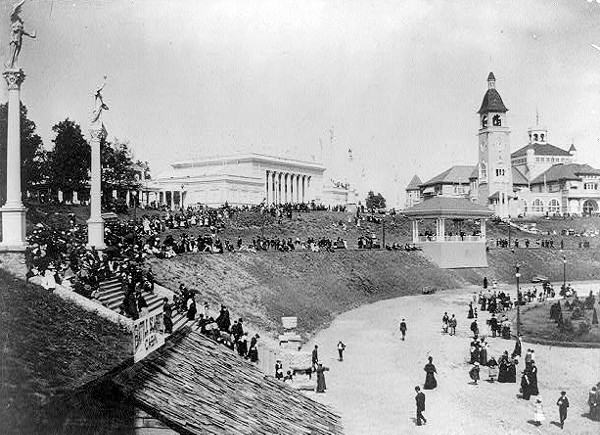 US Government Building at Cotton States and International Exposition
 Women's Building at Cotton States and International Exposition
 Negro Building at Cotton States and International Exposition
 (Image Credits: All images from Library of Congress, Prints and Photographs Division. Public Domain.)
The Act also authorized the participation of the Treasury Department/US Mint via the striking of commemorative and award medals for the Exposition. The coin-like commemorative souvenir piece was a gold-plated bronze medal. The 35 millimeter medal was struck at Philadelphia and brought to the Exposition for sale/distribution.
The obverse design of the medal features a bale of cotton with a phoenix rising from the flames above it. "1865" (end of the US Civil War) is seen within the flames, "1895" (the date of the Exposition) is inscribed on a ribbon above the phoenix. Clasped hands, a sign of friendship and reconciliation are presented below the cotton bale. The design is symbolic of the South's rise and revitalization following the destruction experienced during the US Civil War.
The medal's reverse presents a front-facing portrait of Henry Woodfin Grady (1850-1889). Grady was a journalist and public speaker who advocated for the industrialization of the South and worked to reintegrate the Confederate States back into the Union after the US Civil War. The US Mint-struck medal was the official medal of the Exposition.
US Mint-Struck Commemorative Medal for 1895 Cotton States and International Exposition

A nice, general article about the Exposition can be found here:
https://www.georgiaencyclopedia.org...-in-atlanta/To read the BTW post referenced above, see:
-
1946-51 Booker T. Washington Memorial - Ephemera II.
For other of my posts about commemorative coins and medals, see:
Commems Collection.










 Posted 11/27/2022 1:50 pm