Between 1958 and 1961 (85th, 86th and 87th Congresses), three bills were introduced in the House of Representatives that called for a half dollar "in commemoration of the Nation's pioneer lumbermen." Each of the bills was introduced by Elford Albin Cederberg (R-MI); all were referred to the House Committee on Banking and Currency.
The bills called for a coin that would have shared design characteristics with the 1936 Elgin, IL - Pioneer Memorial Half Dollar. Where the Elgin coin depicted Trygve Rovelstad's Pioneer Memorial statue on its reverse (it depicted a pioneer family), the Pioneer Lumberman half dollar would have featured the "Lumbermen's Memorial Monument in the Huron National Forest, State of Michigan."
Pioneer Lumbermen Monument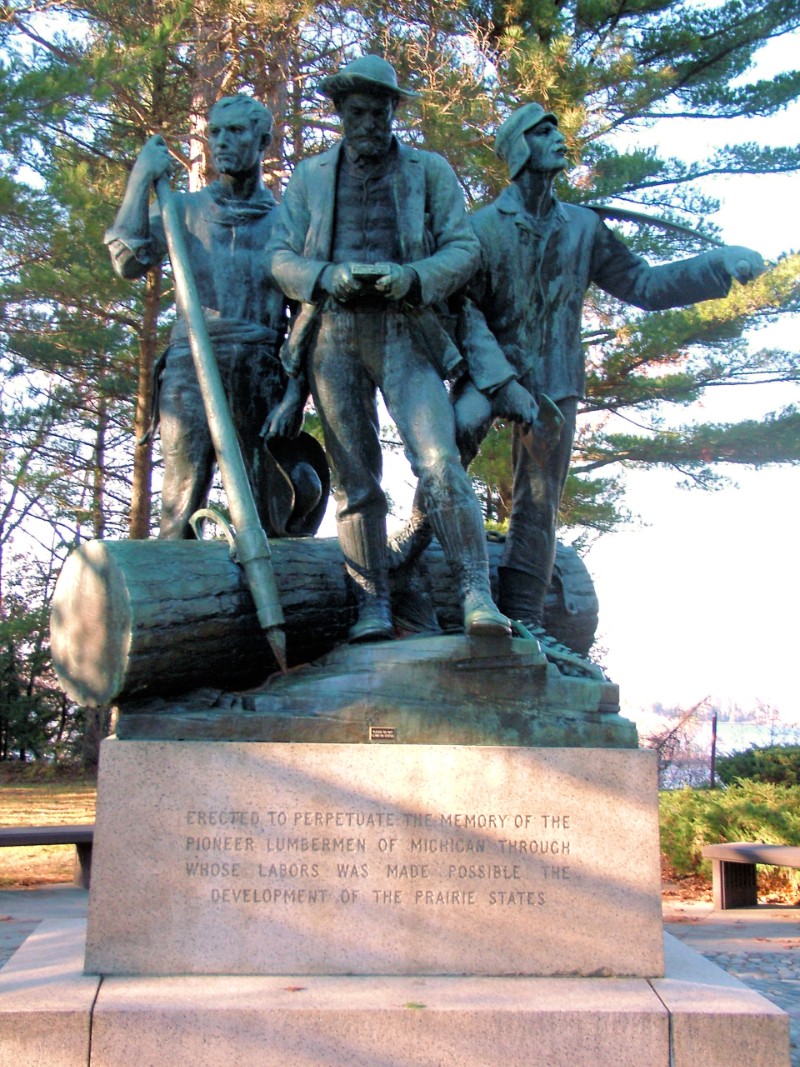 (Image Credit: Public Domain.)
The three figures of the statue represent a typical "River Rat" at left (viewer's perspective), with a surveyor in the center and a sawyer (right). "River Rat" refers to the lumberjacks who rode on top of logs as they traveled down a river - their job was to guide the logs and keep them moving down the river. The sawyer is a lumberjack whose primary job is to cut down (saw) trees and/or trim logs before they are transported. A surveyor is responsible for determining boundaries of an area to be harvested, as well as which trees are appropriate for harvesting. Historically, in the US, surveyors also marked trees that were to be reserved for the British King and his purposes vs. to be used by colonists.
The Pioneer Lumbermen Monument was conceived by R. G. Schreck, founder/owner of R. G. Schreck Lumber Company of Tawas, MI and one-time Supervisor of the Huron National Forest. Robert Aitken, the New York City artist responsible for the Gold $1 and Gold $50 coins for the 1915-16 Panama-Pacific International Exposition, as well as the 1921 Missouri Statehood Centennial Half Dollar and the 1935-36 California-Pacific International Exposition Half Dollar (aka, the "San Diego") sculpted the Monument. Aitken received $50,000 for his efforts. The monument was dedicated in July 1932.
(Side Note: Aitken also designed a number of medals, some were struck by the US Mint, but most were struck by private mints, such as Medallic Art Company). he Pioneer Lumbermen Monument is located within the River Road National Scenic Byway at the eastern end of Huron National Park. (The Huron National Forest was combined with the Manistee National Forest, for administrative purposes, in 1945, and is now referred to as the Huron-Manistee National Forests.)
The bills called for 25,000 coins for the benefit of the Tawas City, Michigan Kiwanis Club, which was to use net proceeds from the coins to defray expenses incurred by the Club for its authorized functions. (Such activities do not appear to have been directly connected to the Monument.) The striking of the coins was not restricted to a single Mint facility by the bill, nor did it set an expiration date for coining authority. One restriction it did put in place was that coin orders had to be for a minimum of 5,000 half dollars.
None of Cederberg's three Pioneer Lumbermen bills was reported out of Committee, and thus died for lack of action as each respective Congress adjourned.
I think that if the coin's proceeds were earmarked to assist forestry projects in Huron National Park, I would've been a supporter - but not for unspecified "functions" of a local Kiwanis Club.
For more of my topics on commemorative coins and medals, including more What If? stories, see:
Commems Collection.










 Posted 12/13/2022 09:38 am


 ...... Mighty Topic..


