Coin Community Family of Web Sites
Shop CCF Members on eBay! Coin, Banknote and Medal Collectors's Online Mall Shop for APMEX Bullion on eBay!Vancouvers #1 Coin and Paper Money Dealer Royal Canadian Mint products, Canadian, Polish, American, and world coins and banknotes. 300,000 items to help build your collection! Specializing in Modern Numismatics


Username:
Password:
Save Password
Forgot your Password?


This page may contain links that result in small commissions to keep this free site up and running.

Welcome Guest! Registering and/or logging in will remove the anchor (bottom) ads. It's Free!

Commems Collection Classic: What If? 1958-61 Pioneer Lumbermen

To participate in the forum you must log in or register.
Author Previous TopicReplies: 9 / Views: 1,298Next Topic  
CCF Master Historian of USA Commemoratives
Learn More...
commems's Avatar
United States
12252 Posts
 Posted 12/13/2022  07:50 am Show Profile   Bookmark this topic Add commems to your friends list Get a Link to this Message Number of Subscribers
Between 1958 and 1961 (85th, 86th and 87th Congresses), three bills were introduced in the House of Representatives that called for a half dollar "in commemoration of the Nation's pioneer lumbermen." Each of the bills was introduced by Elford Albin Cederberg (R-MI); all were referred to the House Committee on Banking and Currency.

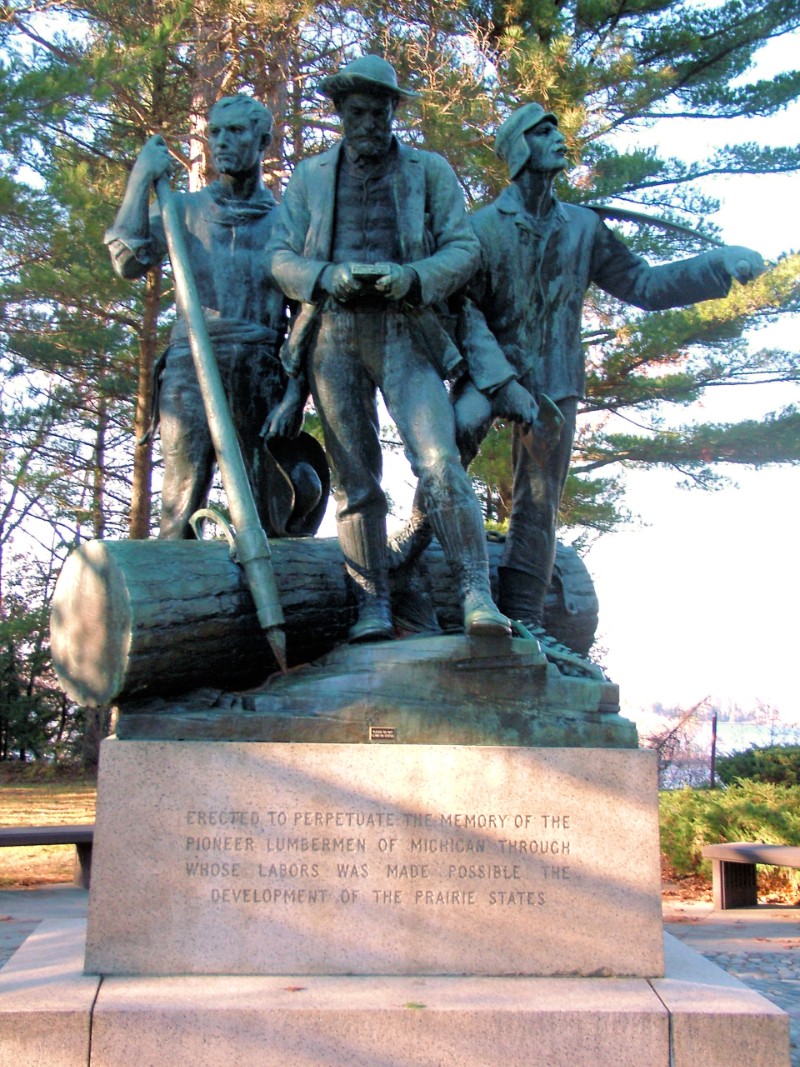
The bills called for a coin that would have shared design characteristics with the 1936 Elgin, IL - Pioneer Memorial Half Dollar. Where the Elgin coin depicted Trygve Rovelstad's Pioneer Memorial statue on its reverse (it depicted a pioneer family), the Pioneer Lumberman half dollar would have featured the "Lumbermen's Memorial Monument in the Huron National Forest, State of Michigan."

Pioneer Lumbermen Monument
Commems-Collection-Classic:-What-If?-1958-61-Pioneer-Lumbermen
(Image Credit: Public Domain.)

The three figures of the statue represent a typical "River Rat" at left (viewer's perspective), with a surveyor in the center and a sawyer (right). "River Rat" refers to the lumberjacks who rode on top of logs as they traveled down a river - their job was to guide the logs and keep them moving down the river. The sawyer is a lumberjack whose primary job is to cut down (saw) trees and/or trim logs before they are transported. A surveyor is responsible for determining boundaries of an area to be harvested, as well as which trees are appropriate for harvesting. Historically, in the US, surveyors also marked trees that were to be reserved for the British King and his purposes vs. to be used by colonists.

The Pioneer Lumbermen Monument was conceived by R. G. Schreck, founder/owner of R. G. Schreck Lumber Company of Tawas, MI and one-time Supervisor of the Huron National Forest. Robert Aitken, the New York City artist responsible for the Gold $1 and Gold $50 coins for the 1915-16 Panama-Pacific International Exposition, as well as the 1921 Missouri Statehood Centennial Half Dollar and the 1935-36 California-Pacific International Exposition Half Dollar (aka, the "San Diego") sculpted the Monument. Aitken received $50,000 for his efforts. The monument was dedicated in July 1932. (Side Note: Aitken also designed a number of medals, some were struck by the US Mint, but most were struck by private mints, such as Medallic Art Company).

he Pioneer Lumbermen Monument is located within the River Road National Scenic Byway at the eastern end of Huron National Park. (The Huron National Forest was combined with the Manistee National Forest, for administrative purposes, in 1945, and is now referred to as the Huron-Manistee National Forests.)

The bills called for 25,000 coins for the benefit of the Tawas City, Michigan Kiwanis Club, which was to use net proceeds from the coins to defray expenses incurred by the Club for its authorized functions. (Such activities do not appear to have been directly connected to the Monument.) The striking of the coins was not restricted to a single Mint facility by the bill, nor did it set an expiration date for coining authority. One restriction it did put in place was that coin orders had to be for a minimum of 5,000 half dollars.

None of Cederberg's three Pioneer Lumbermen bills was reported out of Committee, and thus died for lack of action as each respective Congress adjourned.

I think that if the coin's proceeds were earmarked to assist forestry projects in Huron National Park, I would've been a supporter - but not for unspecified "functions" of a local Kiwanis Club.


For more of my topics on commemorative coins and medals, including more What If? stories, see: Commems Collection.


Collecting history one coin or medal at a time! (c) commems. All rights reserved.
Edited by commems
12/13/2022 10:44 am
Bedrock of the Community
Coinfrog's Avatar
United States
94367 Posts
 Posted 12/13/2022  08:52 am  Show Profile   Bookmark this reply Add Coinfrog to your friends list Get a Link to this Reply
So the King even had his own trees!
CCF Master Historian of USA Commemoratives
Learn More...
commems's Avatar
United States
12252 Posts
 Posted 12/13/2022  09:38 am  Show Profile   Bookmark this reply Add commems to your friends list Get a Link to this Reply

Quote:
So the King even had his own trees!

Yes, typically the tall, straight trees of larger diameter - useful, for example, in making sailing ship masts.

"It's good to be the King!" - Mel Brooks, History of the World, 1981.


Collecting history one coin or medal at a time! (c) commems. All rights reserved.
Moderator
Learn More...
jbuck's Avatar
United States
187582 Posts
 Posted 12/13/2022  09:44 am  Show Profile   Bookmark this reply Add jbuck to your friends list Get a Link to this Reply
Very interesting!

I might have liked this one. Assuming the funds were distributed more appropriately.
Moderator
Learn More...
nickelsearcher's Avatar
United States
15386 Posts
 Posted 12/13/2022  12:47 pm  Show Profile   Bookmark this reply Add nickelsearcher to your friends list Get a Link to this Reply
Great read commems. This appears to be a worthwhile commemorative topic that I could have supported.

I can only imagine the that River Rat job became quire dangerous when the traveling log ran into the typical log jam
Take a look at my other hobby ... http://www.jk-dk.art
CCF Master Historian of USA Commemoratives
Learn More...
commems's Avatar
United States
12252 Posts
 Posted 12/13/2022  2:54 pm  Show Profile   Bookmark this reply Add commems to your friends list Get a Link to this Reply

Quote:
I can only imagine the that River Rat job became quire dangerous when the traveling log ran into the typical log jam

I know it's a job that I would never have wanted!


Collecting history one coin or medal at a time! (c) commems. All rights reserved.
Pillar of the Community
Morgans Dad's Avatar
United States
5602 Posts
 Posted 12/13/2022  6:06 pm  Show Profile   Bookmark this reply Add Morgans Dad to your friends list Get a Link to this Reply
Pioneers in more ways than one... These people were Tough, they took on living and breathing Logging, Under Extreme Weather and Terrain Working conditions... Many Thanks to These Brave, Talented, Determined Men...... Another IF only ...... Mighty Topic..
Bedrock of the Community
Coinfrog's Avatar
United States
94367 Posts
 Posted 12/13/2022  6:29 pm  Show Profile   Bookmark this reply Add Coinfrog to your friends list Get a Link to this Reply
Were British ships employing the "King's trees" ever built in colonial shipyards?
CCF Master Historian of USA Commemoratives
Learn More...
commems's Avatar
United States
12252 Posts
 Posted 12/14/2022  08:04 am  Show Profile   Bookmark this reply Add commems to your friends list Get a Link to this Reply

Quote:
Were British ships employing the "King's trees" ever built in colonial shipyards?

The way I understand it, many of the mast-worthy trees marked by Royal Surveyors were cut down, trimmed and shipped back to England for use on ships built there, including those for the King's Royal Navy.

However, colonists often ignored the King's "Broad Arrow" mark placed by Royal Surveyors and cut the trees down for use in their own shipyards (and for other purposes). As American-built ships were generally cheaper than European ships due to the greater availability of lumber (from previously untapped forests), many British merchant ships were built in colonial shipyards. So, made of "Royal trees" with colonial hands!


Collecting history one coin or medal at a time! (c) commems. All rights reserved.
Moderator
Learn More...
jbuck's Avatar
United States
187582 Posts
 Posted 12/14/2022  10:14 am  Show Profile   Bookmark this reply Add jbuck to your friends list Get a Link to this Reply

Quote:
So, made of "Royal trees" with colonial hands!
  Previous TopicReplies: 9 / Views: 1,298Next Topic  

To participate in the forum you must log in or register.


Disclaimer: While a tremendous amount of effort goes into ensuring the accuracy of the information contained in this site, Coin Community assumes no liability for errors. Copyright 2005 - 2026 Coin Community Family- all rights reserved worldwide. Use of any images or content on this website without prior written permission of Coin Community or the original lender is strictly prohibited.
Contact Us  |  Advertise Here  |  Privacy Policy / Terms of Use

Coin Community Forum © 2005 - 2026 Coin Community Forums
It took 0.39 seconds to rattle this change. Forums


