As the 150th anniversary of the American Revolution approached, the US Congress considered requests for the Federal Government to participate in local celebrations. One such event was the commemoration of the sesquicentennial of the Battle of Bunker Hill (actually Breed's Hill).
The Battle at Bunker/Breed's Hill took place on June 17, 1775 (just two months after Lexington and Concord) in Charlestown, MA. The battle engaged approximately 3,000 British troops and 2,400 American. The Americans were able to defend themselves against two waves of British troops from their hastily-built fortification but succumbed to the third wave as they ran out of powder/ammunition. The battle ultimately proved to be a British victory, but it proved to the Americans that they could hold their own against the British. As a result of the Battle, the British ultimately evacuated Boston and the Americans began their long war for independence.
Side Note: Legend has it that it was during the Battle of Bunker hill that American Colonel William Prescott instructed his men "don't fire until you see the whites of their eyes."
If you have a few minutes (~4),here's a great video on the Battle of Bunker Hill.
mgeq7uqqmn8
A Joint Resolution was introduced in the House of Representatives by Peter Francis Tague (D-MA) in January 1925; it was referred to the House Committee on the Library. The Resolution was multi-purpose: 1) Establishment of the US Bunker Hill Sesquicentennial Commission; 2) A $5,000 appropriation for expenses of the Commission; 3) A $10,000 appropriation for Federal Government participation in the Bunker Hill observance on June 17, 1925; 4) Authorization of commemorative stamps for Bunker Hill and the American Revolution; and 5) Authorization for the striking of up to 800,000 legal tender, silver commemorative half dollars of standard specifications.
The Committee reported the bill favorably, but included a recommended amendment in its Report. The amendment? Remove the Resolution's provisions regarding the commemorative half dollar. The Report cited a letter received from Andrew Mellon, Secretary of the Treasury who had been given the opportunity to review the Resolution. In his letter, Mellon stated: "In my judgement the coinage should not be commercialized to finance any project or commemorate any other events than those of great national importance to all the people. The policy of issuing special coins opens the way to counterfeiting and makes the protection of the integrity of our coinage much more difficult. The issue of special coins is not in the interest of the general public and usually satisfies a very little demand."
While I would argue that the Battle of Bunker Hill was an event of "great national importance," the Committee considered Mellon's comments to be an objection to the coin at hand and recommended its removal before the House passed the Resolution. (The Library Committee was not experienced with coin legislation.) When it was brought up for consideration in the House, the coin provisions were dutifully removed and the Resolution quickly passed without debate.
Once received in the Senate, the Resolution was referred to the Senate Committee on the Library. It was reported back without further amendment and passed by the Senate without debate.
Each chamber examined and signed the Resolution before it was sent to the President. US President Calvin Coolidge signed the Resolution into law on March 2, 1925 (two days before his second inauguration). So, though the Resolution became Public Law, it did not include a provision for a commemorative coin. IMO, a missed opportunity!
The Resolution's stamp provision was included in the Public Law but no Bunker Hill-specific stamp(s) were issued. A three-stamp set for the Battles at Lexington and Concord were, however, issued as a result of the Act.
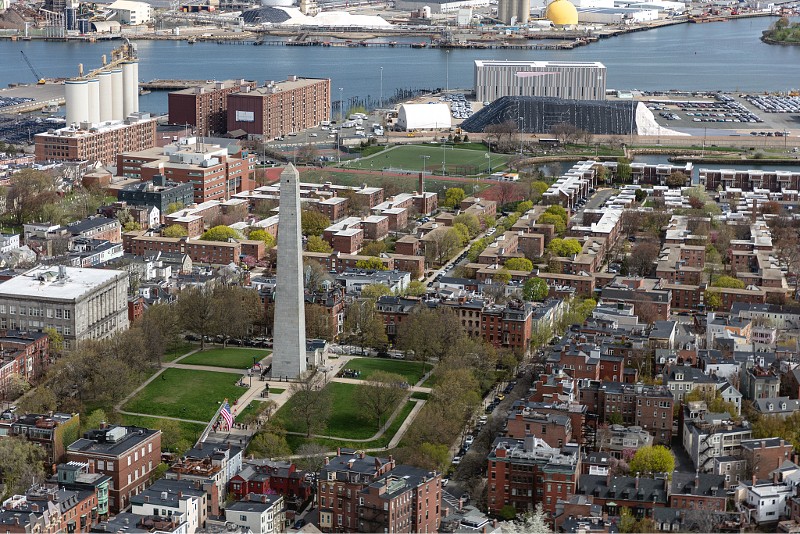
A granite obelisk reaching a height of 221 feet was constructed between 1825 and 1843 (construction was started during the 50th Anniversary year of the Battle of Bunker Hill) as a monument/memorial to the Battle.
Bunker Hill Monument - Aerial View (Image Credit: Library of Congress, Prints andPhotographs Division, Public Domain.)
I visited the Bunker Hill Monument about 10 years ago on a cool Fall dayl My friend and I were the only visiors at the site at the time. I didn't have time to climb the monument (nearly 300 steps to the top!) as I had a plane to catch, but I recall being surprised by the small size of the park and how tightly the neighboorhood surrounded it.
For more of my topics on commemorative coins and medals, including many other What If? stories, see: Commems Collection.
Collecting history one coin or medal at a time! (c) commems. All rights reserved.
I would ask, WHY did the Secretary's Note hold so much weight. The General Public in General, LOVES Coinage, Especially to COMMEMORATE Historic events, as the Battle of Bunker Hill...
Men Stood up to the Obviously Over powered or Out numbered forces.
Reminds me of the Great United States Marine, Chesty Puller.... Totally, and Completely Surrounded by Enemy Forces. " "All right, they're on our left, they're on our right, they're in front of us, they're behind us.they can't get away this time."
America's Pivotal Freedom moments Depended on the Minute Men of the Days!!!!!!
Quote: I would ask, WHY did the Secretary's Note hold so much weight. The General Public in General, LOVES Coinage, Especially to COMMEMORATE Historic events, as the Battle of Bunker Hill...
I believe several factors were in play:
1) Andrew Mellon was a powerful Secretary of the Treasury. His business acumen was well-established prior to his being appointed as the Secretary of the Treasury by Warren G. Harding, and he was highly-respected and successful. His word carried weight.
2) The general public's love for commemorative coins could be questioned based on prior program sales. From the start of the US commemorative coin series - the 1892-93 World's Columbian Exposition Half Dollar - the public had not fully embraced US commemorative coins. The Columbian Exposition program, for example, had millions of its mintage either returned to the Mint for melting or released into circulation at face value. The 1920 Maine Statehood Centennial coin only had half of its authorized mintage struck (50,000 vs. 100,000) and even then it took the Maine Treasurer years to sell them.
3) In 1925, other stories of poor sales and returned coins were known by Mellon for recent commemorative programs: 1920 Landing of the Pilgrims Tercentenary, 1921 Alabama Statehood Centennial, 1921 Missouri Statehood Centennial, 1922 Grant Birth Centenary, 1923 Monroe Doctrine Centennial and 1924 Huguenot-Walloon 300th Anniversary all had coin returns. With a recent commemorative coin track record that was spotty at best, it's not too difficult to understand Mellon's reluctance (IMO).
Collecting history one coin or medal at a time! (c) commems. All rights reserved.
Disclaimer: While a tremendous amount of effort goes into ensuring the accuracy of the information contained in this site, Coin Community assumes no liability for errors. Copyright 2005 - 2026 Coin Community Family- all rights reserved worldwide. Use of any images or content on this website without prior written permission of Coin Community or the original lender is strictly prohibited. Contact Us | Advertise Here | Privacy Policy / Terms of Use









 Posted 04/08/2023 09:31 am





 ....
....


