| Author |
 Replies: 36 / Views: 5,603 Replies: 36 / Views: 5,603 |
|
New Member
Australia
40 Posts |
Just acquired some pennies with flaws. This 1938 penny was one and has a massive obverse flaw. I've looked for help as to how this has happened but some collectors think it's a die breakage event. My thoughts are that the preceding planchet had a large delamination which separated during the strike, and stuck in the obverse die. My coin planchet then followed but was struck with lamination material as well which melded on. It would account for the thicker legend in places due to more material present during the strike. The reverse may have had material fragments deposited on the reverse die at the same time. Any comments would be welcome. 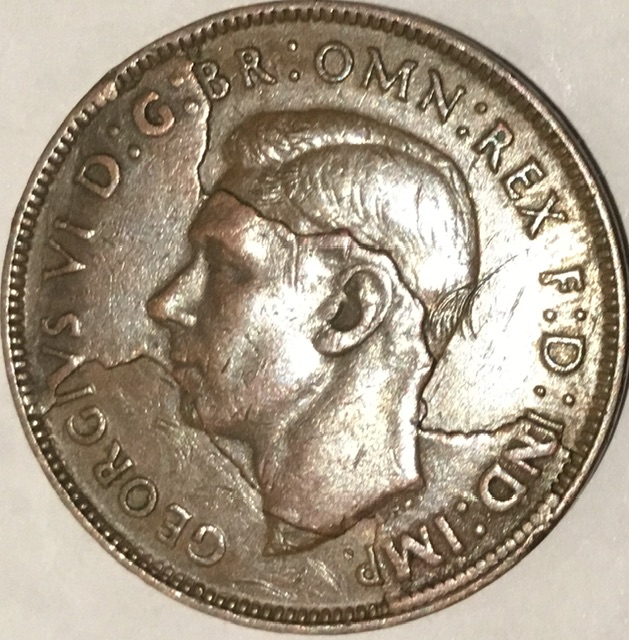 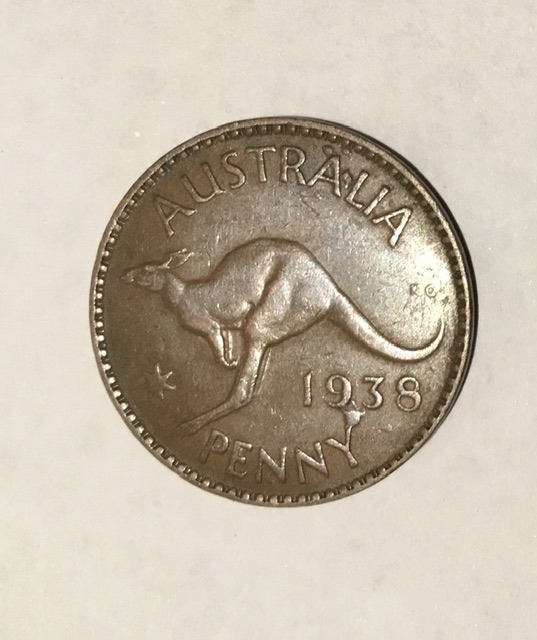 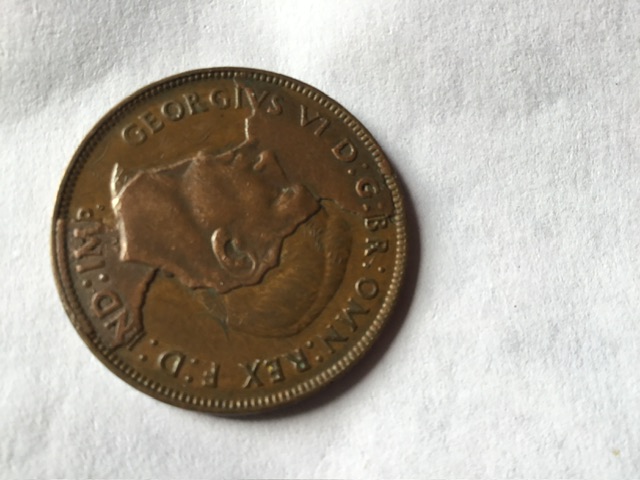 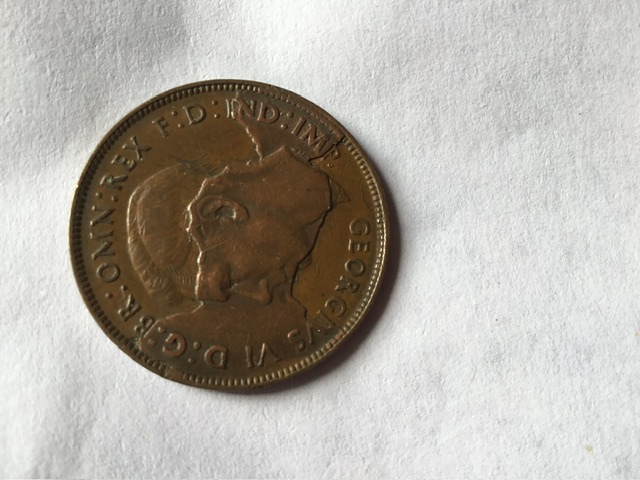 |
|
|
|
Pillar of the Community
 United States
6883 Posts |
Massive laminations.  |
|
Pillar of the Community
 United States
5720 Posts |
Looks like a jigsaw puzzle! What's the weight of the coin? That might help determine whether the coin added material when it was struck as you suggested or is just an irregularly delaminated planchet.
|
|
Bedrock of the Community
United States
94367 Posts |
Never seen anything quite like that!  to the CCF! |
|
Pillar of the Community
United States
945 Posts |
As soon as I saw it, I thought "Frankenstein." Cool find
|
|
Pillar of the Community
Australia
1047 Posts |
Yes,interesting Coin,as posted it may be a clear resin of some kind.
Edited by Basil
11/13/2023 5:14 pm
|
|
New Member
 Australia
40 Posts |
Thanks for the comments so far. My theory is just that, and I'm hoping for more information from those who know this coinage and how it's minted very well.
I'm quite excited about this find, as I've never had something so dramatic in appearance.
|
|
New Member
Australia
40 Posts |
I don't have scales accurate enough for coins to weigh this coin, so the best I can get is on the high side between 9 and 10 grams, which fits with the nominal weight of 9.45 grams.
|
|
Moderator
Australia
17006 Posts |
I'm sorry, but it looks to me like a layer of varnish or glue, rather than a mint error. Such layers can look very much like "added metal", but they peel off or are dissolved in acetone or other solvents.
Don't say "infinitely" when you mean "very"; otherwise, you'll have no word left when you want to talk about something really infinite. - C. S. Lewis
|
|
Bedrock of the Community
United States
79462 Posts |
Try giving it a soak in 100% pure acetone and see what happens.
Errers and Varietys.
|
|
New Member
Australia
40 Posts |
I know what you mean to think that, but the legend is larger in the affected areas which would be the effect of more metal than normal being struck.
Glue wouldn't change the lettering size . I'll post a better photo.
|
|
New Member
Australia
40 Posts |
This is the best I can without a digital microscope. 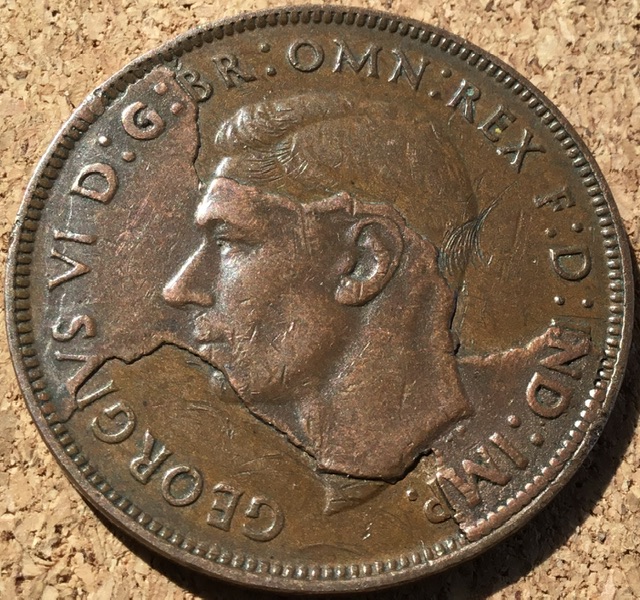 |
|
New Member
Australia
40 Posts |
It can't be glue or similar substance as the surface is worn enough to show that it's copper.
The text differences can be seen around "IND:IMP" showing that the copper material was on my planchet before being struck and imbedded into the surface . At a guess, I'd say the extra layer caused the text to exude creating larger text in that place.
|
|
Bedrock of the Community
United States
79462 Posts |
Now with the new pictures, maybe a Shattered Die?
Errers and Varietys.
|
|
Moderator
Australia
17006 Posts |
The new pics don't dissuade me. The "raised" area is a distinctly different colour than the "sunken" areas.
You've also got the"crack" wobbling around the denticles - I've never seen a die crack do that. But that's exactly what glue would do.
Finally, there's two sets of hack-marks, one on the back of the king's head and one on top of the king's head, both in the "sunken" area - where clearly someone has poked a butter knife in between the coin and whatever it was that the coin was glued to.
Don't say "infinitely" when you mean "very"; otherwise, you'll have no word left when you want to talk about something really infinite. - C. S. Lewis
|
|
Pillar of the Community
Australia
606 Posts |
Agree with Sap.
Some sort of adhesion.
Watch your top knot
|
| |
Replies: 36 / Views: 5,603 |







 Posted 11/12/2023 08:26 am





