








 Posted 10/07/2010 12:13 pm


BAM! I just found the information you are looking for courtesy of Mr. Larry "Ski" Smulczenski, and a posting I found online from 2002. It reads:
"...So, lets look at that series of
notes issued for Japtan Island Recreation Area. If you
are not familiar with the notes, there is a picture of
one on page 427 of your World War II Remembered. They
were issued in values of 5c, 10c, 25c, 50c, and $1.
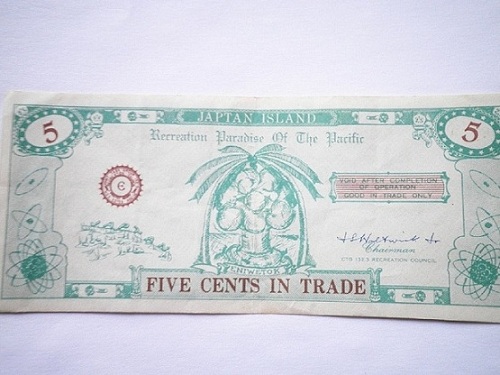
All the designs were the same except for a color
change between the values. There was a palm tree with
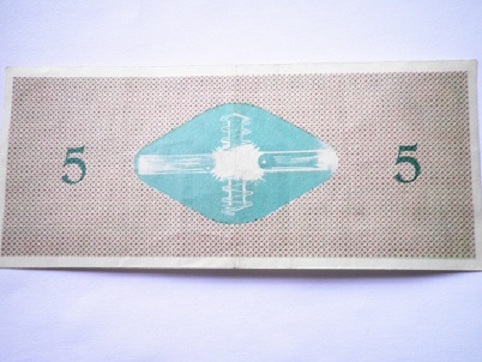
coconuts on the face, and a picture of two nuclear
particles bombarding the core of the explosive on the
back. The major color of the notes was green with
brown, blue, pink, green and black used respectively
on the five values.
Japtan Island was the Rest and Recuperation (R &
R) Area for the Nuclear Tests conducted on Eniwetok.
Since most of the sailors were at sea most of the time
during the tests, and there were no are & are towns in the
vicinity, Japtan Island filled that void. There was a
bar, a swimming beach, and a shipwreck on Japtan
Island. Notice I didn't include any girls, maybe a
few natives, like Bloody Mary from South Pacific.
With no women for entertainment, fights frequently
broke out between the various crews and most sailors
felt they didn't have a good time unless they went
back to their ships with at least a few cuts and
bruises on their bodies.
Japtan is a small island in the same chain of
islands as Eniwetok Atoll. Both are in the Ralik
Chain of the Marshall Islands. After World War II,
this area was designated as the site for atomic tests
from 1947 to 1962. Since there was a 15-year period
there, I tried to determine when the notes were
issued.
You will notice that there is a seal on the left
side of the face of each note. It says that the notes
were printed on board the USS Estes.and that the Joint
Task Group was 132.3. If this was like the Bikini
Tests, the point 3 indicated the Naval Support ships
for the operation. The commander for this operation
was RADM C.W. Wilkins, CTG (Commander Task Group?)
132.3. His flagship was the USS Curtiss and the test
sequence was known as operation IVY. The ship arrived
at Eniwetok on 12 October 1952 and participated in
several tests thru June of 1953. Included was the
first thermonuclear device detonated. The USS Estes
was also part of the Task Group during these months.
So this appears to be when these notes were printed.
The right hand side of the face of the note has a
statement that says "Void after completion of
operation. Good in trade only". Theoretically, the
notes should have been voided around the middle of
1953.
This however doesn't explain the overprint listed
in World War II Remembered for the USS Batroko. I
have searched for a ship by the name Batroko, but was
never able to find one with that name. I did however
find the USS Bairoko, which was an escort aircraft
carrier. The Bairoko though was involved in the
Korean war until August of 1953, therefore could not
have been associated with operation IVY. Further
research uncovered that USS Estes and Curtiss returned
to Eniwetok in early 1954 along with the USS Bairoko
as JTG 7.3 for a series of high yield thermonuclear
weapon tests known as operation CASTLE. In this case
the Estes was the flagship and the firing station for
the tests. The Bravo test under CASTLE was to have a
predicted yield of 6 megatons but actually yielded 15
megatons. This was the most ever exploded in the
atmosphere by the USA and was the worst incident of
fallout exposure in the entire series of atmospheric
tests. Fallout was scattered over 7000 square miles
of ocean and radiation burns were experienced by a
number of participants. The USS Bairoko had 16 of her
crew that developed small skin lesions.
World War II Remembered lists the USS Batroko
(sic) overprint as a simple souvenir. I would like to
offer that it may have been a validation stamp to
continue use of the notes at Japtan Recreation Area
for JTG 7 during operation CASTLE. What do you
think?"
Mike
"...So, lets look at that series of
notes issued for Japtan Island Recreation Area. If you
are not familiar with the notes, there is a picture of
one on page 427 of your World War II Remembered. They
were issued in values of 5c, 10c, 25c, 50c, and $1.
All the designs were the same except for a color
change between the values. There was a palm tree with
coconuts on the face, and a picture of two nuclear
particles bombarding the core of the explosive on the
back. The major color of the notes was green with
brown, blue, pink, green and black used respectively
on the five values.
Japtan Island was the Rest and Recuperation (R &
R) Area for the Nuclear Tests conducted on Eniwetok.
Since most of the sailors were at sea most of the time
during the tests, and there were no are & are towns in the
vicinity, Japtan Island filled that void. There was a
bar, a swimming beach, and a shipwreck on Japtan
Island. Notice I didn't include any girls, maybe a
few natives, like Bloody Mary from South Pacific.
With no women for entertainment, fights frequently
broke out between the various crews and most sailors
felt they didn't have a good time unless they went
back to their ships with at least a few cuts and
bruises on their bodies.
Japtan is a small island in the same chain of
islands as Eniwetok Atoll. Both are in the Ralik
Chain of the Marshall Islands. After World War II,
this area was designated as the site for atomic tests
from 1947 to 1962. Since there was a 15-year period
there, I tried to determine when the notes were
issued.
You will notice that there is a seal on the left
side of the face of each note. It says that the notes
were printed on board the USS Estes.and that the Joint
Task Group was 132.3. If this was like the Bikini
Tests, the point 3 indicated the Naval Support ships
for the operation. The commander for this operation
was RADM C.W. Wilkins, CTG (Commander Task Group?)
132.3. His flagship was the USS Curtiss and the test
sequence was known as operation IVY. The ship arrived
at Eniwetok on 12 October 1952 and participated in
several tests thru June of 1953. Included was the
first thermonuclear device detonated. The USS Estes
was also part of the Task Group during these months.
So this appears to be when these notes were printed.
The right hand side of the face of the note has a
statement that says "Void after completion of
operation. Good in trade only". Theoretically, the
notes should have been voided around the middle of
1953.
This however doesn't explain the overprint listed
in World War II Remembered for the USS Batroko. I
have searched for a ship by the name Batroko, but was
never able to find one with that name. I did however
find the USS Bairoko, which was an escort aircraft
carrier. The Bairoko though was involved in the
Korean war until August of 1953, therefore could not
have been associated with operation IVY. Further
research uncovered that USS Estes and Curtiss returned
to Eniwetok in early 1954 along with the USS Bairoko
as JTG 7.3 for a series of high yield thermonuclear
weapon tests known as operation CASTLE. In this case
the Estes was the flagship and the firing station for
the tests. The Bravo test under CASTLE was to have a
predicted yield of 6 megatons but actually yielded 15
megatons. This was the most ever exploded in the
atmosphere by the USA and was the worst incident of
fallout exposure in the entire series of atmospheric
tests. Fallout was scattered over 7000 square miles
of ocean and radiation burns were experienced by a
number of participants. The USS Bairoko had 16 of her
crew that developed small skin lesions.
World War II Remembered lists the USS Batroko
(sic) overprint as a simple souvenir. I would like to
offer that it may have been a validation stamp to
continue use of the notes at Japtan Recreation Area
for JTG 7 during operation CASTLE. What do you
think?"
Mike


