| Author |
 Replies: 47 / Views: 7,129 Replies: 47 / Views: 7,129 |
|
Pillar of the Community
United States
509 Posts |
Quote:
rmpsrpms Quote:
I've found an acceptable compromise to get both good overall lighting, color and some luster is to use a total of 3 lights: If I have time I'll take some comparative pics...Ray
I've been fiddle-faddling around with this and still haven't come up with anything to write home about. Maybe my expectations are unrealistic. I'd be very much interested in seeing some of your efforts along these lines (or anyone else's). It's the luster I'm really concerned about. Not toooo much trouble with color, comparatively speaking. Any thoughts on reflectors such as a small mirror? Proceeding on to the outlandish, what about stacking? Probably not worth the time and effort. No guarantee of positive results. Just thinking it might work for someone who knew what they were about. That's certainly not me.
|
|
|
|
Moderator
 United States
23522 Posts |
Stacking isn't relevant - that's the solution for insufficient depth of field. I've never had any real problems capturing luster - indeed, my problem has been getting too much of it - with the small MR16 bulbs I use. 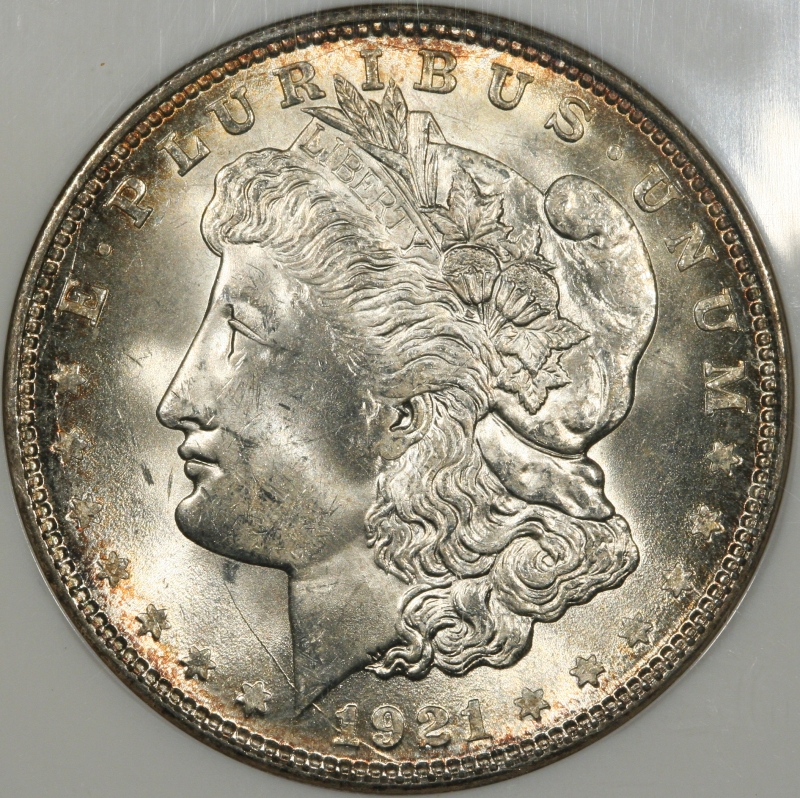 |
|
Pillar of the Community
 United States
509 Posts |
Lotsa nice luster shows up in that one SD. Thanks. I should have been more specific in my post. I was talking about the blast white "headlight" coins that will poke your eye out in broad sunlight. This is the kind of luster photo I'm trying to get: http://img146.imageshack.us/img146/...09syymos.jpgYes, I know, stirling silver is not the same surface but it is silver and is also highly reflective. Just apples and oranges? Not possible? |
|
Moderator
United States
23522 Posts |
It's been my experience that the closer you can come to a pinpoint light source, the better time you'll have developing the luster in a coin. Check out the pic you posted - the only way you can "see" the brilliant luster is because there's a comparison area on the same piece which doesn't show that luster. So, the closer you can come to illuminating only portions of a coin's fields, the better it'll show that contrast which implies "luster." That's much easier with the smallest-possible light source, at least for me.
|
|
Pillar of the Community
United States
509 Posts |
Quote:
closer you can come to a pinpoint light source, the better time you'll have developing the luster in a coin Now that seems to make a lot of sense and bring it together a bit. And I do see what you mean about the "implication" of luster after looking at the photo again. It's the lighting contrasts in the fields provided by the pinpoint light. I've never seen that concept talked about before. Seems so simple now but still awaits to be done! A nice challenge and one I'm looking forward to. Now, to find that pinpoint light source. Thanks SD. I'm off to the races with new heart. |
|
Pillar of the Community
United States
4051 Posts |
Quote:
Any thoughts on reflectors such as a small mirror? Proceeding on to the outlandish, what about stacking? Probably not worth the time and effort. No guarantee of positive results. Just thinking it might work for someone who knew what they were about. That's certainly not me. The 3 sources I've had luck with are: diffused at 10:00 and 2:00, and pinpoint at anywhere from 7:00 to 5:00 depending on where I want the luster to show up. In these positions the luster shows up nicely in fields both left and right of the main devices. Mirrors are a method of diffusing the source. I've had some luck with this using aluminum foil sheets but it's not my mainstream approach. They greatly complicate the illumination and create a "look" all their own. The LED lights I've been promoting are highly pinpoint in nature and do almost too good a job at bringing out luster. One of those in addition to your regular lighting can help amplify the luster element. And while SuperDave is right that stacking per se is not useful for your purposes, CombineZP has a nice algorithm called "Do Average" which will in essence merge multiple shots together. I had some luck with taking a "pure" luster shot that was not useful on its own, and a "pure color" shot that again was not useful on its own, and merging them with CZP. The only issue is if you have an ethical issue with creating an image that is not an actual photo of the coin, but a "collage" or effectively a multiple exposure. It also doesn't fulfill your original goal of a single shot to give both luster and color. Some folks have a big issue with this sort of thing, although in reality it is the same concept as focus stacking multiple images but with lighting instead of focus. |
|
Valued Member
United States
262 Posts |
SuperDave, instead of using the traditional halogen MR16 in 2700K color, get a replcement LED MR16 3000K. It surely will softened things up for you.
|
|
Pillar of the Community
United States
4051 Posts |
Quote:
It's been my experience that the closer you can come to a pinpoint light source, the better time you'll have developing the luster in a coin. ...the closer you can come to illuminating only portions of a coin's fields, the better it'll show that contrast which implies "luster." That's much easier with the smallest-possible light source, at least for me. I like to think of luster as "specular" in nature. Luster is created by high contrast between the tiny areas that reflect light directly from the source to the sensor and the rest of the coin. Luster is actually a bunch of little mirrors that do this. Only a small part of the surface of the field shows this, while the rest of the field shows more diffuse reflection rather than direct. Smaller sources, such as the LED or a halogen at a far distance from the coin, shine brightly off the "luster mirrors" and thus enhance the contrast with rest of coin. The trick is to combine some amount of this with enough diffuse lighting at a high angle to show the color of the coin as well, and (insert dozens of hours of trial and error here) you're set! |
|
Moderator
United States
23522 Posts |
Quote:
SuperDave, instead of using the traditional halogen MR16 in 2700K color, get a replcement LED MR16 3000K. It surely will softened things up for you. I use 5000k Halogen spots (as opposed to floods) for the 15-degree convergence angle. Color Temperature isn't relevant; you can compensate for that in-camera, or in post. You can't compensate for the width of the beam. |
|
Valued Member
United States
262 Posts |
Color temperature surely is relevant, taking a picture with a 6500K vs a 2700K will make a HUGE difference in appearance. I do agree with you that beam spread is highly important though.
|
|
Rest in Peace
United States
9104 Posts |
Quote:
Now, to find that pinpoint light source. Mal-Wart, halogen desk lamps, under $10. |
|
Pillar of the Community
United States
4051 Posts |
The Jansjo LEDs that I use are also a very pinpoint source and are on sale at IKEA (in store only) for $9.99. Nice thing about them vs halogens is they run very cool. http://www.ikea.com/us/en/catalog/p...ts/10128734#The subject of color temperature is very interesting. I've been working under the assumption that if you do a white balance with each lighting setup that you can compensate the image appearance over a wide range of color temperatures. So far this seems to be the case, but I've never looked into the subtleties of the compensation, range that can be compensated, etc. Anyone know this? How well-compensated are the images? Do all cameras (at least the ones that can WB at all) have similar abilities? |
|
Moderator
United States
23522 Posts |
Quote:
Color temperature surely is relevant, taking a picture with a 6500K vs a 2700K will make a HUGE difference in appearance. I do agree with you that beam spread is highly important though.
Only if you don't correct for White Balance, which is a standard part of every imaging session. |
|
Bedrock of the Community
United States
14454 Posts |
I am having a real hard time photographing DMPL coins like the VAM-85 with the T1i. The JVC took fantastic shots of proof and DMPL coins but I can't seem to get them right with the canon T1i. Anyone have any steps that may help me with these while also helping the original OP's question, if not I will start my own thread. Just remember I am a camera noob so will basically need someone to hold my hand through the steps because I even had to look up what stacking meant
|
|
Pillar of the Community
United States
509 Posts |
I'm a newbier than you are Bryan and I hesitate giving anyone advice until my right hand knows what the left hand is doing. Don't wanta lead anyone astray. I suspect your problems with the DMPL/Proofs are very similar to mine with the blast whites which are still running me around in circles. I am kina surprised though as some of those shots you've posted since your put on your 100mm lens have looked really good. I assume they were PL as opposed to proof/dmpl.
|
|
Pillar of the Community
United States
509 Posts |
Tried diffusing, refusing, reusing, defractions, infractions, refractions, reflections, deflections, genuflections, tin foil and a mirror on this blast white. One lamp, two lamps, and three. Even tried color stacking. This is my best effort and I got it using my original set-up, one compact fluorescent at 12 noon. It does show some of the luster but not what I was looking for. No post except for sizing.  Bought a spot halogen but obviously it didn't mix well with my fluorescents. Wish I could get some of those Jasco's but the nearest outlet that has em is about 40 miles up the road. Well guess I don't feel toooo bad. Ray mentioned having to throw in a few dozen hours on the lighting. I only put in six. |
| |
Replies: 47 / Views: 7,129 |










 Posted 06/12/2011 5:57 pm


