| Author |
 Replies: 10 / Views: 1,092 Replies: 10 / Views: 1,092 |
|
|
Valued Member
United States
77 Posts |
I need some education on the exact process used to make coins today. I have some error coins and when asking about them, I see lots of terms like collar, dies etc that I can imagine, but have never seen. What I would like is kind of like an operators manual showing drawings of the machine and the parts involved labeled.
I've watched the US Mint videos of production, but it does not show the details for the parts of the actual production. So many here are using the terms for the machine parts that I am ignorant of.
I looked at the titles to the sub forums and didn't see any dedicated to my question. I searched, How are coins made? and came up blank.
Can anyone point me in the right direction?
Edited by jerrytheplater
08/11/2025 3:18 pm
|
|
|
|
Moderator
 United States
105745 Posts |
 to CCF. There are lots of videos abound - I'm sure that someone will come along with a few links for you. |
|
Valued Member
 United States
77 Posts |
Dearborn, I did some searching and came up with 3 Chinese companies making Coining machines. They did not detail how to operate the machines. I'd really like to see how the collar fits around the dies and how it works at 800 coins per minute.
Pretty sad the Chinese came up first and not any American manufacturers.
Edited by jerrytheplater
08/11/2025 9:22 pm
|
|
Pillar of the Community
Australia
3841 Posts |
There's plenty of videos on youtube. Give it a go.
|
|
Valued Member
United States
77 Posts |
I started searching on YouTube and watched a few. So far, have not found what I wanted. I did see one that looked like "the ring" was in four pieces. Not sure if that was it as the video didn't ID it either verbally or with a label. I did see a die being engraved. Not sure if they are mounted/fixtured so that no alignment at all needs to be done when changing dies.
|
|
Moderator
Australia
16967 Posts |
This website has some illustrations of a coin press with the various parts labeled, as well as illustrating how some of the typical die alignment errors are made: https://minterrornews.com/features-...sk-dave.htmlThe illustrations show an older, slower coin press, but the basic function of a modern high-speed coin press is essentially the same; a modern press is typically vertical rather than horizontal, to allow gravity to do a lot of the work in feeding blanks and ejecting coins. But the process is essentially the same. Dies are large, heavy steel blocks or cylinders with the design of one side of the coin stamped into one end of them. This stamping happens using a hub, which is essentially a die but mirror-reversed so that the design looks like a normal coin, except it's stuck on the end of a steel cylinder. Hubs are in turn made from master dies. This convoluted die-making process ensures that each die is the exact same design, all copies from the original. Obverse and reverse dies are designed differently, since one (the reverse or hammer die) tends to move much more than the other, this one is usually lighter and smaller. The obverse die moves much less, and is typically larger and heavier. It is thus impossible to "accidentally" get the two mixed up to make double-headed or double-tailed coins - it's literally a square-peg-round-hole problem. Dies also usually have some kind of locking pin to make sure they are inserted into the press "the right way up". Collar dies are usually in a single piece, essentially a giant ring of hardened steel with the edge design (if any) cut into the inner circle. If collar dies were modular, then there would be a lot more "missing collar piece" errors than we actually see. A lot of the specialized design and mechanisms of high speed presses in the various mints around the world are trade secrets for those mints, so it may be difficult to find detailed schematics online. The schematics you can find available are the commercially available presses, which usually aren't quite the high-speed devices used in a mass-production mint. Don't say "infinitely" when you mean "very"; otherwise, you'll have no word left when you want to talk about something really infinite. - C. S. Lewis
|
|
Bedrock of the Community
Canada
21865 Posts |
Not sure if this helps or not but here are a couple of photos of some of the main parts Reeded Collar for 10 cent coins  Feeder Finger for inserting and ejecting coins from striking chamber 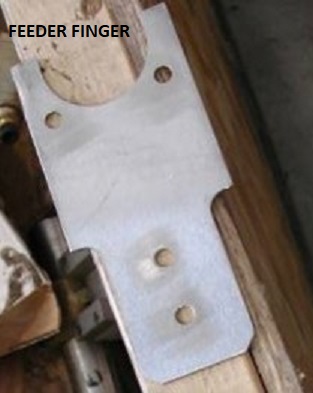 Here is a simplified version of how coins are struck. Courtesy of our late member Crazyb0 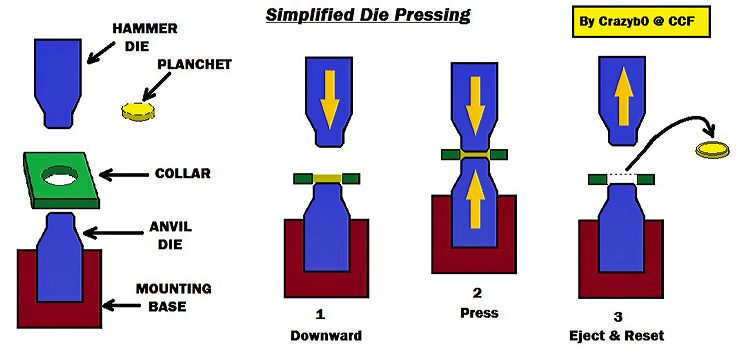 Edited by JimmyD
08/13/2025 12:22 pm
|
|
Valued Member
United States
77 Posts |
Thanks to Sap and JimmyD for your posts. That diagram and the photos helped tremendously. Now I see that the collar is actually a third part of the coin making process, not just the obverse and reverse dies. I greatly suspected if the collar were 4 pieces, you'd see the gaps where the pieces meet. See about Turk's Heads below. https://www.fenn-torin.com/metal-fo.../turks-heads My last job was at a non ferrous (copper, beryllium copper, brass, bronze, nickel, nickel silver) wire redraw and rolling mill. We would make square and flat wire from round wire by rolling it in a Turk's Head machine. A Turk's Head has four rolls that can be adjusted to make whatever size is needed. The rolls contact each other so that there is no gap in them. Wire has to be sized correctly to fill the hole in the rolls. If the wire is too big, it will force its way out and cause a fin on the edge of the wire, or crack the carbide rolls. If too small, the corner radius of the square wire will be too big. This flowing of the metal is exactly what is happening in the dies as a coin is produced. |
|
Bedrock of the Community
Canada
21865 Posts |
Correct, there are 3 dies involved in producing a coin. You can also get a Rim Fin on a coin if the planchet and dies are not aligned properly allowing the metal to squeeze through the gap. |
|
Valued Member
United States
77 Posts |
JimmyD, I can understand fins exactly. Thanks for that link. I would never have thought of a fin on a coin though.
|
|
Bedrock of the Community
United States
17884 Posts |
Quote:
a modern press is typically vertical rather than horizontal, to allow gravity to do a lot of the work in feeding blanks and ejecting coins. Other way around, older presses struck vertically, modern presses strike horizontally. Quote:
I greatly suspected if the collar were 4 pieces, you'd see the gaps where the pieces meet. Segmented collars DO show a raised fin at the point where the segments come together. They can be seen on the proof President, NA, and innovation dollars, and on the Saint-Gaudens eagles and double eagles. Tried to find an image but was unable to. I have a good understanding of how a vertical strike press works, but I really don't understand how a horizontal press works.I can't see how you can get the planchet to "fall sideways" into the collar. Unfortunately all videos I have seen of such a press in action have had all their safety guards and sound deadening guards in place. You can't see the internal workings and operating at 13 cycles per second what little you see is a blur. Edited by Conder101
08/21/2025 3:52 pm
|
| |
Replies: 10 / Views: 1,092 |
|










 Posted 08/11/2025 9:21 pm


