











 Posted Today 7H 53M ago


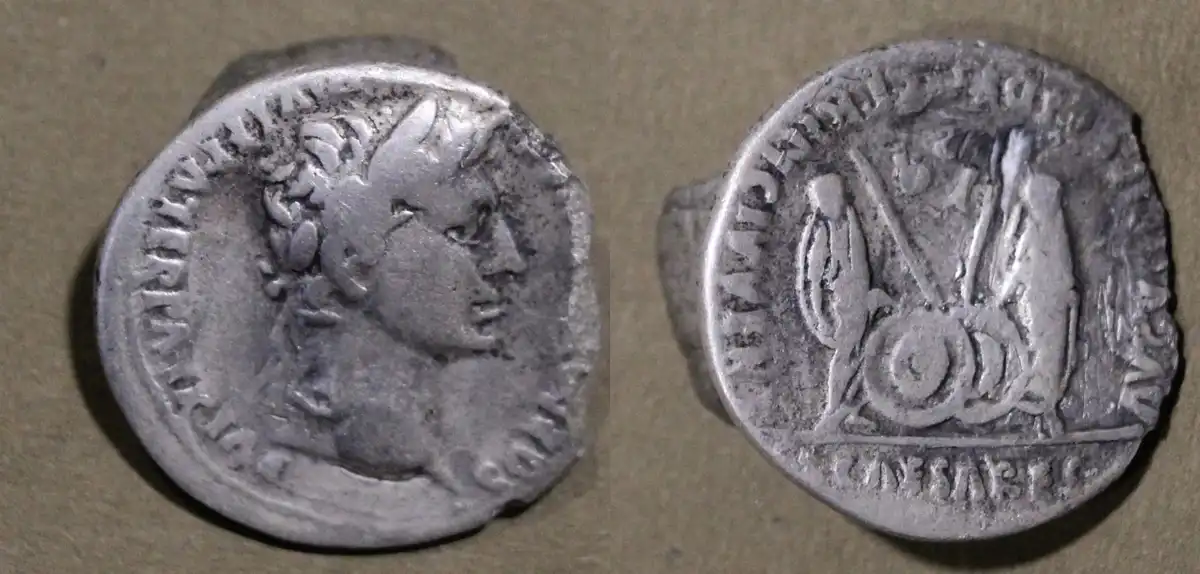
The coin has had a piece broken off due to silver crystallization embrittlement.
I'm seeing scratches on the reverse, to the right of the central design. I would tend to presume that this, plus the piece missing, is evidence that two coins fused together while buried underground; the person who dug them up attempted to prise them apart with some kind of sharp tool (causing the scratches), but ended up causing a piece of this coin to break off entirely. I suppose the damage could also be explainable by the coin being soldered to another coin and likewise broken off.
It is unfortunate that most of the emperor's name "Augustus" was on the missing piece; though the coin is still easily recognizable as an Augustus denarius, the missing name means this coin will not attain the same premium as one where the emperor's name is clearly present and readable. "One from every emperor" collectors like to be able to read the names.
I'm seeing scratches on the reverse, to the right of the central design. I would tend to presume that this, plus the piece missing, is evidence that two coins fused together while buried underground; the person who dug them up attempted to prise them apart with some kind of sharp tool (causing the scratches), but ended up causing a piece of this coin to break off entirely. I suppose the damage could also be explainable by the coin being soldered to another coin and likewise broken off.
It is unfortunate that most of the emperor's name "Augustus" was on the missing piece; though the coin is still easily recognizable as an Augustus denarius, the missing name means this coin will not attain the same premium as one where the emperor's name is clearly present and readable. "One from every emperor" collectors like to be able to read the names.
Don't say "infinitely" when you mean "very"; otherwise, you'll have no word left when you want to talk about something really infinite. - C. S. Lewis


