| Author |
 Replies: 12 / Views: 256 Replies: 12 / Views: 256 |
|
|
Valued Member
Canada
177 Posts |
I've had this awhile and before I knew much about errors I thought it was worth getting back then. I've come to learn that printed fold errors are pretty common. Also the H4 plate position is consistent with the error. As I was looking it over today I noticed some ink ghosting (probably the wrong phrase) on the reverse. Could someone educate me as to how this happens? I'm guessing it's not uncommon. Is it worth keeping or would a bank just take this back and give me my $100 back? Also, should I modify the image to mark it as a specimen or something to avoid any issues with currency reproduction? Thanks for looking. 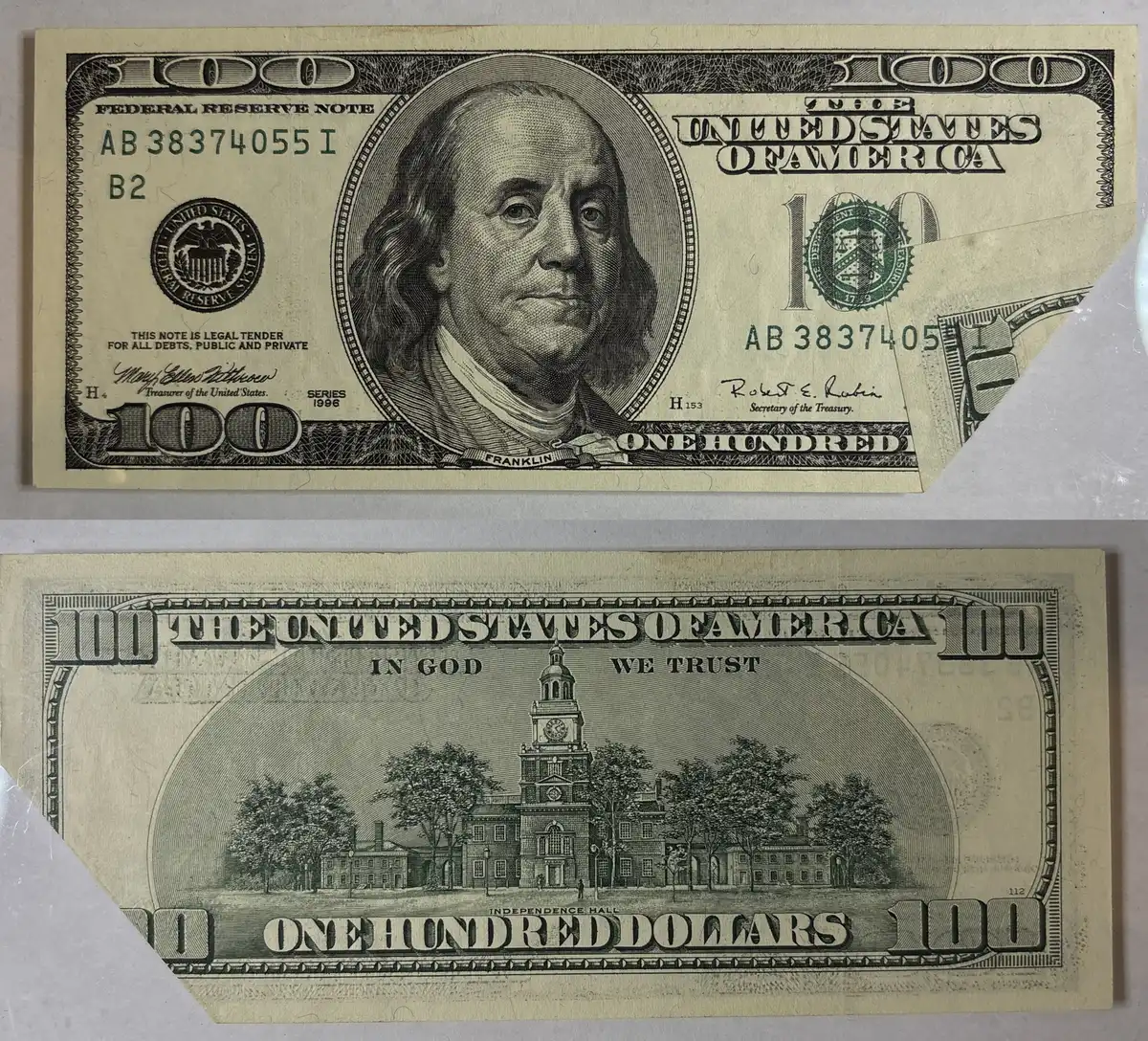 |
|
|
|
Pillar of the Community
United States
2880 Posts |
I don't know much about printed fold errors, but I would assume they are uncommon and would demand a premium. Keeper for sure, nice find.  |
|
Moderator
 United States
191802 Posts |
Nice example! |
|
Pillar of the Community
United States
602 Posts |
I know almost nothing about paper money, but a little bit about printing.
Apparently, the reverse was printed before the obverse, and the folding happened between.
Interesting.
EDIT: Just noticed the 100 over the Seal must've been printed before the folding, too. Hmmm. I'm in over my head.
Edited by Vector Ze
Yesterday 5:33 pm
|
|
Valued Member
 Canada
177 Posts |
Thanks all for taking a look. A couple additional comments.
The printing of this series of notes I believe used what are called 32 subject sheets, that is 32 notes per sheet. The sheets are organized in four quadrants of 8 notes each A1-H1, A2-H2 and so on. The note designated H4 is positioned at the lower right corner of the sheet. Also, I believe that things like the serial numbers and seal are printed later in the process and in this case were printed after the fold occurred.
When I say that printed fold errors are common I mean that they are a more common type of error not that errors themselves are common. At least that is what I've read.
How the "ghosting" happened is a mystery to me. I'm hoping someone more familiar with the whole process will have an idea.
|
|
Pillar of the Community
United States
602 Posts |
In regular printing, 'ghosting' can occur several ways.
One is by applying ink too heavily and leading to bleed-through.
But, more often it is the result of freshly printed sheets, not sufficiently dried, being pressed together.
How that applies to Federal Reserve Notes, I have no clue.
|
|
Bedrock of the Community
Canada
21717 Posts |
That is known as an offset. It occurs when the ink is not completely
dry when the sheets are stacked during printing.
lahave56 is correct when he said the number and seal was printed
after the sheet had folded. These are printed on a second press
after the initial printing of the design.
Do not take this to the bank, there is a premium for such an error.
|
|
Pillar of the Community
United States
7328 Posts |
Your note has a premium over face. Considering the value I would recommend you get this graded, I see 4 folds and a stain so this maybe EF40 or VF35 no EPQ but it should get about $300-$400. I don't collect error notes so the value is just a guess based on ebay sells. |
|
Valued Member
Canada
177 Posts |
Thanks @Vector Ze, @JimmyD and @hfjacinto @hfjacinto I tried to identify the 4 folds and stain you mentioned in the image below. I only found 3 possibles for the folds (circled in red) and the stain (circled in blue). Could you confirm these are what you are referring to and maybe point out fold #4? I've also been puzzling over the way the fold terminates to the side as highlighted by the purple bubble. I have not tried to unfold it but it seems like if I did that edge of the note would not run straight which would imply a very odd cut on that edge. Can anyone tell me if I'm missing something obvious? Thanks 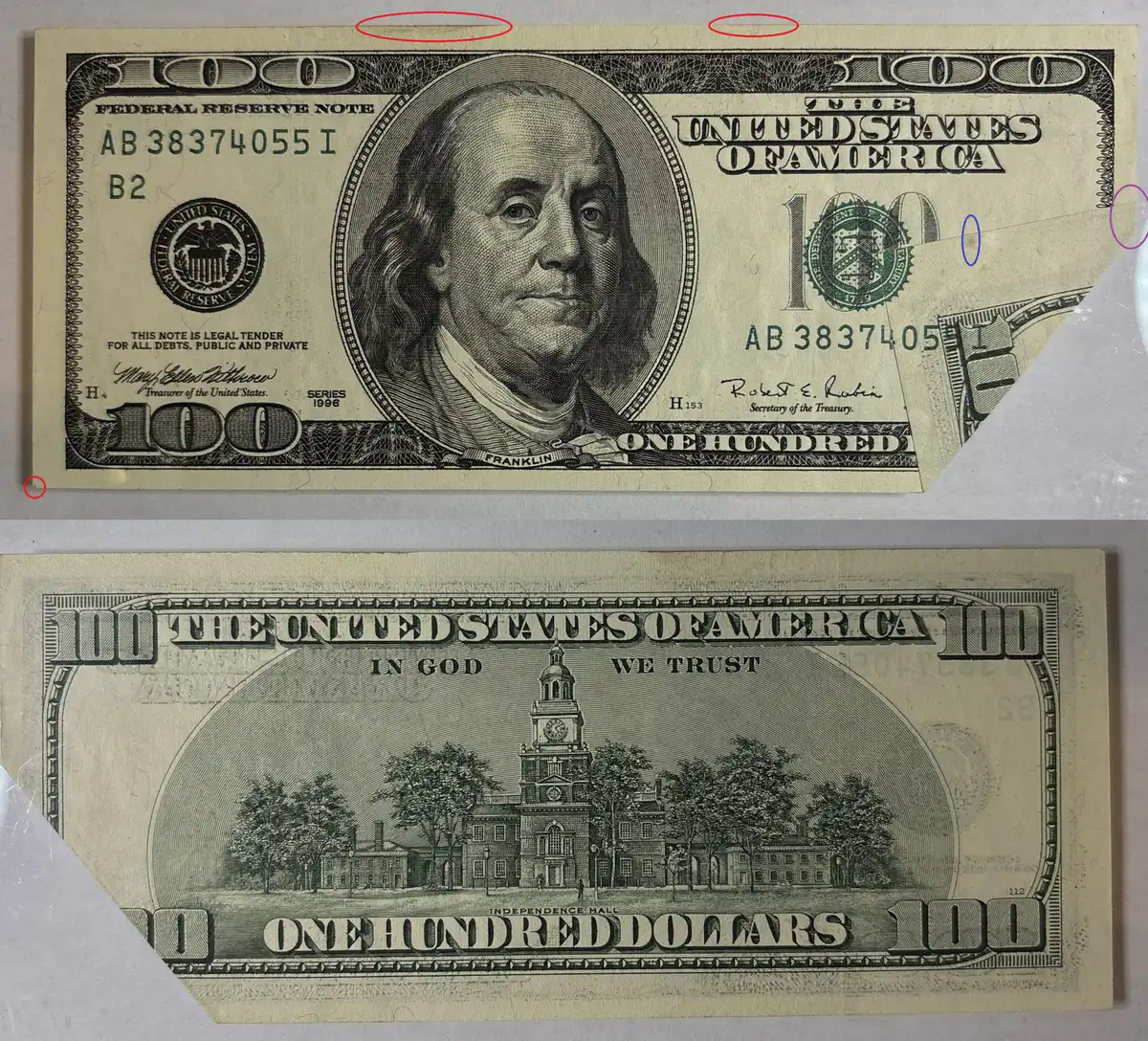 |
|
Pillar of the Community
United States
602 Posts |
Yes, if you were to unfold it, you would see an irregularity on the trim.
That's what happens when a sheet is trimmed after it is folded.
Note: I am far from an expert on US Notes, just offering what I know from 25 years in the printing industry. You've got a little extra paper there that wasn't trimmed off.
Edited by Vector Ze
Today 1H 32M ago
|
|
Valued Member
Canada
177 Posts |
I feel like Homer Simpson Doh! That makes perfect sense @Vector Ze thanks!
|
|
Valued Member
Canada
177 Posts |
Another thought about the fold before the cut....
Since we don't see the same irregularity on the bottom of the note then either the bottom was trimmed before the fold or since it is the bottom of the sheet this area is not trimmed at all.
|
|
Bedrock of the Community
Canada
21717 Posts |
Correct, as it is the bottom of the sheet, it would not be trimmed.
The fold must have occured after the second printing of the obverse and before
the third printing of the seal and numbers. This would account for the extra paper
that was not trimmed.
|
| |
Replies: 12 / Views: 256 |
|






 Posted Yesterday 4:16 pm





