| Author |
 Replies: 19 / Views: 3,910 Replies: 19 / Views: 3,910 |
|
New Member
United States
7 Posts |
Hi, appears to be a die error, it reads, plainly: doollar
the second O has a faint L struck over it, and the first L is double-struck, and then the second L is single-struck.
does anyone have information on this type of error? the front of the coin is worn and looks like it had an old cleaning, or was on a belt buckle or something... the rear is in much better condition and has evidence of an old mount. I'm not so much interested in the condition of the coin as I am interested in the die error on the lettering.
Any thoughts? Does it add or subtract value?
Thank you for reading! Edited by sobelife
10/31/2011 3:49 pm
|
|
|
|
New Member
 United States
7 Posts |
See below image: D O O L L A R 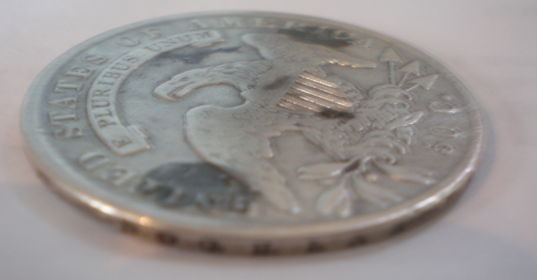 |
|
Pillar of the Community
United States
1388 Posts |
Hard to tell with the pics, we probably need better pics... As far as I know, the mint knew how to spell back then  ... I was thinking maybe a die clash, which is common among bust halves, but the spacing would have been normal between the letters... Could also be a counterfeit as well... This one has got me boggled...  |
|
Pillar of the Community
United States
1388 Posts |
And by the way,  to the community... |
|
Pillar of the Community
United States
2596 Posts |
could you post pictures of the obv and rev?
|
|
Pillar of the Community
United States
2596 Posts |
This sounds like an edge die malfunction and because its not so bold of an error I cant really see you getting much more for the coin unless you sent it in to get graded and attributed by a TPG. Please post heads and tails pics... there are a few varities for this date. |
|
New Member
United States
7 Posts |
Photos, I paid $24 for it. Front has been cleaned and is worn, back has nice details but has marks from old mount. I thought the old side lettering was hand done... was it literally by hand, or were the dies set and then the coins were laid in one at a time and struck? 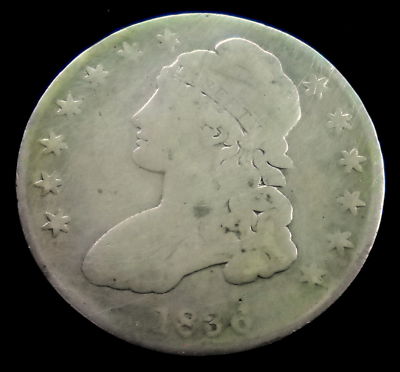 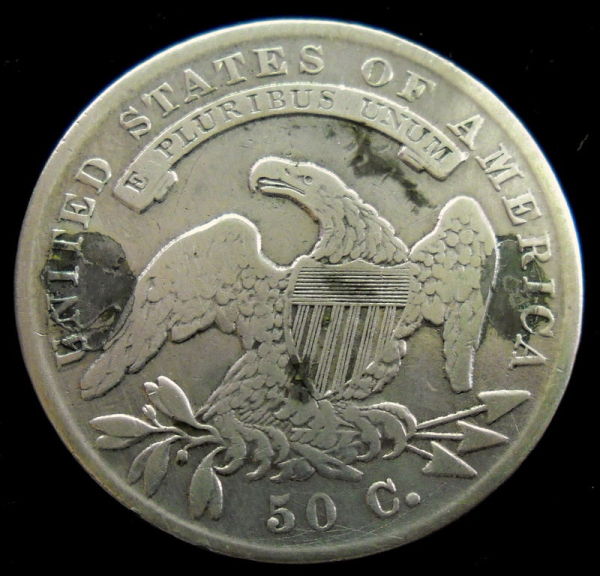 |
|
Pillar of the Community
United States
2596 Posts |
they used edge dies. one type of edge die is a pair of rectangular dies with half of the inscription on each die. The planchet was rolled 180 degrees between dies-one fixed die and the other slides. then there was the slotted die with the design impressed into it and the planchet was rolled to impress the inscription. there was segmented dies that pressed the inscription into the planchet. They also used a circular metal band with the inscription on it placed in the collar around the planchet before it was struck.
|
|
Pillar of the Community
United States
2596 Posts |
you got a good deal by the way I think any bust half is a nice coin
|
|
New Member
United States
7 Posts |
Thanks. No doubling on the 1 as far as I can see. I'm new to coins (again). I collected as a kid, then sold some of my favorites about 10 years ago (including an 1833 half dollar) because I wasn't into collecting anymore. I realized recently when I was looking at what I had left that I still enjoyoed them, and selling them had seemed somewhat pointless, financially, so I decided to spend a little and replace what I sold. 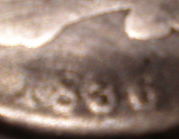 |
|
Moderator
 United States
23522 Posts |
There's a whole lot of opportunity on the Bust Half minting process to create mistakes like your coin shows; they're not uncommon. I'm not home with my Overton and can't offer an opinion of variety, but I'll have a look in the morning.
|
|
Bedrock of the Community
United States
17884 Posts |
Examine the edge closely for any other traces of other letters. I can't see how such a doubling of a letter in the middle of a word could occur with the edge dies they used. One edge die said HALF A DOLLAR and the other said FIFTY CENTS OR. Typically the edge errors are caused by the the edge dies not being in the proper place when the planchet was cranked through. This would result in an overlapping to some degree of the beginning and endings of the inscriptions found on the dies. Or sometimes a coin would be started, backed up, and then restarted and this could result in doubling of the beginning or ending of one die inscription or the other But not doubling of a letter in the middle of a word in the middle of the die.
|
|
New Member
United States
7 Posts |
I didn't realize this, there's another error.
As I read around the edge of the entire coin it reads:
FIFTY CENTS... clearly... then there are very faint fine close shallow ridges... then it reads FIFTY (again) but where the Y is it is partially overstruck with the H for HALF A DOOLLAR, so it reads all together:
FIFTY CENTS |||| FIFTYHALF A DOOLLAR ||||
In between all the words the ridges are very faint, but it looks like vertical lines are ridges but it doesn't continue up to the surface of the coin, like a normally ridged coin, it's a faint strike, similar to the size of the lettering, more of a design than a true ridge.
|
|
New Member
United States
7 Posts |
I took a better photo and can see now what they did.... It looks like they started to stamp it D O L L A and then stopped and restruck it and the second time the D struck over the O, so it looks like it reads D O O L L A R. or looked at another way it reads D D O L L A R. Photos of all letters below: 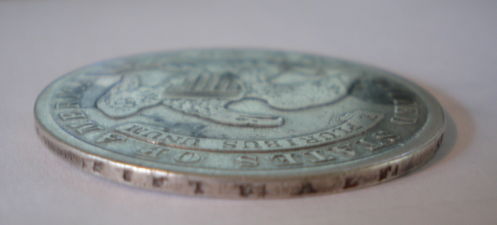 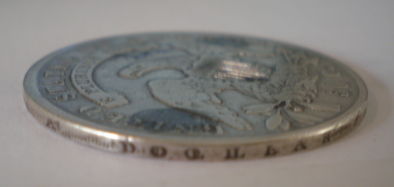 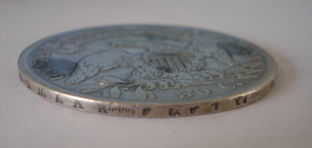 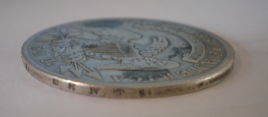 |
|
Pillar of the Community
United States
2596 Posts |
it almost looks like it was struck twice overlapping.
|
|
New Member
United States
7 Posts |
yeah, gives it character I guess ;)
|
| |
Replies: 19 / Views: 3,910 |










 Posted 10/31/2011 7:47 pm


