| Author |
 Replies: 51 / Views: 16,135 Replies: 51 / Views: 16,135 |
|
|
|
Pillar of the Community
United States
5362 Posts |
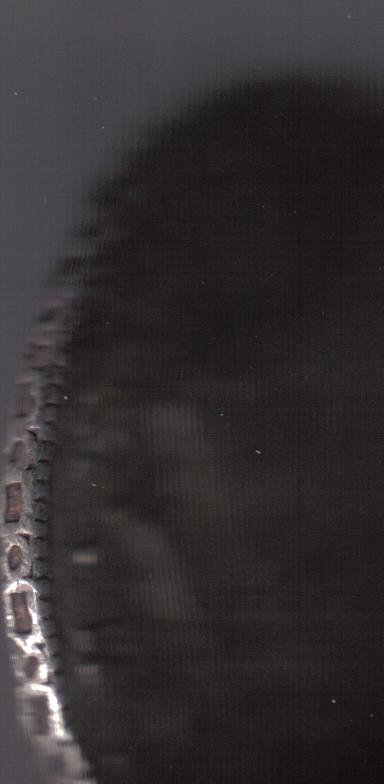
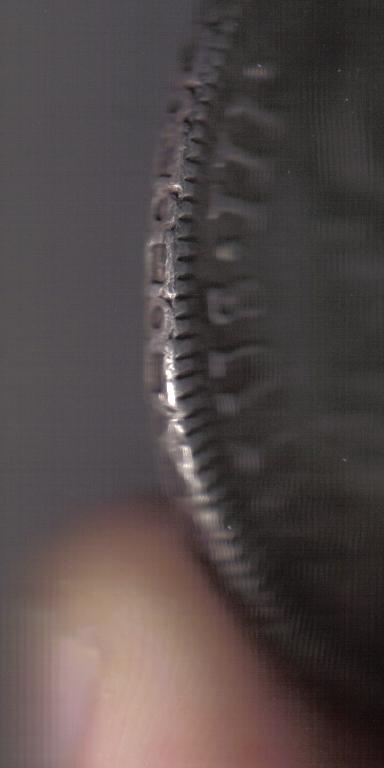
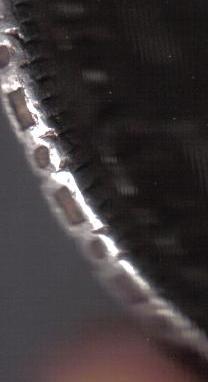
MathieuMa All edges have 2 overlaps - one overlap is a counterfeit unless damage or wear prevents identification of the opposite lap. The application method precludes anything else. Here is a picture I posted earlier. The mechanism was essentially identical in its physical operation from 1732 until 1897 even though it was modernized and powered mechanically. But the results are the same.  The edge design is most visible in the dentils on pieces where the coin is edged off center. If this happens after the coin is struck the dentils will be "displaced" with metal being pushed away from the edge by the edger - these small displacements often look like simple edge knocks but they were caused by the action of the edger. The GAPS created in the dentils by the edge application will BE SHARP SIDED and uniform. The reverse is true if the edge is applied first. An eccentric LOTUS edge will still of course show gaps in an off center edging BUT the key point is that the dentils will be straight and any metal displacement will be INTO the gaps. The grinding of the corners to hide evidence typically occurs on CAST coins with REEDED edges applied by ring dies. AS illustrated here. 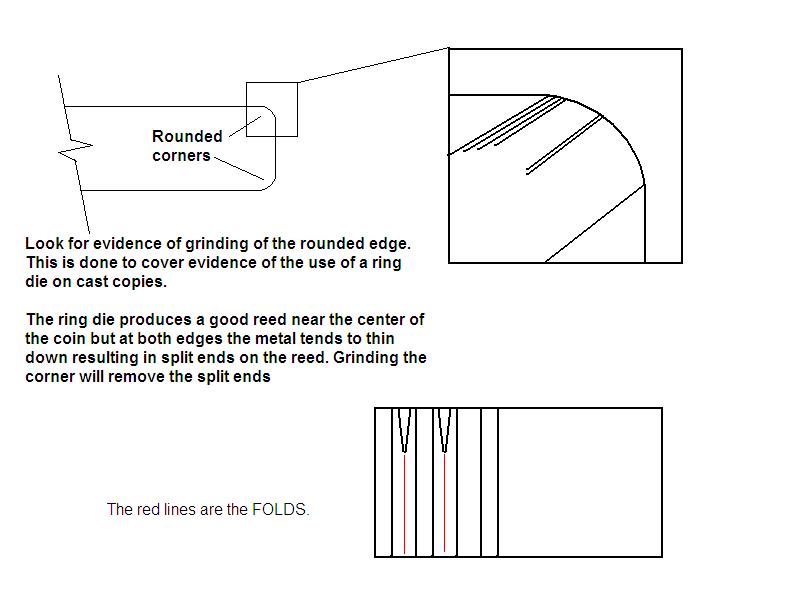 But here is a picture of a cast 1758 8R with a ground edge - used to remove the trace of a seam. The grinding which was done in this case after the coin was artificially aged causes a radical difference in appearance of the surface. Very unnatural and the evidence of mechanical grinding is obvious. In earlier or poorer quality fakes only the edge of the coin with the seam will be ground. But better forgers realize one ground edge is too obvious and the grind BOTH and also tend to age the coins chemically AFTER all the grinding is done. 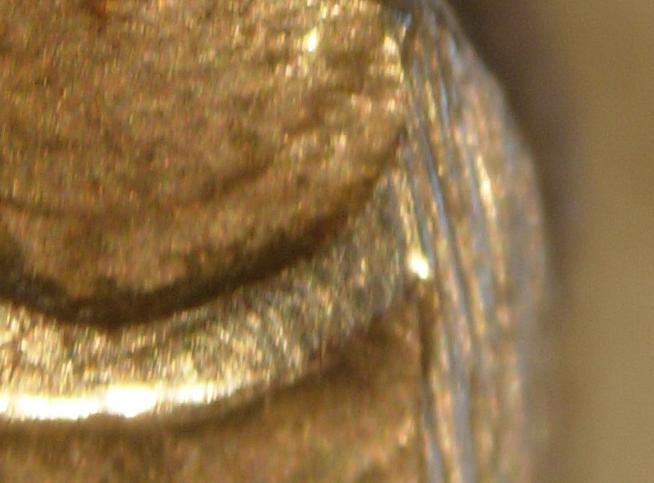 Cast coins where the edge is MECHANICALLY added after the casting are also seen in the business and may look much better . They do not typically need grinding AFTER the application of the edge. The following is one of the best pictures I could locate of a bad copy that was edged AFTER being created (by casting) but you can see the distortion of the dentils by the intrusion of the edge design. In this case - the die faces were even too small resulting in dentils that stopped short of the edge but there is some slight distortion of the dentils. 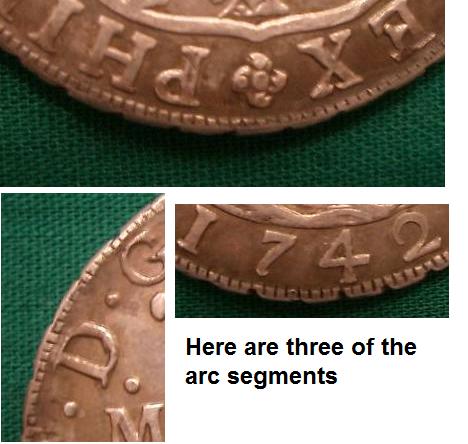 I fear that some people may believe that the GAPS are the intrusion. It is not the presence or lack of gaps it is how the edges of the gaps either "intrude" into the dentils and disturb the edges or how the gaps are altered by the force to the strike producing the dentils.
|
|
Pillar of the Community
France
1591 Posts |
Swamperbob : Thanks a lot for that post, I'll keep it saved ! As you said, on this particular design, there are two overlaps (square and circle) ... but on other designs there can be one only (if the leaves go in the same direction - if I remember well). I didn't checked later designs in Madrid - here is an example (will try to check tonight how those were done - if I find that coin) : 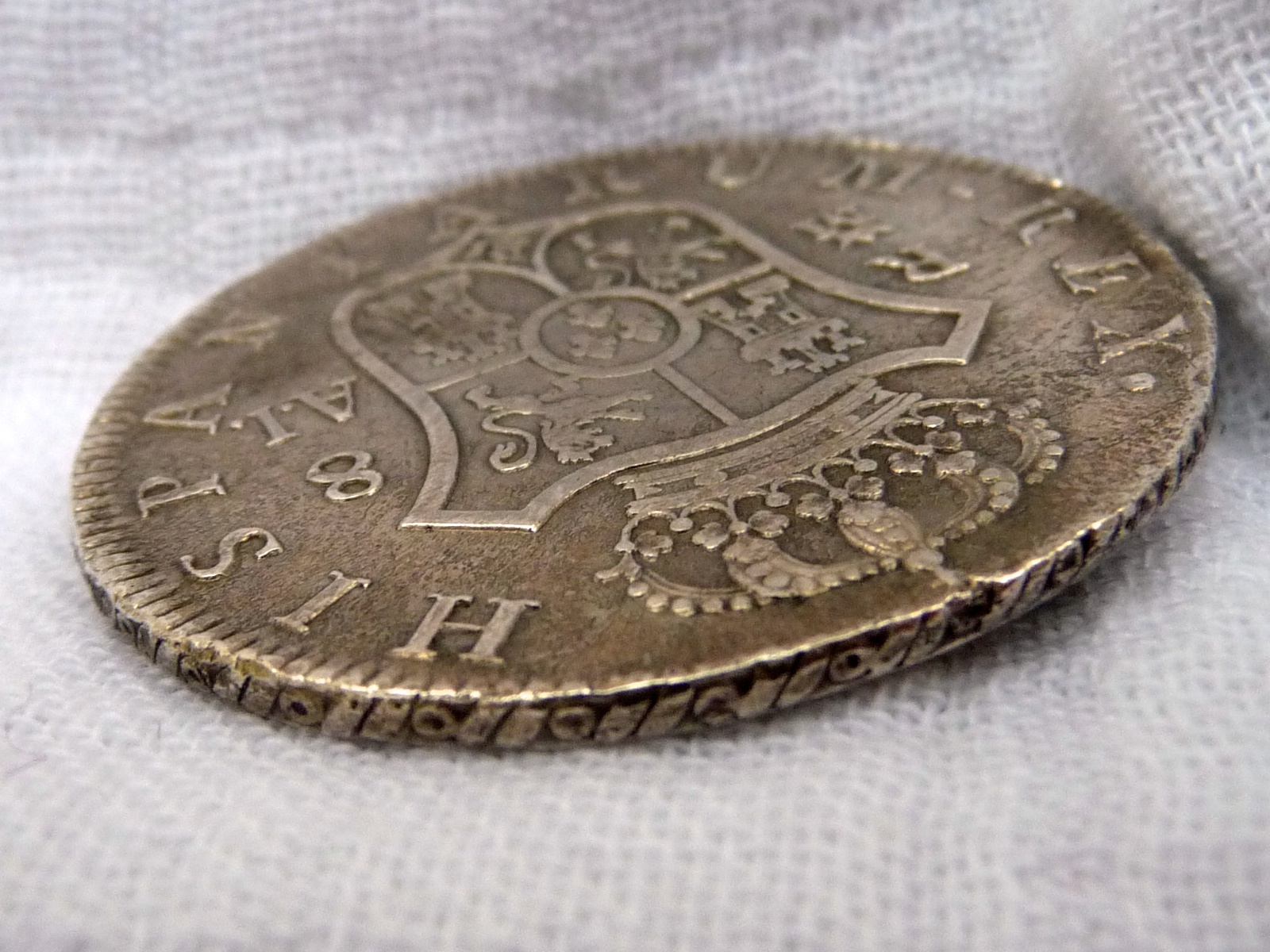 Edited by MathieuMa
11/07/2011 1:02 pm
|
|
Pillar of the Community
United States
5362 Posts |
Mathieu - There are always TWO overlaps - sometimes they are simply not very visible. If the coin diameter aligns exactly with the design interval - you can have coins that have VERY HARD to spot laps BUT the blanks were edged in a way that these have to be TWO.
I have never seen a description of a single sided edger being used in the NEW World. Perhaps someone at sometime used a one sided edger (which would produce 1 lap) but it would be far less efficient than the 2 sided edger which was developed in the 16th century.
So for the issues in question - there are always two overlaps even if you can not see them clearly.
|
|
Pillar of the Community
France
1591 Posts |
This is an old world coin ;) I'll check it for overlaps though - I didn't even checked them on this one ... UPDATE : Here is the overlap, pretty visible (this pattern is easy to check), at the correct place. 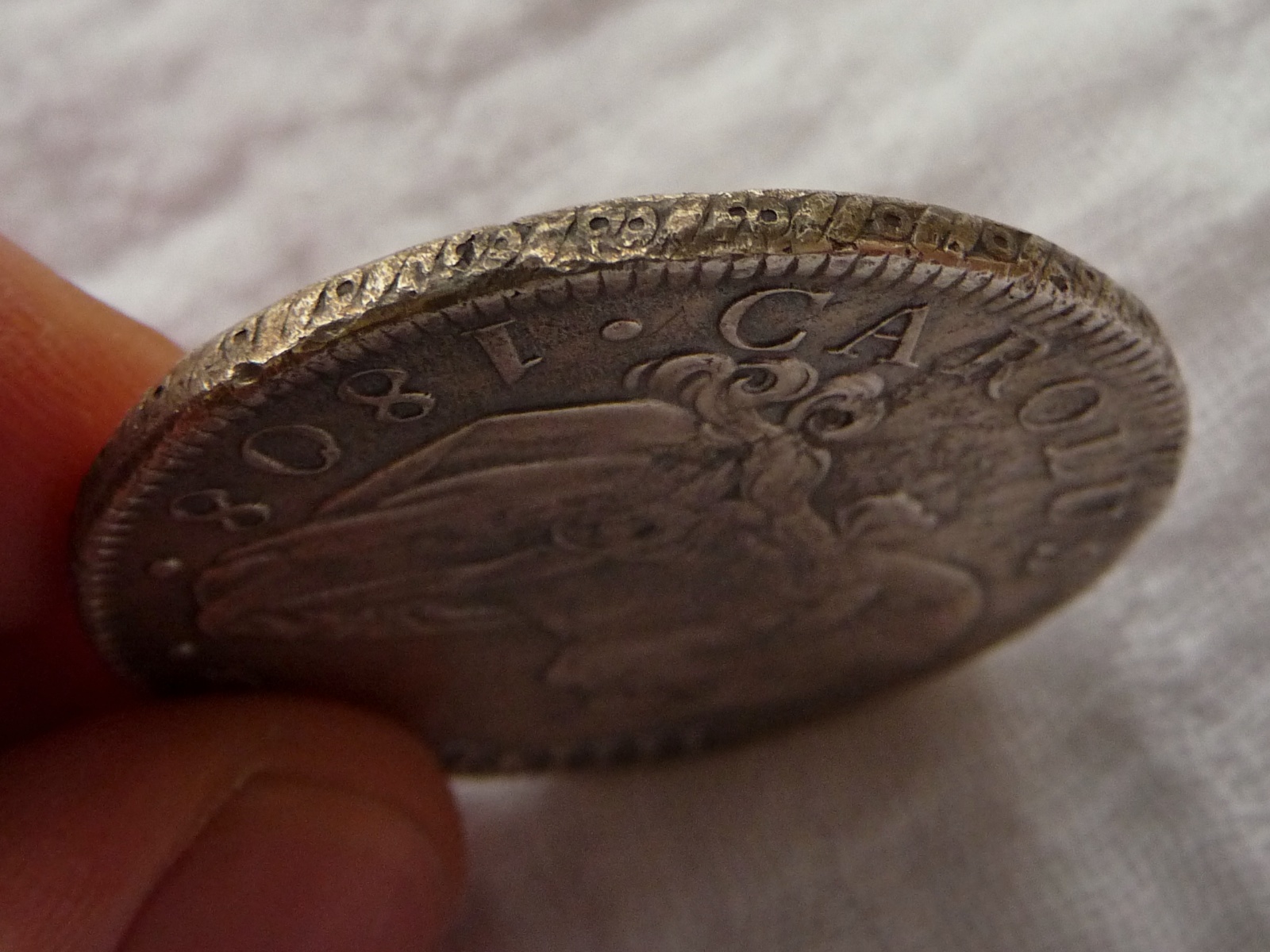  Edited by MathieuMa
11/08/2011 07:30 am
|
|
Pillar of the Community
France
1591 Posts |
|
|
Pillar of the Community
France
1591 Posts |
Edited by MathieuMa
11/08/2011 07:36 am
|
|
Pillar of the Community
France
1591 Posts |
|
|
Valued Member
 United States
328 Posts |
I think I am starting to see it. It is very subtle. Do you have any examples of a Portrait 8 reales coin pre 1800?
|
|
Pillar of the Community
France
1591 Posts |
I don't think I have any fake 8 reales prior to 1800 (at least, I'm sure I don't have any unless I discover one of those is fake - but then it would be contemporary ...).
We'll need Swamperbob to post those I think (unless someone else got such coins)
|
|
Valued Member
Philippines
386 Posts |
Super nice illustrations.
Thanks for sharing guys :-)
|
|
Pillar of the Community
United States
3499 Posts |
|
|
Pillar of the Community
United States
5362 Posts |
That edge looks right for a Potosi - they do tend to stand up above the dentils. BUT they used a similar methodology for edge application.
Until the advent of collared strikes ca 1835 most world mints that used edge security devices were using a two bar system. There are a few other methods but a study of a few known examples for any country should give you clues to determine the application method.
|
|
Pillar of the Community
United States
3499 Posts |
swamperbob- Thanks for the info! Honestly, I had been worried about the edge design jutting out for the side and beyond the dentils for some time now. I'm glad to know that it's OK.
|
|
Pillar of the Community
United States
5362 Posts |
Archraz I understand your concern completely - because the first coin I saw with this edge I also suspected (many years ago). It was not until I had examined a dozen or so examples from this mint that I realized the design was in fact correct.
I have found that it is best to study edge designs of each mint separately because each evolves over time with changes in dies and machinery. This goes double for the Mexican branch mints. I have avoided the War years in Mexico as simply too chaotic to be able to establish true standards.
Personally 90% of my edge studies involve the issues from Mexico and the branch mints because those are the target population I collect.
One thing I can say with NO FEAR of correction, after examining tens of thousands of 8R coins from Mexico City, is that the same "raised" edge was not used in Mexico. It is seen ONLY on coins I believe to be forgeries.
|
|
Pillar of the Community
Australia
653 Posts |
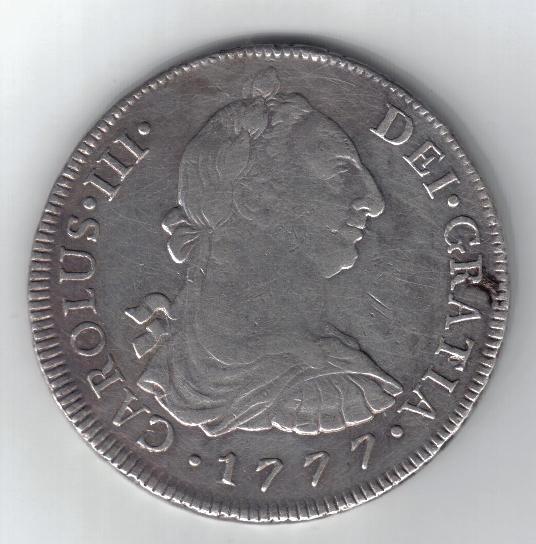
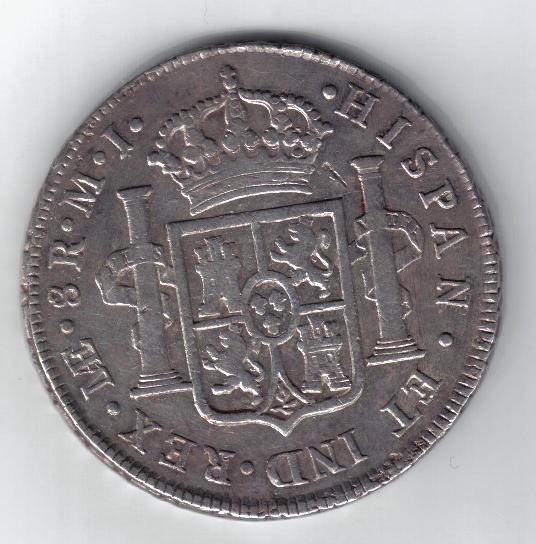
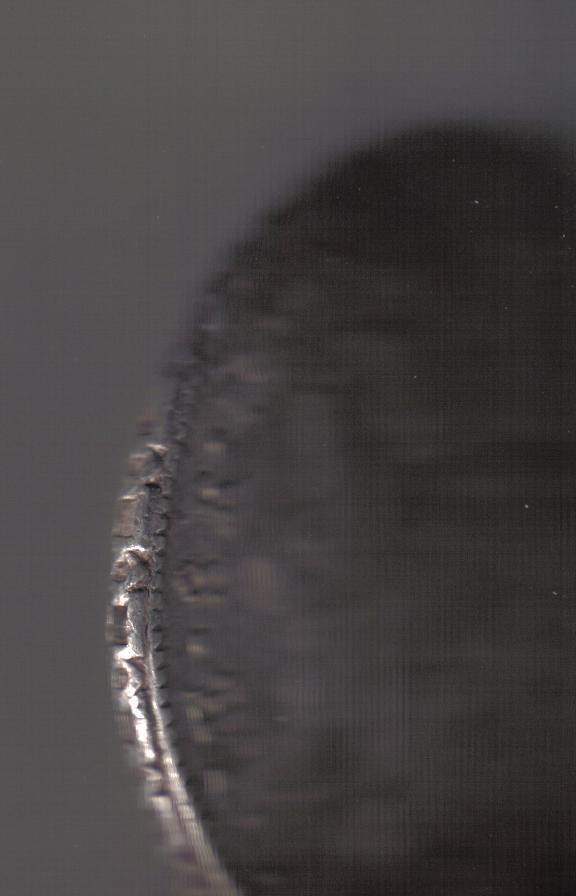
Dear Coin Community Forum members I hope you can help me in indentifying the pedigree of this 8 Real Coin. When I was browsing through the coin shop this coin really "spoke to me". To me it looked really special and I especially liked the oriental "chop marks" upon the obverse and reverse. I read up Coin Community Forum information about the 8 Real coin, specifically about the weight, the fact that it is non-magnetic and that it should have "squares and circles" or similar edge design. The coin dealer kindly weighed the piece and this was 26.8 grams. I noted the "squares and circles" edge design in cursory inspection. The coin is not magnetic. The diameter of the coin is between 39 and 40mm as one side appears to be particularly worn. However, when examining the coin closer at home I noted that the edge design is very curious. I have attached the obverse and reverse of the coin and also the edge design. Upon first impression I thought that the coin may be a restrike or a re-rimmed coin. I would appreciate any comments regarding the origin of this coin. Original Mexican from a later mintage? USA restrike? another kind of restrike? Thanks a lot for your help Squire 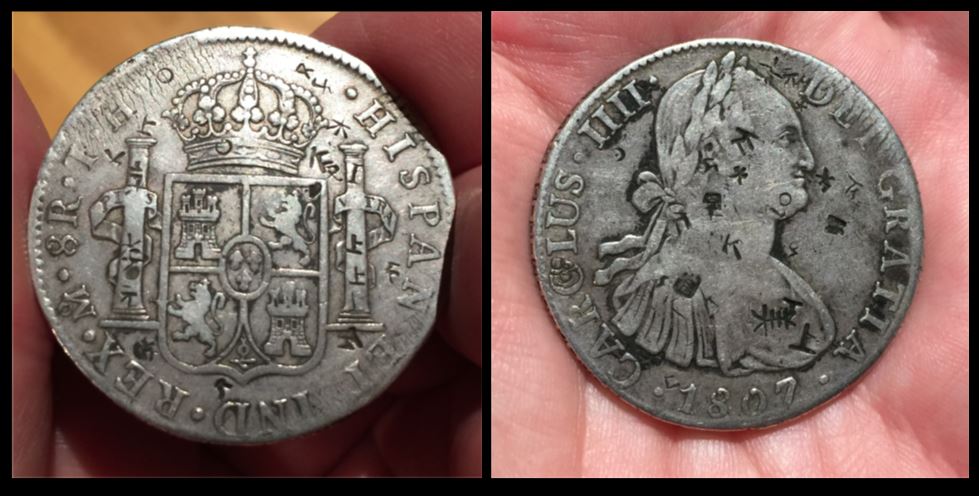 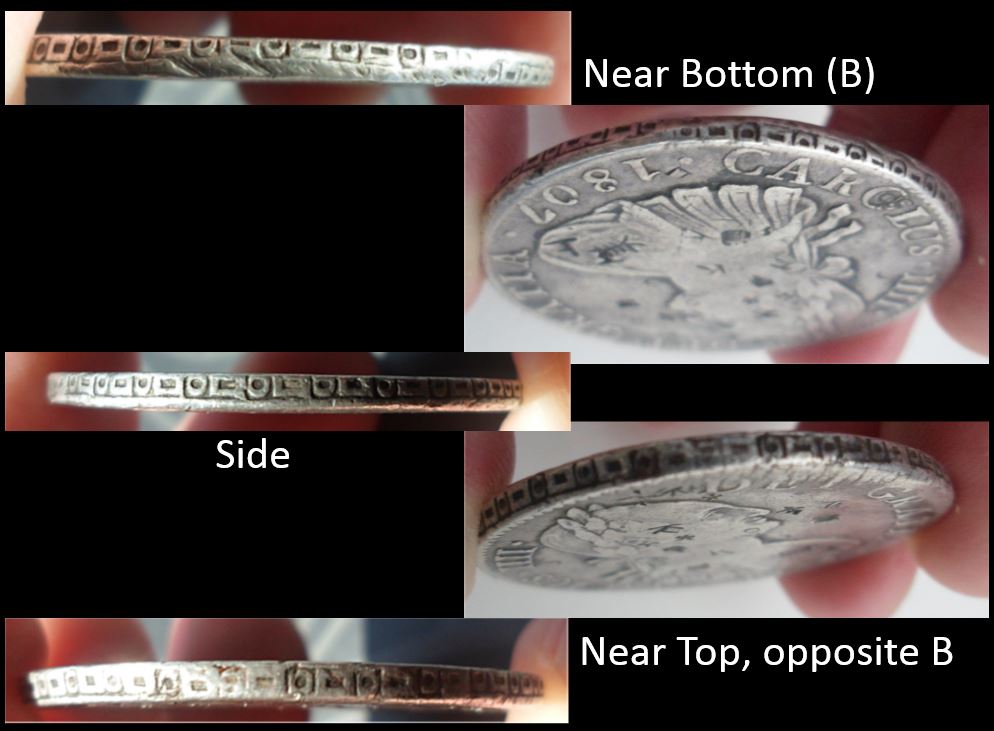 |
| |
Replies: 51 / Views: 16,135 |








 First Page


 Posted 11/07/2011 1:01 pm