| Author |
 Replies: 16 / Views: 3,200 Replies: 16 / Views: 3,200 |
|
New Member
United States
12 Posts |
Just picked up 2 of these. Lamination issue on cheek? Rusty Die? Both coins have exact cheek/neck marks. Thoughts? 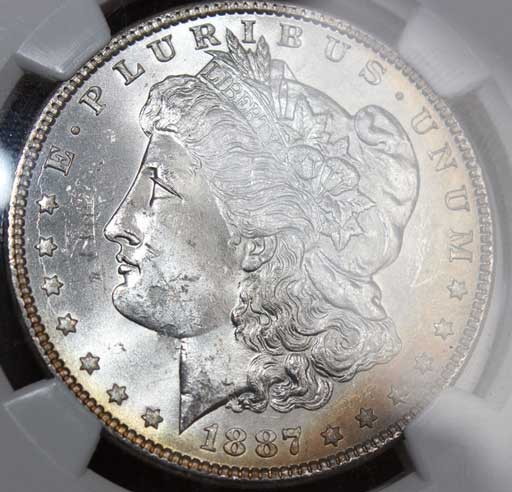 |
|
|
|
Pillar of the Community
United States
5854 Posts |
These look like normal marks to me.
|
|
Moderator
 United States
23522 Posts |
Welcome to CCF, ulichen. You seem to have an eye for the odd ones.  Tough call here. I wouldn't expect post-mint damage to make it into an NGC slab, and I know of no such die anomaly on 1887-P; we'd probably have seen this before were it a die issue. However, I wouldn't expect a random planchet irregularity to be duplicated on two coins. I'm guessing you're referring to the areas southwest of the mouth, and towards the point of the neck. Does it look as if material is missing? |
|
New Member
 United States
12 Posts |
I'l post better pics in a min
|
|
New Member
United States
12 Posts |
Close ups. Note that the 2 bottom pictures are 2 different coins.....thus it can't be wear... Both are NGC MS63 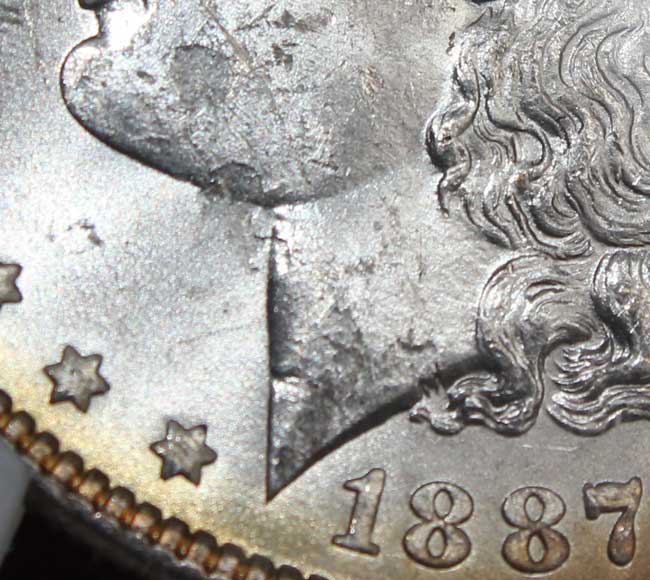 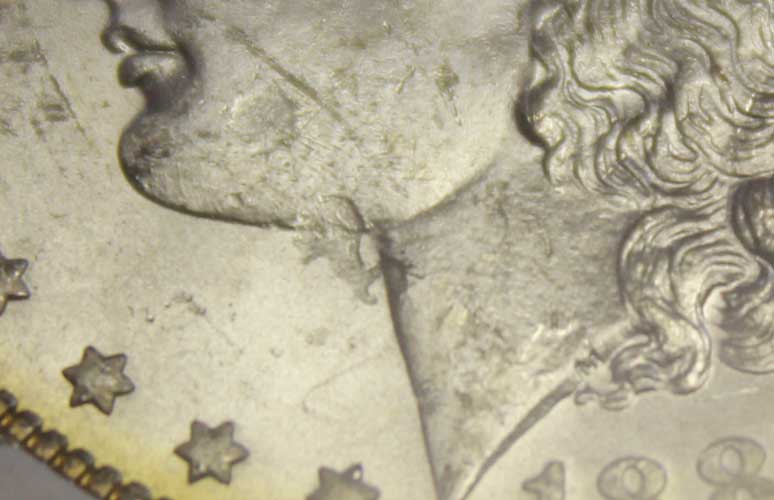 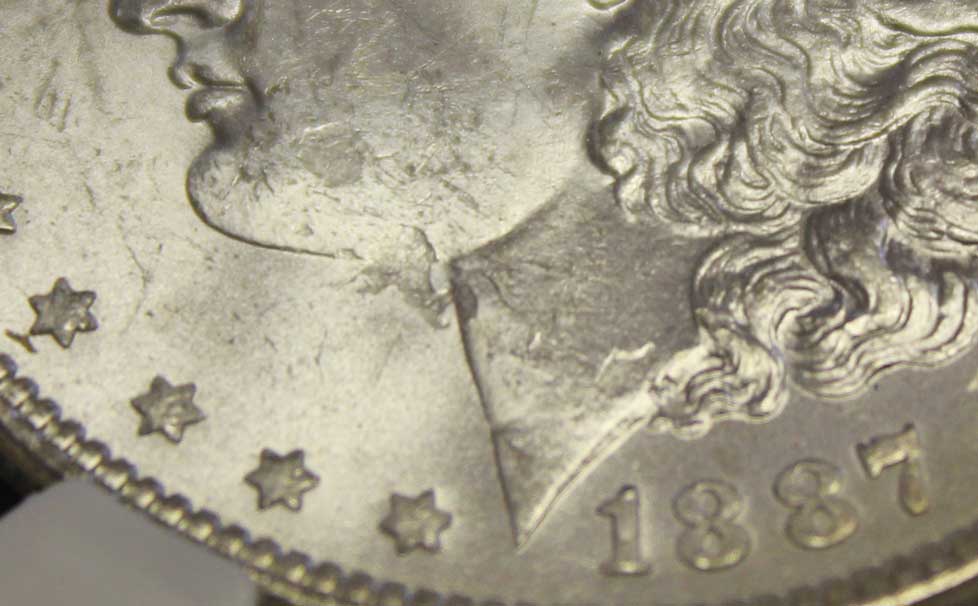 |
|
Moderator
United States
23522 Posts |
That's beyond fascinating. Obviously planchet issues, and not quite perfectly identical but very, very close.
You know, I had an '87 with an odd appearance at the bottom of the neck, on the neckline which contained the initial. I wonder if they had a run of bad planchets during that year.
|
|
Pillar of the Community
United States
5854 Posts |
That is really cool! I had thought they were marks until you posted the close up of the coins.
|
|
Rest in Peace
United States
10625 Posts |
Definitely not PMD. It appears to be a die defect of some sort. Very cool twins! |
|
New Member
United States
12 Posts |
Here is more to the mystery...both have same reverse...note the clash coming out the eagles neck....I don't see a VAM with this...thoughts? Die crack over AMERICA as well. 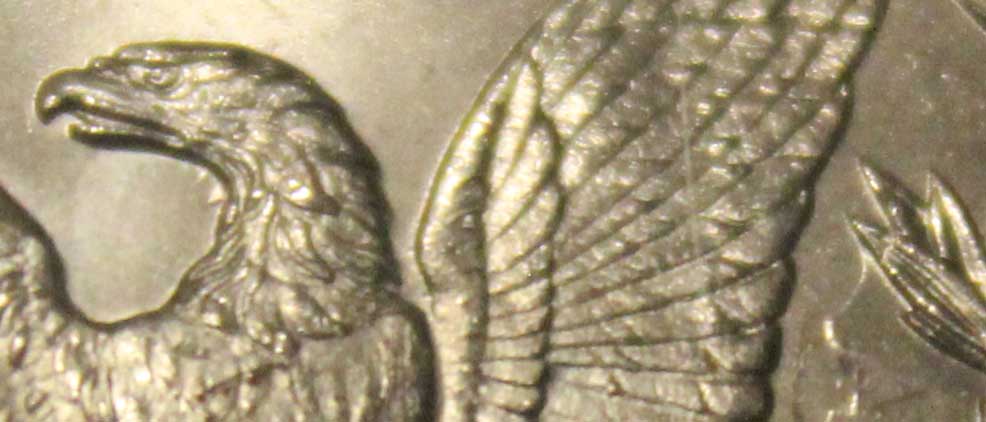 |
|
Pillar of the Community
United States
4897 Posts |
Quote:
Obviously planchet issues, and not quite perfectly identical but very, very close I dont know about that. I am by no means an expert on Morgans but seems more likely a die issue.....IMveryHO. |
|
Rest in Peace
United States
10625 Posts |
The reverse die definitely is clashed. The obverse however does not show the normal signs of a clashed die.
|
|
Moderator
United States
23522 Posts |
Quote:
I dont know about that. I am by no means an expert on Morgans but seems more likely a die issue.....IMveryHO. This is why I feel they're not die issues: 1) There's no known die defect for 1887 in any way resembling what we see here. Yes, the remote possibility exists that we're looking at a totally-new die, but.... 2) The finish in the "missing" areas is different than the surrounding coin. It doesn't have the smoothness of a strike, but rather looks more like raw metal. The more I think about it, the more I believe these are strikethroughs. The OP has been lucky enough to come up with consecutive (or very nearly consecutive) strikes from the same foreign object stuck to the obverse die. |
|
Pillar of the Community
United States
7841 Posts |
What are the odds of having a planchet defect in almost the same striking area?
360 degrees and then you have both sides 360 x 360 = 129,600 (1 in 129,600)
(Stats is not my strong point)
If the bottom two pictures of the obverse are different coins, then I would think that is has to be some foreign material on the die itself to make those similar indentations, it would not be the planchets themselves.
Edited by oih82w8
12/19/2011 11:58 am
|
|
Valued Member
United States
224 Posts |
SuperDave, I am sure that you hit it on the nailhead! I was leaning towards a delamination error until I saw the pics of both coins. It is definitely a Strike-Thru of some rough foreign material! I believe that the reason that the coins exhibit some slight delamination...especially the coin in the first pic, is due to extreme pressure caused by the foreign material. (i.e. The extreme pressure pushing outward from the Strike-Thru area caused the surface of the coins to delaminate adjacent to it!) My statement and question to everyone is this: The coins exhibit Die Clashing and therefore could possibly be pinned down to a known VAM. So, if more than one coin (which we can see here) exhibits the same Strike-Thru (due to the foreign material being stuck to the Die and not the planchet) and they are known VAM's, would they be designated as a new sub-category for the known VAM? Probably not but the foreign material is an issue of the Die and not the planchet, seeing that it is stuck to it! Frank Edited by huntsman53
12/20/2011 11:41 pm
|
|
Moderator
United States
23522 Posts |
I don't believe Leroy would create a sub-designation for a strikethrough, even in this unique instance of consecutive or near-consecutive strikes. Might be interesting to try to attribute these, though. The die cracks at 9:00 obverse are a pretty unique pattern, and may help.
|
|
New Member
United States
12 Posts |
Would be very cool to get them "known". I think they are VAM 13A They are actually from the "Mcclaren Collection" which was about 30,000 coins sold by Legend a while back. NGC has that on labels as well. |
| |
Replies: 16 / Views: 3,200 |










 Posted 12/18/2011 2:23 pm


