











 Posted 01/16/2012 1:42 pm


When trying to ID a piece it's always nice to be able to see both sides. 
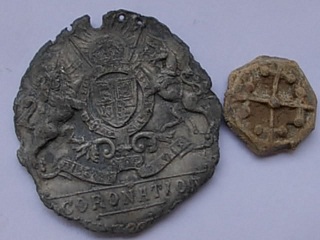
The bigger one is obviously a (what's left of it) coronation medal. The image of "a king and queen" would pinpoint the date of it. I'm pretty sure many of us who collect British coins/medals will recognize the people even without any inscription left. Edit: the options are Edward VII (and Alexandra) in 1902, George V (and Mary) in 1911, or George VI (and Elizabeth) in 1937.
The Latin inscriptions on the British Royal Coat of Arms are:
Dieu et mon droit (God and my right) on the ribbon below, and
Honi soit qui mal y pense (Evil to him who evil thinks) on the Garter around the shield.
But if it is a (local) variation of the COA the phrases could be different. Still, The royal couple would give you the clue to the age of the artifact.
I cannot even guess what the smaller piece is without seeing the other side.
The bigger one is obviously a (what's left of it) coronation medal. The image of "a king and queen" would pinpoint the date of it. I'm pretty sure many of us who collect British coins/medals will recognize the people even without any inscription left. Edit: the options are Edward VII (and Alexandra) in 1902, George V (and Mary) in 1911, or George VI (and Elizabeth) in 1937.
The Latin inscriptions on the British Royal Coat of Arms are:
Dieu et mon droit (God and my right) on the ribbon below, and
Honi soit qui mal y pense (Evil to him who evil thinks) on the Garter around the shield.
But if it is a (local) variation of the COA the phrases could be different. Still, The royal couple would give you the clue to the age of the artifact.
I cannot even guess what the smaller piece is without seeing the other side.
Edited by svslav
01/16/2012 1:50 pm
01/16/2012 1:50 pm


