Since I have still not located a local shop that sells world poundage, I decided to have a look at the local monthly coin show. I'd been once before but was mostly browsing. There were three dealers who looked to have a decent amount of world coins, and what-do-you-know, the first one I asked had some poundage available. It wasn't really poundage because he didn't sell it by weight, but close enough. He had a big ziplock bag of coins he estimated to be about 10 lbs that he offered me for $50, and I accepted. I'd have liked to look around at the other dealers since I'd basically just gotten to the show, but this bag plus a few small coins from his world silver tray used up my budget for this trip (I'm keeping it low since I'm just starting out) and I didn't want to be tempted to overspend. I weighed the bag when I got home and it only came to 7 pounds. I don't fault the dealer for this, as he was just guessing at the weight, and didn't even quote me a per pound price, just a total for the lot. That makes the price of this lot $7.17/lb.
I forgot to take a picture of the lot right out of the bag, but here is a shot of the coins after my first sorting, which separated them by continent.
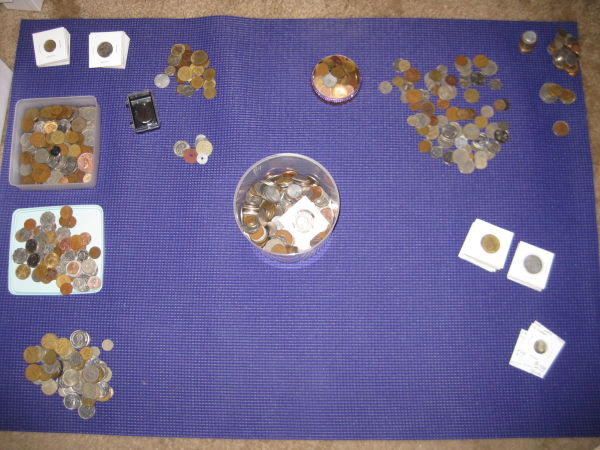
This first sort revealed a couple things. First, there were no Canadian coins. The chances of this randomly happening seem about nil, so this dealer has obviously removed them. That's certainly a strike against this lot for me, because I really like Canadian coins. Second, it was very heavy on Mexican coins - strike two. Not that I have anything against Mexican coins, but as they are so common in these lots I'm going to favor suppliers who's lots don't over-represent them. Third, there were almost no African coins. This is more a simple observation than a complaint, as I have no particular affinity towards African coins, though a few more would have been nice to get me towards my OFEC goal.
This next step is where I need to change my system. After sorting by country and removing duplicates, I decided to put all the coins in 2x2s before labeling any of them. Two problems with this approach. One, my hand hurt. Stapling everything was bad enough, but flattening the staples really started to do a number on my hand, and I had to split the work over several days. Two, in the process some of my sorting was undone, so that just created more work for me later. In the future I'll be doing one region at a time, at least in big lots like this one. Here are the coins after all the stapling and flattening was done.
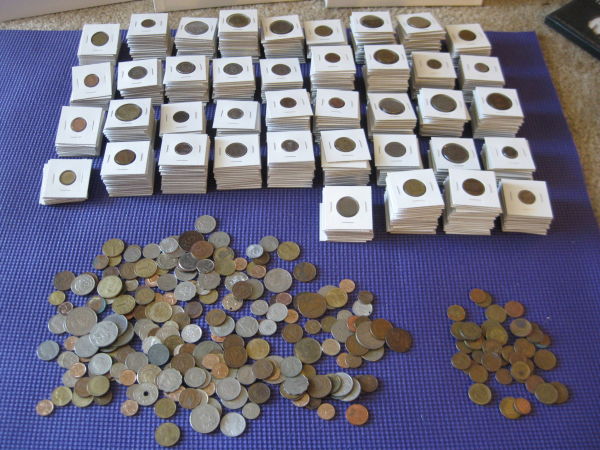
The loose coins at the bottom are duplicates, and there are a few too many of them for my taste. My collection was only a few hundred coins before this, so most of those were duplicates within this one lot. There were a total of 829 coins:
Keepers: 567
Duplicates/culls: 256
Tokens: 6
That's a keeper rate of only 68%. I'd say about half the duplicates came from the Mexican coins. There were however an above average number of coins in this lot, so the price per keeper remained pretty good, at 8.8 cents each. Of course, this was possible because so many of the coins were small, low denomination coins, which isn't really a good thing. Here is a picture of the final result, after everything has been fully labelled, stacked by country and those stacks sorted by region.
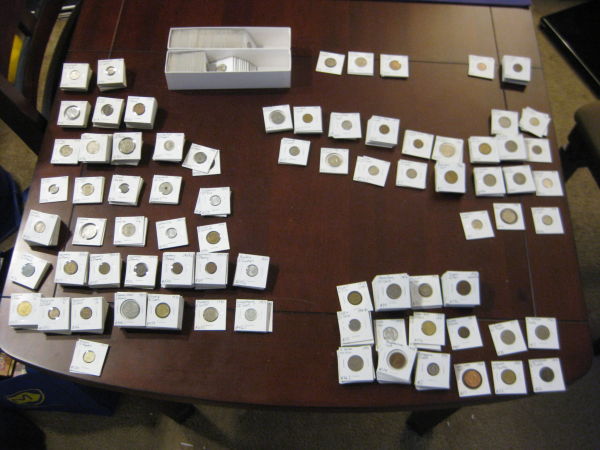
The large group on the left is Europe. Bottom right Asia, and above that the Americas and Caribbean. Top right is Oceania, and top left is Africa. You can see what I mean about Africa, as I had more coins from Australia than the whole of Africa. The most represented countries by regions are:
North America: Mexico (55)
South America: Colombia (6)
Caribbean: Bahamas (11)
Europe: Germany (61)
Africa: South Africa (3)
Asia: tie, Japan and Hong Kong (16)
Oceania: Australia (10)
The top 5 countries overall were, except for Mexico, all European:
Germany (61)
Mexico (55)
France (35)
Belgium (35)
Netherlands (28)
The small denomination problem with this lot can be seen in the German coins, because though there were 61 keepers (and about half that many duplicates, there was nothing larger than 10 pfennig.
There were only two 19th century coins in the lot:
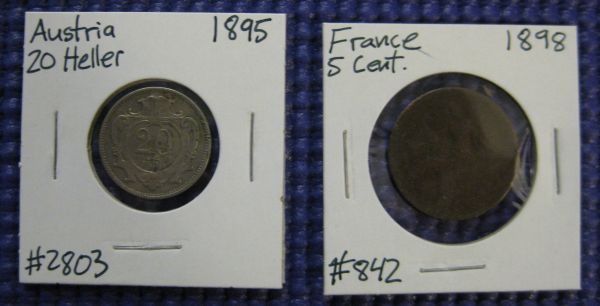
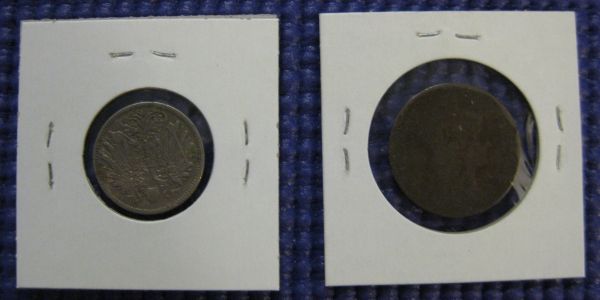
Though there were a fair number from the early 20th century, so overall I was pretty happen with the date range.
My favorite coin from the lot is a Bahamas 1 cent, from 1974.
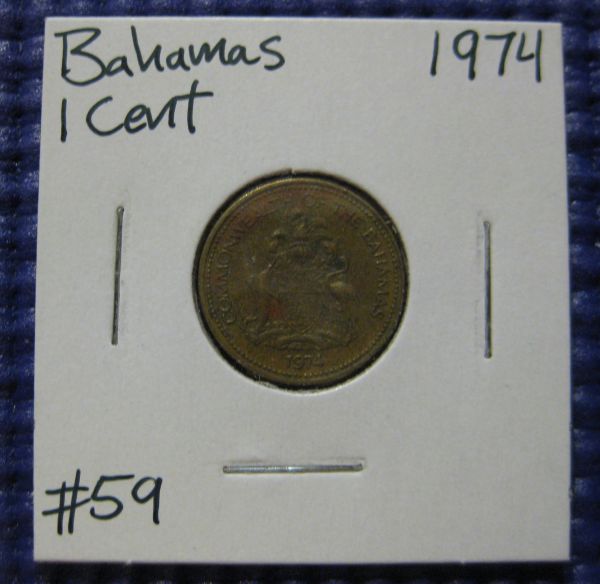
Not an expensive coin by any means, but if the mintage in Krause is accurate it is quite scarce, with only 11,000 made.
Overall, I would rate this lot a C. I would have bought it even fully knowing its shortcomings, but I will not be making this dealer one of my regular suppliers.







 Posted 01/17/2012 02:36 am





