| Author |
 Replies: 5 / Views: 3,200 Replies: 5 / Views: 3,200 |
|
|
Pillar of the Community
Canada
1700 Posts |
The photos may appear unclear to you since I have you make them blurrier in order to post them. 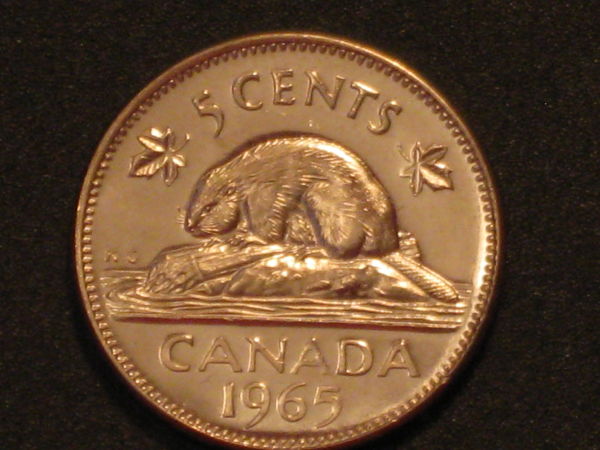 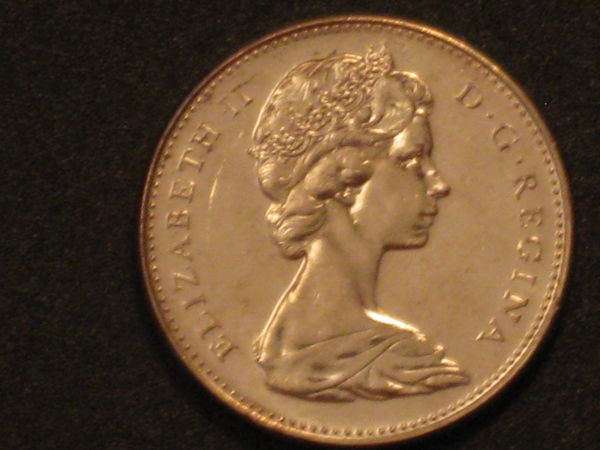 What grade would you give this coin? Do you think that it's large beads or small beads? Now, if you're wondering what the title means, here's the answer. Should I keep it by protecting, sell it for a price to a local dealer, spend it as $0.05 or leave it in my melt basket? I found this in a nickel roll while roll hunting. |
|
|
|
Pillar of the Community
United States
1054 Posts |
If I had to venture a guess its a small beads. I use the same mark for the 65-66 dollars in that if the "I" in Regina is pointing to one bead and not between two, then it is a small bead variety. As far as keeping it, its always fun to keep various varieties, Canada coins have so many.
|
|
Pillar of the Community
United States
1195 Posts |
From this American perspective, I'd keep it on account of the condition it's in for it's age.
I'd defiantly keep a 1965 US nickle in that condition!
|
|
Pillar of the Community
Canada
1161 Posts |
Here is an explanation of how to determine the Large Beads and the Small Beads 1965 nickel. I borrowed it from Ken Potter. Many thanks to Ken for his work.
For me...it works best to rotate the coin so that the "II" after Elizabeth is @ 12 O'clock and check the beads directly above them. As you can see in the pictures provided by Ken...there is an obvious difference between the two.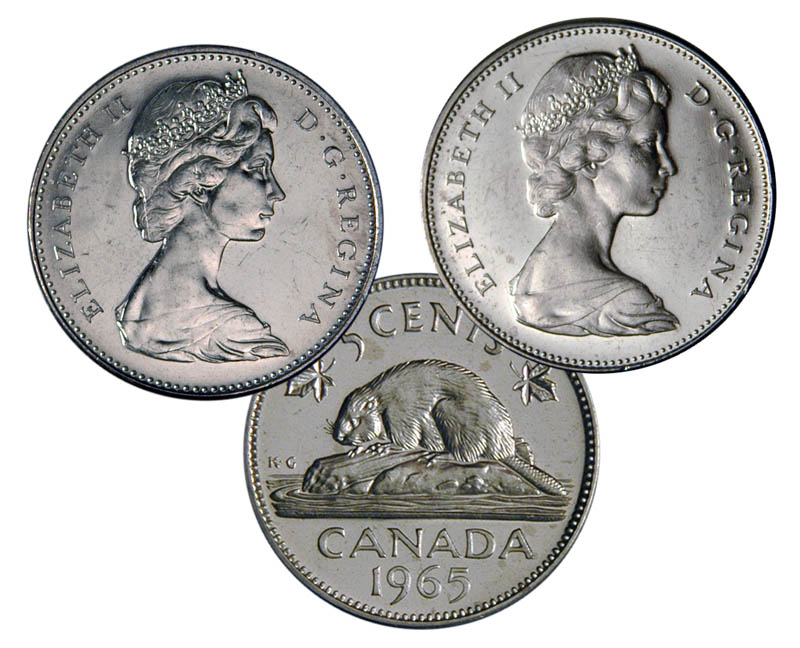
The common Small Beads Variety is shown above to the left while the rare Large Beads Variety is to the Right.By Ken Potter - NLG
October 2007
© Ken Potter 2007Jerry Kennison of Vancouver, Washington discovered the 1965 Large Beads five cent piece in 1996 it and its existence was detailed by me in Canadian Coin News more than a decade ago where it was dubbed the Large Beads/Detached Jewel variety. In that article I noted the many differences between the Small and Large Beads varieties and revealed the fact the Kennison had found a dozen examples in a roll of proof-like 1965 five-cent pieces that he obtained from a roll that he was certain contained a proof-like coins taken from PL sets. I noted that he had sent two stages of the coin for me to examine, one with a nice proof-like cameo effect on both obverse and reverse and another with the same obverse sans the cameo effect with a more uniformly brilliant finish to the obverse. A tiny obverse die crack shared by both coins linked them together as being from the same obverse die.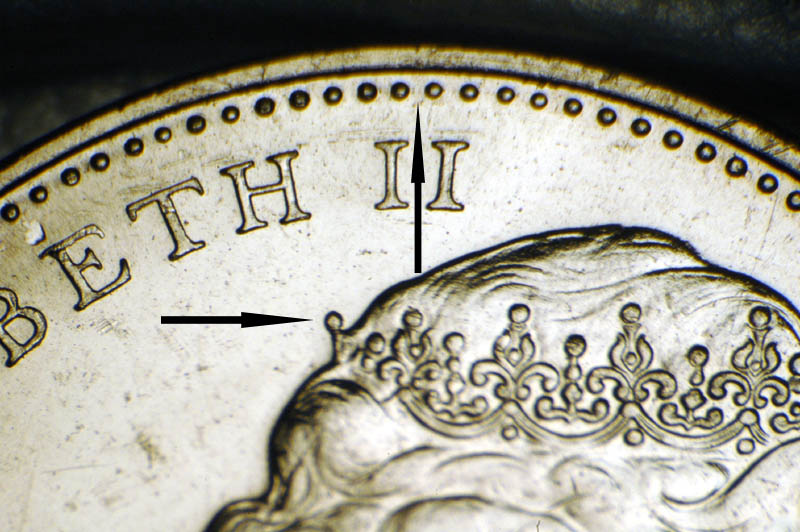 Here is a look at the common Small Beads varietyNow, after more than a decade, Kennison has revealed even more of the story that he has kept hidden all these years! Two of the dozen coins he found in that roll were of an earlier die stage with the jewel to the rear of the tiara weaker than on the Small Beads variety but nonetheless fully attached. In effect, anybody searching for this rarity that has restricted his or her examination to the rear jewel, considering the detachment as a positive indicator of the variety, may have missed finding it completely. It also means the popular term; Large Beads/Detached jewel is now invalid since the term "detached jewel" is only a diagnostic to the later, perhaps less-desirable, stages of the same variety. Here is a look at the common Small Beads varietyNow, after more than a decade, Kennison has revealed even more of the story that he has kept hidden all these years! Two of the dozen coins he found in that roll were of an earlier die stage with the jewel to the rear of the tiara weaker than on the Small Beads variety but nonetheless fully attached. In effect, anybody searching for this rarity that has restricted his or her examination to the rear jewel, considering the detachment as a positive indicator of the variety, may have missed finding it completely. It also means the popular term; Large Beads/Detached jewel is now invalid since the term "detached jewel" is only a diagnostic to the later, perhaps less-desirable, stages of the same variety. Here is a look at the rare Large Beads variety in the early die state with a barely attached rear jewel Here is a look at the rare Large Beads variety in the early die state with a barely attached rear jewel
While my earlier articles on these varieties went into great detail on all the differences in the bead to lettering alignment on each of the varieties, it is suffice to note that the entire legend-to-bead orientation about the rim is different on each variety. Perhaps the easiest place to discern this is on the Roman numeral II of Elizabeth II. An arrow placed vertically between the "II" of ELIZABETH II pointing toward the rim on the common Small Beads variety will easily pass between two beads. The horizontal arrow in our image points to the strongly attached rear jewel on the Queen's tiara. On the rare Large Beads variety the same arrow will bump right into a bead that is fairly well centered between the II. The horizontal arrow points to the rear jewel in the Queen's tiara that on this stage is more weakly attached than on the Small Beads variety; it is completely detached on later stages of the Large Beads variety.
There are also significant differences in the detail of the lower portrait and for those up to the tedious task of counting you will find the Small Beads variety bears 119 beads located in a bit closer to the portrait vs. 138 beads located closer to the rim on the Large Beads variety.Direct link to Ken Potters page:http://koinpro.tripod.com/Articles/...BeadsVar.htm
|
|
Pillar of the Community
Canada
1161 Posts |
The OP coin is a very nice example of a Small Bead. I would keep it for sure.
|
|
Valued Member
423 Posts |
Small beads. Keep it! Put it to the side and when you get to 40 nice examples roll them as mixed dates. Keep the kings, or to 1962 if you like the look of the sided nickel, or really nicely toned examples. You can give them away to new collectors or trade them or whatever done the road. It only cost two bucks each time you store 40 found coins away...
plus the nickel is the best coin...
Edited by realpenny
02/13/2012 01:12 am
|
| |
Replies: 5 / Views: 3,200 |
|







 Posted 02/12/2012 3:10 pm





