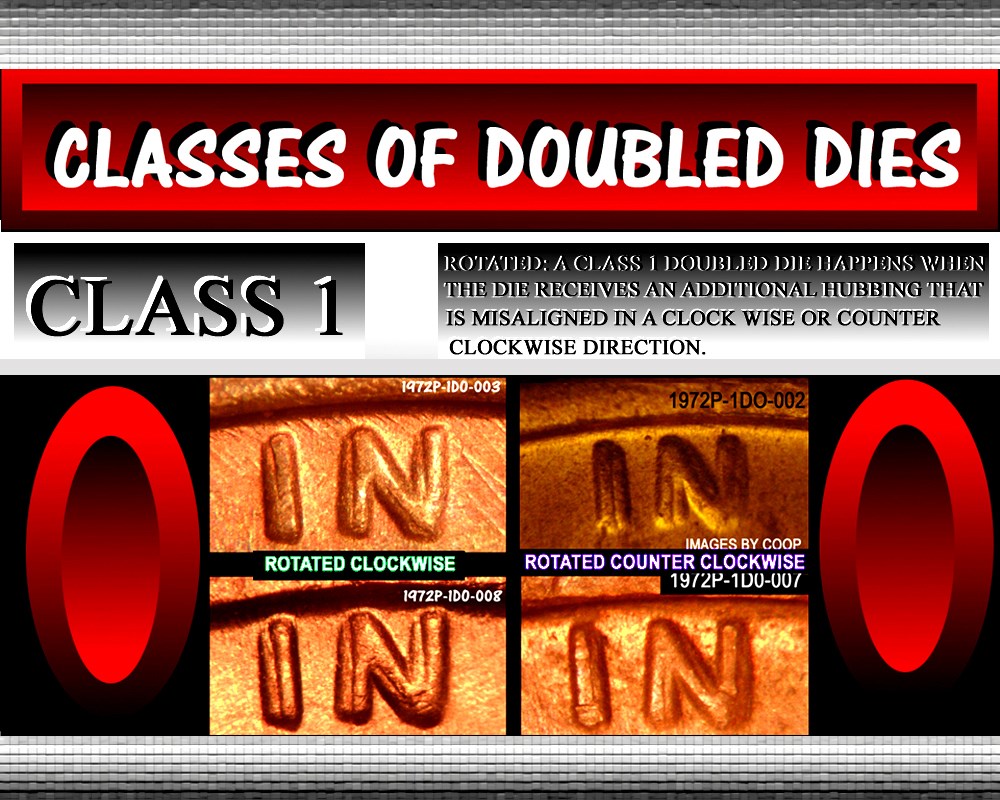
Have you ever used a rubber stamp? When you try to place a second stamp over a previous stamp you get something similar. You get widened letters in a certain direction, above or below the previous stamp. But in the case of dies, the hub that is used to make a die (which is positive) makes a negative (the die) to strike positive coins. When the alignment is not exactly the same, or a different hub is used, or a hub is warped, the die will show this on the coins struck. The classes of doubled dies indicate what happened during the die making process. So when you look at the 1972 doubled dies, the first 8 on the coppercoins list are all class 1 dies. Why are they called class 1? They are variations of the rotated CW or CCW rotation of the hubbing process. Each variety was hubbed differently. When attributing these dies, you need to consider what is different for each one and see how your coin matches with the attributed dies listed. Each device would have to line up, just like the attributed dies spreads. We just can't say that ours is the most valuable one. We have to check the spreads and see which die it matches up with. So back to the question, the hubbing alignment plays a large part to what makes a die a doubled die. It is not a striking issue, a die aging issue, the hub doubling is on the die making it a .......doubled die Hope this helps answer the question.
Thanks coop for your input on this one. Always a learning lesson. I have to keep referencing some of the stuff you post, still alot to grasp, understand and learn. thanks again.
Disclaimer: While a tremendous amount of effort goes into ensuring the accuracy of the information contained in this site, Coin Community assumes no liability for errors. Copyright 2005 - 2026 Coin Community Family- all rights reserved worldwide. Use of any images or content on this website without prior written permission of Coin Community or the original lender is strictly prohibited. Contact Us | Advertise Here | Privacy Policy / Terms of Use








 First Page





 Posted 07/12/2016 11:03 pm


