| Author |
 Replies: 24 / Views: 4,524 Replies: 24 / Views: 4,524 |
|
Pillar of the Community
United States
1315 Posts |
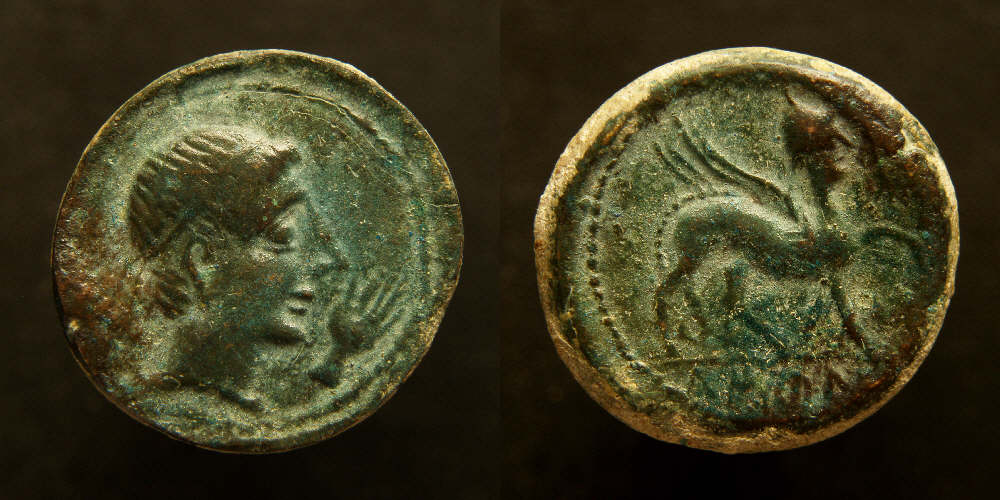 I like this coin and found this one for a good price so I picked it up. Castulo, Spain....Male Head right / Helmeted Sphinx. It's now one of my favorites. I'm not sure if this is a provincial coin or not. Some say it might be Augustus on the obverse and he is said to have taken the Sphinx as his Seal. I can't find out much about it yet. The only site that I found so far that says anything about it is from Doug Smith. http://dougsmith.ancients.info/feac35cas.htmlPlease let me know if you know where there is more info on this type. Thank you much.
|
|
|
|
Pillar of the Community
United States
4253 Posts |
Sorry, but I don't know anything about this coin. However, I wanted to tell you this is a very nice and interesting coin
|
|
Bedrock of the Community
United States
10045 Posts |
Is your coin also around 28mm? Yours is very nice, and impressive at that size--I wish it were in my collection.  |
|
Pillar of the Community
 United States
1315 Posts |
Yea, I forgot to mention it's 28mm and 13.3 grams. It is pretty big.
|
|
Moderator
 United States
23731 Posts |
Very nice coin don't see many of these around.
|
|
Pillar of the Community
Serbia (Srbija)
576 Posts |
|
|
Pillar of the Community
United States
1315 Posts |
Thanks for the comments guys. I've been working on the mint mark letters. They are written in Iberian script. It seems as though they read KSTLO, though on this coin the symbol for the O is off the flan. http://en.wikipedia.org/wiki/File:U...ea_2004).jpg |
|
Valued Member
Spain
108 Posts |
Hi. Very nice coin but must be the young brother of mine (43.4 grs/ 37mm) 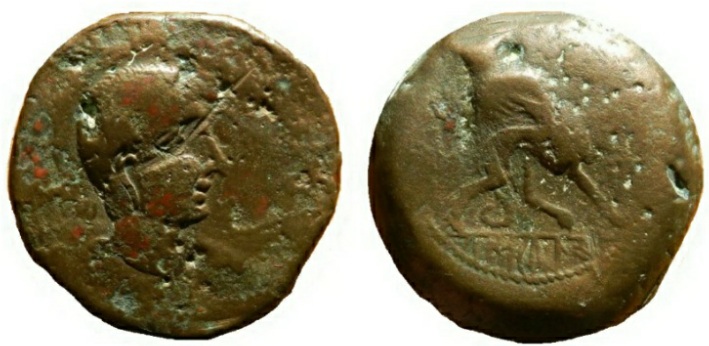 It had (and has) problems with bronze disease, light spots of cuprite and a long scratch but it is the biggest coin I have. According M.P. García-Bellido and C. Blazquez (Diccionario de Cecas y Pueblos Hispánicos, 2001) we can date about 195-179 BC this one. Yours (Doucet) about 165-80 BC (They say that this serie is long and can be divided into 5 groups, your coin is from first issues so better 165-145 than 100-80). Leyend is in iberian script, this language is semi-syllabic (sign alphabetic and other sillabics) so if we use that table http://en.wikipedia.org/wiki/File:U..._2004).jpg for G/K, B and D/T we must cross with vocals. Then we must read: KA , KE ... and read: KA S TI L O I hope to be able to explain (sorry for my limit english) |
|
Pillar of the Community
3772 Posts |
Welcome to this corner of CCF 'Veton' and I am sure your knowledge of early Iberian coinage will be helpful. Since your link doesn't work in the form you gave it, here is the (hopefully right) table: .jpg) |
|
Pillar of the Community
United States
7067 Posts |
Edited by Kamnaskires
01/28/2015 10:37 am
|
|
Valued Member
Spain
108 Posts |
Thaks for your welcome. This table corresponds to southeast iberian alfhabet. I have put a small line on M as in these coins. Also sign for KO (present in some coins of this mint) So I think is easy to see semi-syllabic script.  Edited by Veton
01/28/2015 11:16 am
|
|
Pillar of the Community
United Kingdom
3626 Posts |
|
|
Valued Member
Spain
108 Posts |
Hi. About Augustus:
Most experts agree that after the sertorian war (Sertorio died 72 BC) most iberian mints began to use latin or bilingual iberian-latin leyends and circa 45 BC with Caesar, they use -only- latin alphabet, so it is unlikely attribute to Augustus this type of coins (he was emperor from 27 BC to 14 DC). Also for historical or archaelogical references and metrology these coins seems to be earlier than Augustus time.
Although are only opinions
|
|
Moderator
United States
23731 Posts |
Interesting, this is an area that is not covered very much on this forum but I would like to learn more about.
|
|
Pillar of the Community
3772 Posts |
|
|
Pillar of the Community
United States
5010 Posts |
that's an awesome pdf med, thanks.
|
| |
Replies: 24 / Views: 4,524 |







 Posted 03/07/2012 10:56 pm





