| Author |
 Replies: 7 / Views: 2,044 Replies: 7 / Views: 2,044 |
|
|
New Member
United States
2 Posts |
Based on these pictures, does this coin appear to be authentic? 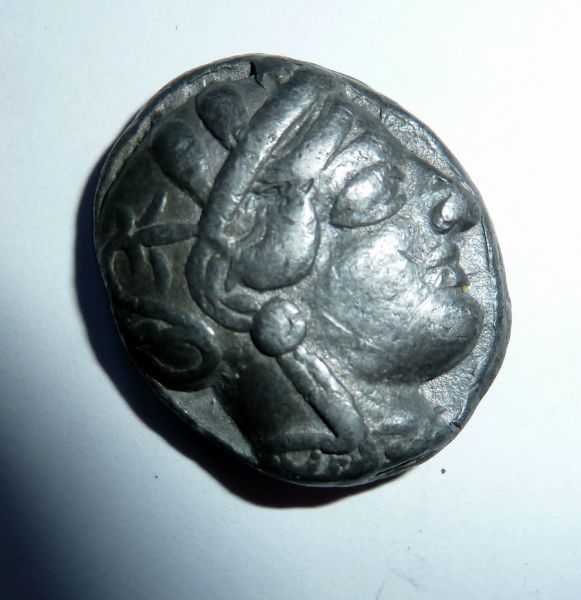 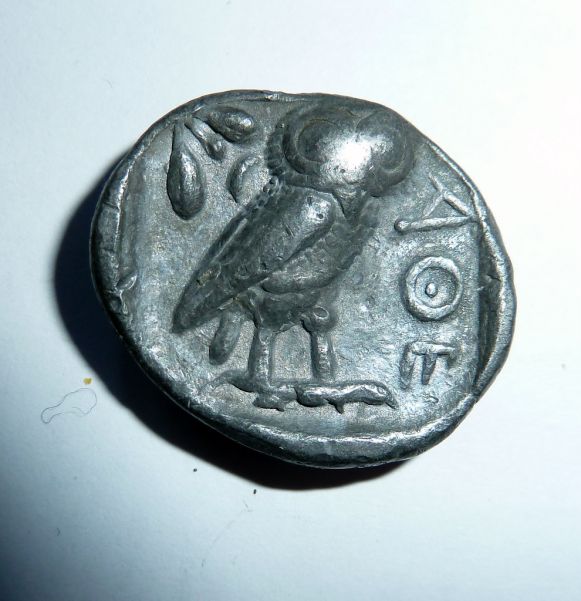 Edited by smHrth
03/12/2012 8:26 pm
|
|
|
|
Bedrock of the Community
Australia
21792 Posts |
smHrth: Welcome to the CCF!
"Based on these pictures (only), does this coin appear to be authentic?"
Probably not. These celebrated coins, as you may have talked through with others, are perhaps the most heavily faked of all ancient coins.
Despite what may appear as wear, there is not enough detail showing in most features of the design on both sides.
These coins, were struck to the Attic weight standard, which equals in modern terms, 17.2 grammes for a tetradrachm. You should check your coin for weight.
I cannot really see the edges of this example, but I would not expect to see peripheral join lines, because I think this coin has been die struck, as were the original coins.
I have an attic tetradrachm myself, of the period 449 - 413 BC, a period in which a huge number were made, so mine is of the commonest style. It was in this period that Athens rose to it's height of greatness, which was funded by these coins.
There has been some such excellent fakes of these coins to have fooled even the most professional (may be not wary enough at the time), of dealers.
Thorough and rigorous further questioning of this piece is required. I would be happy to have my very short opinion to be proven wrong.
|
|
Pillar of the Community
United States
842 Posts |
It might just be the way the pictures were taken, but this coin almost looks like it was struck in lead.
|
|
Moderator
 United States
23731 Posts |
 to the community I don't know a whole lot about this coin type other than it is one of the most copied ancient coin. IMO it is not real. |
|
Bedrock of the Community
United States
10045 Posts |
 That these coins popularity also means they are widely copied. I'm hardly an expert on these coins, but I have looked at many, and to my eyes the details look slightly too rough--while centered very well on both sides.  All the little dents are most concerning on the left rim of the reverse, where it appears applied to make the flan look more irregular--again, just first-impressions and hunches here. If this is a coin you are considering buying, I would only consider buying one from a dealer with a proven reputation--and lifetime guarantee of authenticity. --just my impressions. |
|
New Member
 United States
2 Posts |
this could be not real but it's a good fake nevertheless I think maybe............while it does appear "lead-y" ----didn't early versions of this coin contain almost 40 % lead with certain stampings? no sure..........if it were fake would it be worth anything? and how much do you think? Thanks guys
|
|
Bedrock of the Community
Australia
21792 Posts |
If it is proven to be a fake and you collect ancient coins, by all means keep it. If you are not interested in ancients, then negotiate with someone who is. Even a fake of this nature has a legitimate part in a collection of ancients for the education of the owner. So long as you sell it as a fake, if it is proven to be so.
|
|
Bedrock of the Community
United States
10045 Posts |
Quote:
-didn't early versions of this coin contain almost 40 % lead with certain stampings? Athenian owl tetradrachms from this period were at least 95% silver, and the weight ranges usually from 16.75-17.2gr |
| |
Replies: 7 / Views: 2,044 |
|







 Posted 03/12/2012 9:30 pm





