










 Posted 03/23/2012 8:52 pm


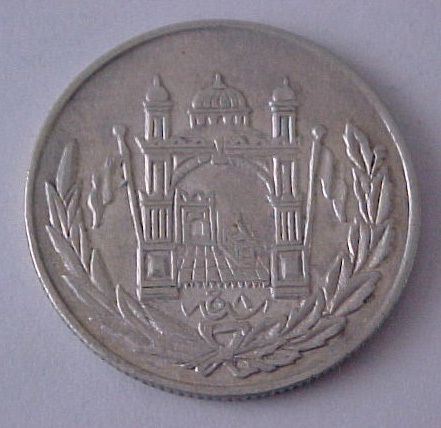
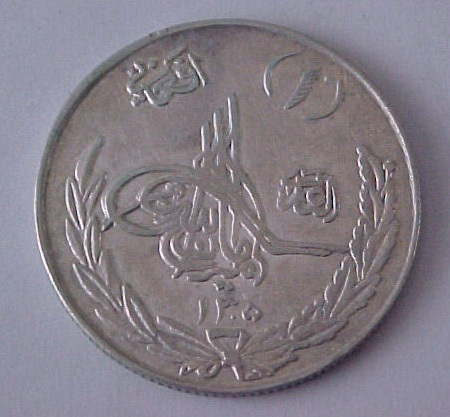
The date on the coin is "1305". Afghanistan had two "year 1305s", the first in AD 1887/8 and the second in AD 1926. That's because, in AD 1922, Afghanistan officially switched from the Lunar (AH) to the Solar (SH) Islamic calendar. For the years which "occur twice" (1298-1337), the only thing you can do, if your Arabic/Persian isn't good enough to read the Shah's name inside the toughra (and it sure isn't for me) or read the name of the denomination (which for me is hit-and-miss), is to pick one possible date, try looking it up, and if you can't find it, try the other option. It helps that coin design in Afghanistan rarely stayed the same for 40 years, so the coins from the two time periods look radically different.
In your case, it's the later option, SH 1305, the 1 afghani, KM# 910. KM# 910 was not produced in AD 1886/7.
You'll have to ask a Muslim to verify the theological implications of the two different calendars. But as I understand it, the Qur'an explicitly states the number of months and the names of two of them and the teachings of Muhammad and his successors state the definition of "Year 1" as the year Muhammad fled persecution in Mecca, but nowhere is it explicitly defined what a "year" is. Traditionally, the Arabian nomads out of which Islam arose had used the Lunar calendar, comprising 12 months of 29.5 days, giving a total of 354 days to the year. In the deserts of Arabia, North Africa and the Middle East, where rainfall is irregular and "seasons" have little meaning, having a year that is disconnected from the seasons has little practical impact.
However, in Persia and surrounding lands, the calendar had long been connected to the solar year (just like the AD calendar is) prior to the arrival of Islam, with a strong tradition of astronomers/astrologers carefully observing to keep the year matched to the Equinox. At first, newly Islamized Persia used the Lunar calendar, but in AD 1079 the Persian rulers recognized the impracticality of a Lunar calendar for local use and adopted a Solar calendar instead, the Jalali calendar. They continued to use the old AH calendar on their coins, but in daily life the solar calendar was used. Finally, in AD 1911, a modified Jalali calendar was formally adopted in Persia, followed by Afghanistan in AD 1922.
So, both the SH and AH calendars consider "Year 1" to be AD 622. But because the AH year is shorter, the number of AH years is larger than the number of SH years. Thus, over the centuries, the two calendars have drifted apart.
Hope this helps, rather than confuses further.
In your case, it's the later option, SH 1305, the 1 afghani, KM# 910. KM# 910 was not produced in AD 1886/7.
Quote:
What is SH & AH all about ? Why two SH & AH?
What is SH & AH all about ? Why two SH & AH?
You'll have to ask a Muslim to verify the theological implications of the two different calendars. But as I understand it, the Qur'an explicitly states the number of months and the names of two of them and the teachings of Muhammad and his successors state the definition of "Year 1" as the year Muhammad fled persecution in Mecca, but nowhere is it explicitly defined what a "year" is. Traditionally, the Arabian nomads out of which Islam arose had used the Lunar calendar, comprising 12 months of 29.5 days, giving a total of 354 days to the year. In the deserts of Arabia, North Africa and the Middle East, where rainfall is irregular and "seasons" have little meaning, having a year that is disconnected from the seasons has little practical impact.
However, in Persia and surrounding lands, the calendar had long been connected to the solar year (just like the AD calendar is) prior to the arrival of Islam, with a strong tradition of astronomers/astrologers carefully observing to keep the year matched to the Equinox. At first, newly Islamized Persia used the Lunar calendar, but in AD 1079 the Persian rulers recognized the impracticality of a Lunar calendar for local use and adopted a Solar calendar instead, the Jalali calendar. They continued to use the old AH calendar on their coins, but in daily life the solar calendar was used. Finally, in AD 1911, a modified Jalali calendar was formally adopted in Persia, followed by Afghanistan in AD 1922.
So, both the SH and AH calendars consider "Year 1" to be AD 622. But because the AH year is shorter, the number of AH years is larger than the number of SH years. Thus, over the centuries, the two calendars have drifted apart.
Hope this helps, rather than confuses further.
Don't say "infinitely" when you mean "very"; otherwise, you'll have no word left when you want to talk about something really infinite. - C. S. Lewis


