| Author |
 Replies: 13 / Views: 2,022 Replies: 13 / Views: 2,022 |
|
|
Valued Member
Canada
155 Posts |
Here is an old Judean prutah. I've tried to identify it, but I'm only guessing. Would this be Hasmonean ( 167 - 37 BCE)? It's 12-13 mm in diameter. Could it be John Hyracanus (135-104 BCE? I'm making some wild guesses, so any help would be appreciated. 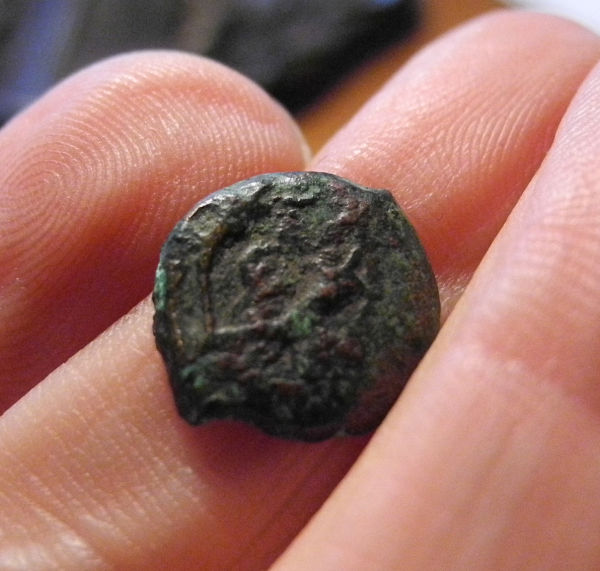 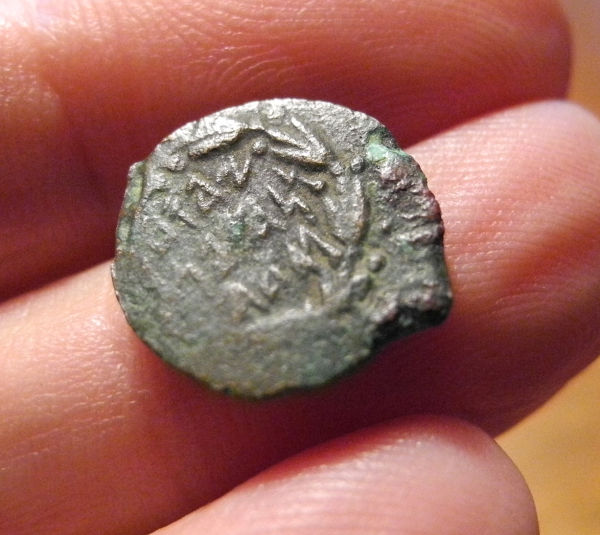 |
|
|
|
Valued Member
 Canada
155 Posts |
I notice lots of views but no replies.
Does anyone know someone, CCF member or otherwise, who could offer a positive ID of this coin?
I have checked my reference "Coins of there Land of Israel", but so many of them look the same to my untrained eye. I am tending towards Hasmonean dynasty, simply based on the "look".
|
|
Valued Member
United States
422 Posts |
Carleroo. I believe your ID of John Hyrcanus I (Yehohanan) 135-104 BCE is the correct one. Hyrcanus ruled from 135 BCE until his death in 104 BCE. He was the son of Simon and nephew of the folk hero Judah the Maccabee. According to Josephus, Hyrcanus was endowed with three godly gifts - temporal power, the dignity of a high priest, and the gift of prophecy. The young Jewish kingdom lost a great deal of prestige when he died after a 30 year reign.
And because he reigned that long he had at least nine known coin types minted either in Jerusalem or possibly Samaria. Among those nine there was a great deal of mis-spelling, errors, off center and double struck coins making ID's that much harder. And in your case it was hard to tell exactly which coin you had because of the off center strike, but I think I have a match. At least I'm about 90% sure.
According to Hendin (fifth edition, 2010) it would be #1140. AE Prutah
Obv: Paleo-Hebrew inscription (Yehohanan the High Priest...) within the wreath.
Rev: Double cornucopia adorned with ribbons, pomegranate between horns, border of dots. These coins had many errors in the Hebrew lettering. Hendin has the worth between $25-100, depending on condition. Hope this helps.
|
|
Valued Member
Canada
155 Posts |
This helps a lot! Many thanks!
|
|
Valued Member
United States
422 Posts |
My pleasure. As many times the forum helped me, giving back a little feels good.
|
|
Valued Member
Canada
114 Posts |
I'm surprised no one has answered yet. There are some experts here. I'm not even close but I think you are right about Hasmonean. this is a tough one because most of them look the same. They're just minted on different dates and I can't read that scribbled Hebrew. Go to forvm.com and Click on judean coins and on the left they are all organized by ruler. Click on Hasmonean and try to match the script on your coin with one on the site. There has to be a letter or symbol that will let you know which ruler it belongs to.
|
|
Pillar of the Community
United States
4253 Posts |
Quote:
I'm surprised no one has answered yet It has been my observation that many (if not most) of the members here collect mostly Roman Imperial coins with a sprinkling of Roman Republican and Greek coins. I am one of these Imperial coin collectors. I have never collected Judean or Greek coins so know nothing to be able help. I'm sure that if anyone had anything of value to help in the attribution, they would have contributed. I knew that oxos would eventually chime in as this is his area of collecting. Nice going Chris. |
|
Valued Member
United States
422 Posts |
Thanks JW... that means a lot.
|
|
Pillar of the Community
United States
4778 Posts |
I have no knowledge of these coins either (I collect mainly Roman imperial and some Byzantine coins), but it's still a nice coin nonetheless IMO
|
|
Valued Member
Canada
114 Posts |
Sorry. I started typing, went back into work, then finished my reply at my next brake. I should have checked for replies before I hit submit. Oxos' answer is exactly what I was waiting for.
Edited by tevlon
04/04/2012 5:43 pm
|
|
Valued Member
Canada
155 Posts |
Thanks, all. I do have a mindless question. What is it about Roman coins, as opposed to the Greek coins, that make them attractive to collectors?
|
|
Pillar of the Community
United States
4253 Posts |
Quote:
What is it about Roman coins, as opposed to the Greek coins, that make them attractive to collectors? I can answer for only me. 1. With Roman coins I can read the legends easily whereas my knowledge of Greek is strained every time I try to decipher a legend. 2. On top of that, I know Roman history much better than Greek history, so I can relate my knowledge to each coin. 3. One last reason. Greek coins are much more expensive. And because of this fact, fakes abound, and I'm not expert enough to identify one from the other. Also there seems to be an abundance of Roman coins found every year making it easier for collectors like myself to have a nice collection. |
|
Valued Member
Canada
155 Posts |
I can see that. From my knowledge of history, I can recall a whole pile of Greek city states, colonies, etc., while with Rome, there is just Rome. That must also make it easier to be able to identify coins and see how they fit into the historical record.
|
|
Pillar of the Community
United States
4778 Posts |
Quote:
I can answer for only me.
1. With Roman coins I can read the legends easily whereas my knowledge of Greek is strained every time I try to decipher a legend.
2. On top of that, I know Roman history much better than Greek history, so I can relate my knowledge to each coin.
3. One last reason. Greek coins are much more expensive. And because of this fact, fakes abound, and I'm not expert enough to identify one from the other. Also there seems to be an abundance of Roman coins found every year making it easier for collectors like myself to have a nice collection. You pretty much answered for me also. But for me personally, for #2, I have to add also that I find Roman history more interesting, which help in my having more of an interest for Roman coins than for Greeks. |
| |
Replies: 13 / Views: 2,022 |
|










 Posted 04/04/2012 2:13 pm


