| Author |
 Replies: 7 / Views: 12,254 Replies: 7 / Views: 12,254 |
|
|
Valued Member
Pakistan
207 Posts |
Could someone explain to me please the different types of the 1992 10p coin, along with information about which ones are common and which are rare? The bit about the dots I can understand easily enough (type 1 and 2 and A and B), but apparently there is a third variable at play as well, whether the edge is "Flat" or "Wired".
I don't understand what these terms mean, and I'm not being able to figure it out looking at my coins, so it is causing me a headache to classify and catalogue them.
With type 1 being with the L and I aligned between two dots (and 2 being them aligned with 1 dot), and type A being with 1 aligned to a dot and B being 1 aligned between two dots (my eyesight is not good enough to make out the tufts and the mane), I have 1A, 1B, 2B, but I don't know how to further classify them according to the edge.
|
|
|
|
Valued Member
 Pakistan
207 Posts |
It seems that most here do not know this :(. I tried googling also, but that didn't help....
|
|
Pillar of the Community
Canada
2366 Posts |
Here is some relevant info; although not specific to the UK 10p ocin.
The Wire Rim and Flat Rim Double Eagle varieties resulted from the use of different collars. in the case of the Wire Rim variety, the collar was not sufficiently tight and the pressure of the repeated blows forced metal up where the edge of the coin meets the collar to form a very thin wire rim. On most Wire Rims, this raised metal encircles the whole coin, both obverse and reverse, while on the Flat Rim variety, the edge is flat, if not beveled.
wire edge
The thin, knife-like projection seen on some rims created when metal flows between the collar and the dies. Also, slang for the Wire Edge Indian Head eagle of 1907.
Wire edge
An effect whereby a thin, wire-like section of the rim of a coin is raised above the rest of the rim along the outside.
WIRE EDGE
Slight flange on coins or medals caused by heavy striking pressure, often characteristic or proof coins. Also Knife Edge, Wire Rim.
|
|
Valued Member
Pakistan
207 Posts |
Thanks for the help, kuh! So many complicated terms :(.... So to understand this correctly, when the different edges of the 1992 10p coins are described at http://en.numista.com/catalogue/pieces879.html as: Quote:
minor varieties concerning edge sharpness and width. rounded ("wire edge"-type; looking thinner, tapers to a narrow reeding) or sharp square edge ("flat edge"-type that uses the full width for reeding) It means something like this? 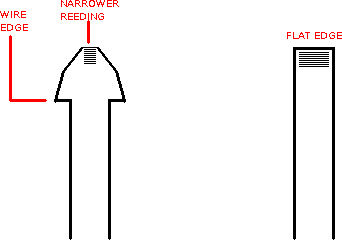 |
|
Pillar of the Community
Canada
2366 Posts |
My understanding is it would be a thin strip of medal sticking up (and/or down) at the outer edge of the coin. Sorry, I haven't seend or read about this type of error on any Canadian coins so I haven't actually seen one in person.
|
|
Valued Member
Pakistan
207 Posts |
For those of you who were wondering, (probably only myself  ), while I can barely make out the difference of the wire edge, I recently found both type of coins, which made the difference much more evident. The narrower reeding makes it much more obvious. It really does look thinner, but it is not:  |
|
Pillar of the Community
United Kingdom
709 Posts |
A really useful reference is "The Identification of British 20th Century Silver Coin Varieties" by David J Groom, published 2010.
There is also a similar book for bronze coins.
It mentions the 4 varieties 1A 1B, 2A and 2B as described in Babar's opening post. Then goes on to state the wire edge is only found on variety 1A, ( as well as the flat edge ), making 5 varieties in total.
Of course, it is possible that more varieties have come to light since then.
|
|
New Member
Australia
45 Posts |
A really useful site can be found at http://www.coins-of-the-uk.co.uk/dec10.html This lists the varieties and gives scarcity by percentages as follows: Obv 1, Rev A, Wire Edge: Extremely common (about 40%) Obv 1, Rev A, Flat Edge: Extremely common (about 40%) Obv 2, Rev B, Flat Edge: Very common (about 20%) Obv 1, Rev B, Flat Edge: Scarce (less than 1%) Obv 2, Rev A, Flat Edge: Rare (much less than 1%) The wire edge is easily identified as it is quite rounded whereas the other edges are quite flat. There is also a list of the later years with their die variations. I have seen examples of the two 2005 dies, but although Tony states that both types are common, I found the Die B to be very scarce. I am no longer in the UK and I have not had the chance to collect any other varieties so I can't really comment on their scarcity or otherwise. I have listed my varieties using letters to define the die, letter position and edge, keeping to the same order to avoid confusion. Die A = A, Die B = B, letters at the dots = A, letters between dots = B, wire edge = W, flat edge = F. For example, Die B, letters at the dots and with a wire edge would be BAW. The five types would therefore be BAW, BAF, ABF, BBF and AAF. The wire edge is only found in the one combination and I believe results from a different planchet source. Hope this helps. Edited by eccentric
10/14/2012 10:48 pm
|
| |
Replies: 7 / Views: 12,254 |
|










 Posted 05/08/2012 3:30 pm


