| Author |
 Replies: 7 / Views: 1,615 Replies: 7 / Views: 1,615 |
|
|
Rest in Peace
1988 Posts |
Hi guys Are these considered die clashes on this 1975 nickel dollar...? 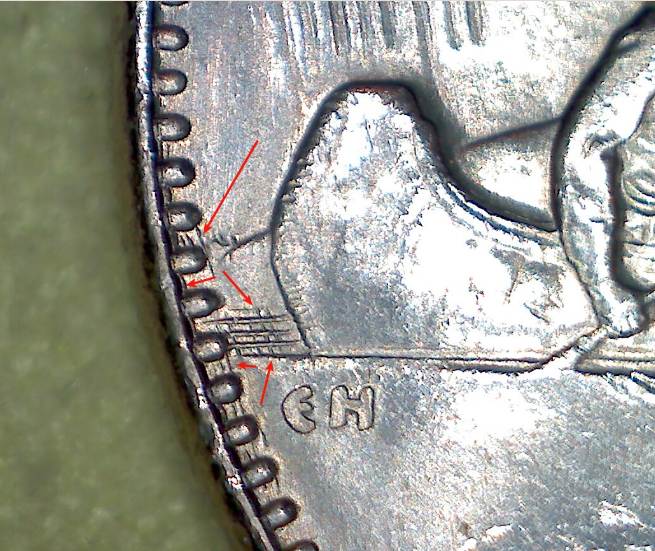 |
|
|
|
Pillar of the Community
Canada
686 Posts |
Hi wert, looks like lathe lines. Is it posible to see the incused sections of the whole coin? It looks like someone was lasy on the old polisher. I bet it's a marker.
|
|
Rest in Peace
 1988 Posts |
Hi cownickHere is a wider picture. 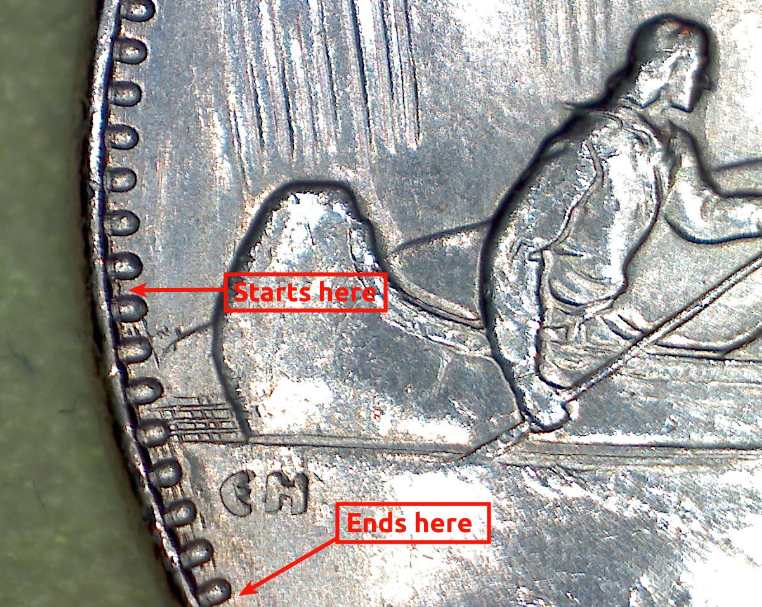 |
|
Moderator
 Canada
10479 Posts |
By definition, these are not clash marks. Clash marks seen on the reverse, would have to be imparted from design elements on the obverse (e.g., beads, legend or effigy).
Remember, the term die clash refers to the dies coming together in contact with each other, and impart elements of the designs onto each opposite die. This mishap occurs when opposing dies collide with each other when a planchet fails to be fed into the striking chamber. Most complete planchet misfeeds don't result in clashed dies because dies normally don't touch each other in the absence of a planchet. In order for dies to clash, the dies must have fallen out of adjustment so that their minimum clearance is zero (or less than zero).
Clash marks are the impressions left on each die after a clash. Part of the design of each die is transferred to the opposing die when they smack into each other. Remember that the fields are the highest points on the dies, so where you find the clash marks will be where the fields on a given side come in contact with the edges of the incuse design elements. Therefore, any coin that is struck will show extra design elements that are mirror-image. Shallow recesses on the die face (corresponding to low-relief areas on the coin) can also pick up clash marks, the "hearing aid" clashes that you see on George VI coins are examples of this. Deep recesses are generally protected from even the strongest clashes. In modern coins, the periphery of each die face will also be free of clash marks in most instances due to die convexity. Each die face bulges out ever-so-slightly, and the convexity is strongest at the periphery. Since opposing surfaces are curving away from each other, there is little opportunity for contact. In older coins however, you can find clash elements almost right out at the rim. In fact, for some years of the Victorian and Edward series, it is much harder to find a clash-free example than one with a die clash.
"Discovery follows discovery, each both raising and answering questions, each ending a long search, and each providing the new instruments for a new search." -- J. Robert OppenheimerContent of this post is licensed under a Creative Commons Attribution-NonCommercial 3.0 Unported License. See: http://creativecommons.org/licenses...0/deed.en_USMy eBay store
|
|
Rest in Peace
1988 Posts |
OK SPPYou blew me away with that explanation (as usual)..WOW Sooooo, are they lathe lines (some how I feel I am going to regret asking...  )
|
|
Moderator
Canada
10479 Posts |
The lines in your coin are straight, I would expect lathe lines to be curved. It almost looks like someone, either intentionally or not, took a file to the surface of the die. Those lines are not only straight, but they only appear in the fields (the highest point of the die surface).
"Discovery follows discovery, each both raising and answering questions, each ending a long search, and each providing the new instruments for a new search." -- J. Robert OppenheimerContent of this post is licensed under a Creative Commons Attribution-NonCommercial 3.0 Unported License. See: http://creativecommons.org/licenses...0/deed.en_USMy eBay store
|
|
Pillar of the Community
Canada
686 Posts |
I was hopeing there were more lines on the coin verifying direction of the lines. I have only seen lathe lines on Canadian nickels on 3 different years. They range from just 1 or 2 or 3 on each coin to 75 per coin.
Your coin looks to be in very good shape. This is a plus for a human error coin.
Although file marks are a possibility, I must disagree. The lines must be straight and perpendicular to the coins centre. Only on this example one can not prove direction. This is rarely seen on Canadian coinage and is a very nice addition to an on going search.
|
|
Rest in Peace
1988 Posts |
cownick
I am going to take a second look at that coin for lines all around....
|
| |
Replies: 7 / Views: 1,615 |
|




 Posted 05/12/2012 10:19 pm





