| Author |
 Replies: 26 / Views: 10,404 Replies: 26 / Views: 10,404 |
|
Pillar of the Community
Canada
2366 Posts |
I've been staring at this for half an hour. Half the time I think narrow and the other half I think wide.  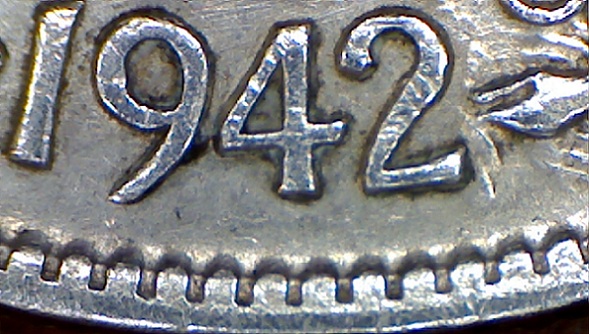 |
|
|
|
Pillar of the Community
 Canada
9902 Posts |
|
|
Pillar of the Community
 Canada
2366 Posts |
|
|
Valued Member
Canada
456 Posts |
This one is neither narrow or wide but kind of in between. In a true wide date 1942, the tail of the two overlaps the hoof... See the following image 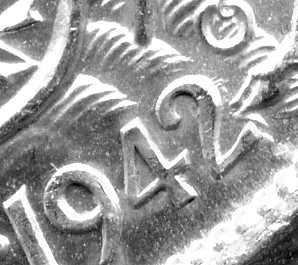 Since the last two date digits for 1942 were entered individually on the dies, and there were 47 reverse dies used, there are 47 digit spacings possible. There are only very few that are real wide and very few that are real narrow and the rest are in between these two extremes. The last two date digits for the Fifty Cent dies were punched individually for 1941 through 1949, and the last digit was punched individually for 1951 and 1952. The date digit spacing is the same for all fifty cent coins in any year 1937,1938,1939,1940,1950. The fact that the date digits were entered into the dies by hand makes for a lot of repunched date digit varieties especially for 1942 through 1945.  Edited to correct typo.... Edited by pginrh
05/14/2012 3:04 pm
|
|
Pillar of the Community
Canada
9902 Posts |
Thanks pginrh,I always assumed if it wasn't narrow,with the 9 and 4 nearly touching,it was wide.I thought all had to be defined as wide or narrow and didn't realize there was also a limbo state of neither wide nor narrow.
Edited by DBM
05/14/2012 1:38 pm
|
|
Pillar of the Community
Canada
684 Posts |
Question, Why in the Charest, Canadian coins and there varieties, dose he state the 1942 as being high 42, high4- low2 and low2. I do not see narrow or wide listed in this year? I have always had trouble in the past learning the difference until I bought the Charest Internet 9th edition 2012.
|
|
Pillar of the Community
Canada
2366 Posts |
Narrow and Wide are the designations in the 2012 Charlton.
|
|
Valued Member
Canada
456 Posts |
Charltons was looking for a way to characterize the dates. Within the narrow/intermediate/wide date categorization you can then have high/low date digits or repunched date digits or different punch style sub classifications. Although there is a 1943 3/3 shown in Charltons there are at least twenty 3/3's and one 3/3/3 that I am aware of. For 1944 there is one 4/4 listed, but I am aware of over 10.
The hand punching of those last two date digits makes for a lot of possibilities.
|
|
Rest in Peace
1988 Posts |
Sooooooooooo, this would be a narrow date...? 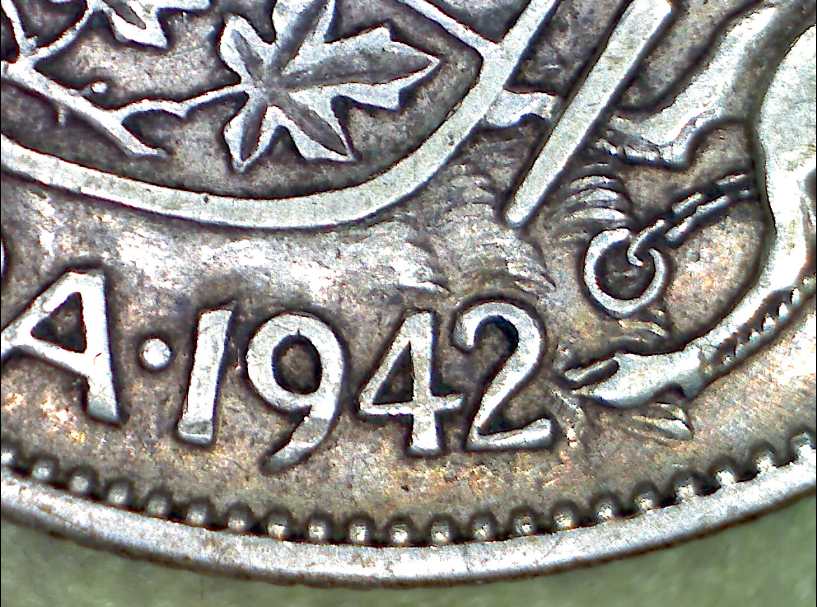 |
|
Pillar of the Community
Canada
2366 Posts |
Looks like it to me! (For what little that's worth :-) )
|
|
Rest in Peace
1988 Posts |
Wasn't looking for wealth kuh_85, just knowledge.
|
|
Valued Member
Canada
456 Posts |
Looks like its tending towards being a narrow date ... in the most extreme narrow date, the 4 is almost touching the 9. Also in the 1942 Fifty Cent coins look for a repunch under the bar of the 2..... there are three different ones....if you look closely at Charlton's Catalogue for his 1942 Wide Date (not as wide as some others) you can see one of them.
|
|
Rest in Peace
1988 Posts |
Wow pginrh
Didn't realize there were so many varieties.
Will have to get my 2012 Charlton out and read more about it.
|
|
Pillar of the Community
Canada
2366 Posts |
@wert: I was referring to the value of my opinion, not the coin.  |
|
Rest in Peace
1988 Posts |
SORRY kuh_85...  I thought you were being nasty, My apology my friend. Hey guys, while we are at it, look at my coin on the LEFT and kuh_85's coin on the RIGHT. Does my coin look like a HIGH 4 or kuh_85's coin look like a LOW 4...? 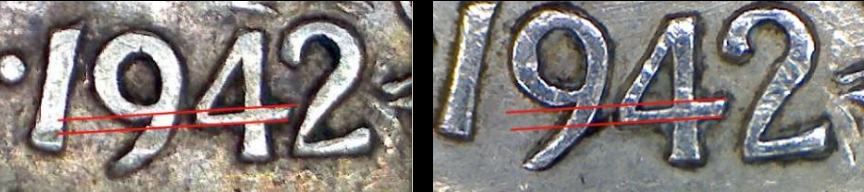
Edited by wert
05/15/2012 5:06 pm
|
|
Valued Member
Canada
456 Posts |
I can't say I see much difference in the side by side comparison above. I haven't noticed much difference in the 4's but there is certainly a high 2 and a low 2 for the 1942's.
|
| |
Replies: 26 / Views: 10,404 |







 Posted 05/14/2012 11:20 am





