Not sure if these are technically ancients but I wanted to post them here in the ancients forum because they have that ancient look about them:D The ID's are from the vcoins seller. I am not sure where to verify attribution for this type.
I simply could not resist the castle and lion motiffs!

Included a some wiki history. Feel free to comment on history and / or attribution:)
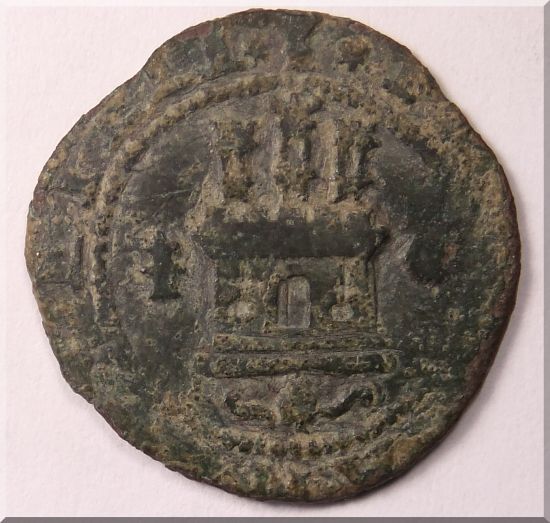
This first coin is:
Fernando V. and Isabella AE25 (2) Maravedis. Castle / Lion
Spain, Castilia and Leon, Fernando V. and Isabella (Reyes Catolicos), Cuenca mint, 1474-1504 AD.,
Obv.: FER-NA[NDVS] ET EL , around a castle, patriarchal cross in left field; beneath, ornament.
Rev.: *I* REX [E]T REGI[NA CA]ST L , around crowned lion to left.
VF+/VF+
The Catholic Monarchs is the collective title used in history for Queen Isabella I of Castile[2] and King Ferdinand II of Aragon. They were both from the House of Trastámara and were second cousins, being both descended from John I of Castile; they were given a papal dispensation to deal with consanguinity by Sixtus IV. The title of "Catholic King and Queen" was bestowed on them by the Pope Alexander VI in 1496, for defending Catholic dogmas within their realms. They married on October 19, 1469, in the city of Valladolid; Isabella was eighteen years old and Ferdinand a year younger. Their marriage united both crowns under the same family. Although many historians, like John Elliot argue that the unification of Spain can essentially be traced back to the marriage of Ferdinand and Isabella, newer historical opinions recognize that under their rule Spain was still a composite monarchy. Castile and Aragon would remain largely separate entities for decades to come. The court of Ferdinand and Isabella was constantly on the move, in order to bolster local support for the crown from local feudal lords.
The 15th century was one of extreme monetary confusion in Castile, reaching a peak under Henry IV (1454--1474). The monetary system was finally reformed and stabilized under Ferdinand and Isabella, when they issued the Ordinance of Medina del Campo. The maravedí then became the smallest Spanish unit of account, the thirty-fourth part of a real. In the new world, nonetheless, there are documents which testify to the reduction of their value to less than the thirtieth part of a real. This reduction was on account of the cost and risk of their transportation from Spain, before the establishment of the first mint houses of Mexico and Santo Domingo. The maravedí remained a money of account in Spain until 1847.
After the discovery of America, copper maravedís, along with silver reales, were the first coins struck in Spain for the purpose of circulation in the New World colonies. These coins, minted with a special design for specific use of the Americas, were first coined in Seville in 1505 for shipment to the colonial island of Hispaniola the following year, thus giving these coins their distinction as the first coins for the New World.

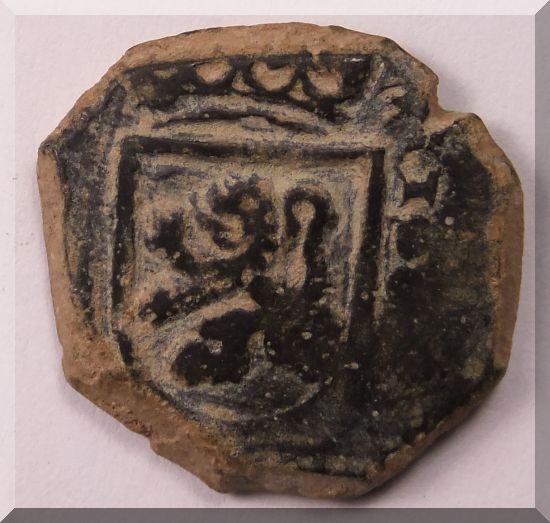
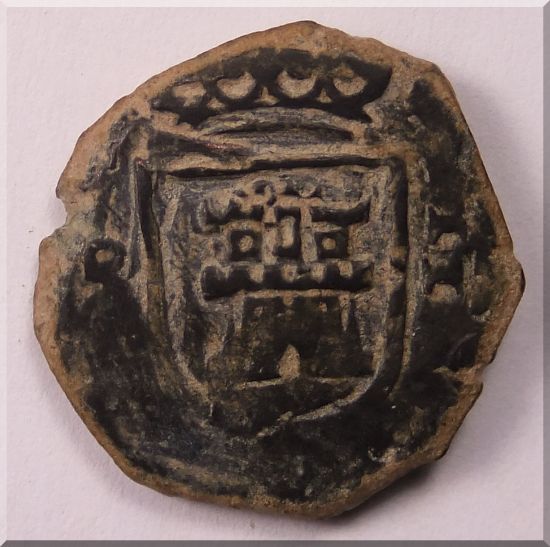
This second coin is:
Philip III of Spain (Spanish: Felipe III, Portuguese: Filipe II; 14 April 1578 -- 31 March 1621), also known as Philip the Pious, was the King of Castile, Aragon, and Portugal. He was also king of Naples and Sicily as Philip II. Born in Madrid, the son of Philip II of Spain and his fourth wife (and niece) Anna, daughter of the Emperor Maximilian II and Maria of Spain, he married Margaret of Austria, sister of Emperor Ferdinand II, and like her husband, a member of the House of Habsburg.
Although considered to be a congenial and pious ruler, Philip's political reputation has been negative -- an 'undistinguished and insignificant man,' a 'miserable monarch,' whose 'only virtue appeared to reside in a total absence of vice,' to quote three major historians of the period. In particular, Philip's reliance on his corrupt chief minister the Duke of Lerma drew much criticism at the time and afterwards. For many, the decline of Spain can be dated to the economic difficulties that set in during the early years of his reign. Nonetheless, as the ruler of the Spanish Empire at its height, and as the king who achieved a temporary peace with the Dutch (1609--21) and brought Spain into the Thirty Years War (1618--48) through an initially extremely successful campaign within the Holy Roman Empire, Philip's reign remains a critical period in Spanish history.
 Moved to World Coins forum - Sap




 Posted 05/19/2012 6:08 pm





