A mysterious Martian silver coin!
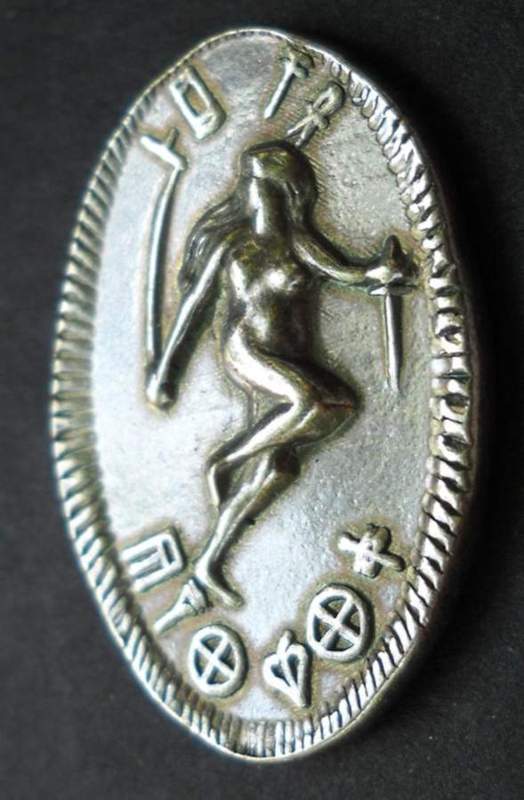
Here is something really very unusual! A small oval coin weighing exactly five grams of pure .999 fine silver. The story goes that a small hoard of these was found in a cave in the desolate hills of the (location redacted) area of the south central Nevadan desert. They feature a nude female figure with sword and dagger on one side. This is no wasp-waisted nymph, but a full-bodied warrior woman in fighting trim! She bears a long curved sword in her right hand, the sword appearing to have a full handguard in the style of a classic naval cutlass. In her left hand she holds a straight bladed dagger with cross-guard in a reverse grip. Her pose would indicate that she's about to initiate a powerful back-kick while defending herself from attack from two directions.
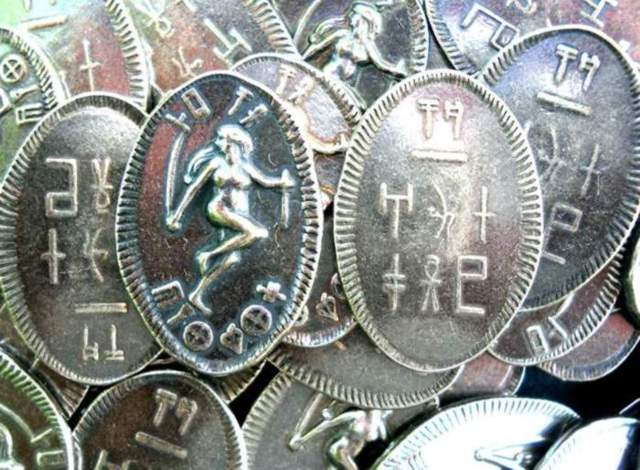
There are apparently inscriptions at top and bottom on the obverse side... as well as on the reverse. Scanning a book on ancient scripts, the shape of the characters appears to be very similar to the pre-Hellenic Mycenaean called "linear-b", which was a great mystery until 1953 when it was finally deciphered. If we attempt to interpret the inscriptions per the syllbary of linear-b we get a series of syllables and perhaps a few reconizable words. One problem with linear-b (and a reason it took so long to decipher) is that it is a sort of shorthand and rather imprecise as to exactly how something should be pronounced. Ending consonants are never written, it is just assumed that the reader will know what they are. So our decipherment will give us a range of words that could be represented rather than a precise vocalization.
The top inscription on obverse... two sets of two letters each. De-Ya To-Ri. These do not appear to be among the list of known words so perhaps it is a name. The first name could be pronounced day-yaa, or deh-yas, or day-jah, or even day-jam. There is no distinction between the hard "t" sound and the soft "th" sound... so the last name could be toe-ree, or thoe-rees, or toe-reem or any of a number of other possibilities. Apparently the users of the coin would know the name so well that they would not need it spelled out any better.
The bottom inscription on obverse seems more complex and one letter even repeats. We get:
Wa-Na-Ka Tu-Ka-Te Actually this one is quite straightforward, Wanaka is the word "king" and tukate is the word for "daughter"... so putting them together "king-daughter" could possibly be taken to mean "princess".
On reverse the top pair is To-So.... a common word meaning "this many" or "this much"
Below the top is a horizontal bar. We may interpret this as a simple graphic element separating the upper from lower inscriptions, but in using linear-b to write numbers, the numeral for "ten" is a horizontal dash... so taking into account the top inscription this could conceivably be literally a number.... interpreted thusly:
"This many: TEN".
The next line transliterates as A-Ku-Ro... the Mycenaean word for silver. Hmmm... since this is clearly a silver piece that is an encouraging sign that we are on the right track.
The final line is Pa-Ri-Su. Again it is not one of the recognized words so we have to assume it's a name. There is no distinction in linear-b between the "b" sound and the "p" sound... so this one could go either way... and again... no ending consonants are ever written. So we've got something like Pah-ree-soo. or Bah-ree-soo... possibly with a consonant on the end like Parisook or Barisoom.
If one happens to be a science fiction fan, then a couple of things jump out and suggest a connection to the work of Edgar Rice Burroughs. Taking just some minor liberties with pronunciation, we could interpret the obverse inscriptions on this coin as "Dejah Thoris, Kingdaughter". Now Dejah Thoris is, as we all know from reading about John Carter of Mars, the princess of Helium on the planet of Barsoom. We may be shocked at her nudity, but Burroughs has already told us that Martians have not the body-shame of most earthers. And she is shown fighting... not the sort of princess-like pose we have grown up with, but fitting in the context of Barsoomian culture. We know that Barsoomian coinage is oblong, which this is... and either copper, bronze, silver, or gold. So far so good. The silver "ten" piece is even mentioned in the texts. And we can easily imagine someone speaking the word "Parisum" in such a way that a listener might spell it "Barsoom". Finally we have the coins found in a desert cave... just such a one as Burroughs described as the location of the mysterious transit point that John Carter uses to travel to and from Mars. So it all fits... and if that interpretation is correct then this is it, final and incontrovertible proof of transdimensional transit of objects from worlds that were seemingly fictional!
The question remains though... why are they inscribed in Myceaean Greek... does that imply that John Carter was not the only Earth Human ever to travel to Mars? Or... that Martians travelled to earth in pre-Hellenic times? Could they be the source of all the old myths? And... how did the coins get here? Is this coin evidence of the truth of the manyworlds hypothesis? Could the Circle of Ourobouros be for real, or did Heinlein get it backwards and authors are not creating these worlds, but simply accessing them on quantum timespace neuronal levels? And now that we know there have been two documented occurrences of contact... might there be yet more? And is it just coincidence or some cosmic intent that brings us these coins at this particular moment in time, on the 100th anniversary of the 1912 publishing of Edgar Rice Burroughs' JOHN CARTER OF MARS? The mystery deepens!
Just to be clear, I make these fantasy coins! I created the blanks by melting and rolling out a 100 oz Englehard .999 silver bar and punching the oval blanks. I cut the dies myself using a combination of hobbing and rotary engraving techniques. Since they are emulating an "ancient" coin, I tumbled them brutally with chemicals to create a "circulated" toning and appearance. In case you're interested, I have a shop-tour page here:
http://www.shirepost.com/ShopTour.htmlThese Dejah Thoris silver pieces were struck using the green 150 ton Waterbury Farrel knuckle press.










 Posted 05/26/2012 10:25 pm


