| Author |
 Replies: 29 / Views: 32,858 Replies: 29 / Views: 32,858 |
|
Pillar of the Community
United States
2269 Posts |
I love to collect different series of coins, themes, different precious and semi precious metals.
Besides owning copper, silver, and gold, I have been on a search for other metals to own. I recently purchased a rhodium coin from the Cohen Mint. Soon I plan to add platinum and palladium to my collection.
But, one of my favorite metals is one that hasn't been produced for almost 1500 years. The metal I am talking about is Electrum. Some are probably thinking "What is Electrum." Electrum is a naturally occurring alloy of gold and silver. Trace amounts of copper can also be found in Electrum.
Greeks referred to the metal as white gold. The color of Electrum can vary from a pale yellow to a deep yellow, depending on the gold to silver ratio. The higher the gold content, the more yellow Electrum appears and visa versa.
First minted by Ancient Lydian, this metal has been around for about 7500 years. The Byzantine Empire was the last major power to produce coins in this metal. Gold essentially eliminated the need for producing Electrum.
Electrum is a forgotten precious metal for producing coins or bullion. I would love to see this metal make a resurgence. The price would probably be less money than gold, but much higher than the spot price of silver.
Electrum is my favorite precious metal and I would love to be able to have a bullion piece to add to my precious metals collection.
My question is this; if an Electrum Bullion coin or bar was produced would anyone want to purchase it, or am I alone on this?
For now, I will happily settle for my Bosporus Stater of Caracalla. If anyone wants to know what an Electrum coin looks like, Just look at my avatar. Personally, I love the look and the idea of owning an uncommon precious metal.
|
|
|
|
Pillar of the Community
United States
3345 Posts |
Wow spider thats really interesting! Thanks for sharing!
Any idea of the surviving population of electrum coins that were made?
And If I had the money I would consider buying a bullion coin of electrum!
|
|
Pillar of the Community
United States
3294 Posts |
Technically, it is an alloy, not a metal. The problem I would see with electrum is one of purity. Is there a standard silver to gold ratio for it to be electrum? If you are talking about bullion, you will need some kind of standardized ratio since obviously gold and silver have significantly different values, making a 10G90S bar not worth the same as a 50G50S bar even though both may have the same weight and both be electrum.
|
|
Moderator
 Australia
17023 Posts |
The difference between "electrum" and "debased gold" is simply a matter of origin; electrum is naturally-occurring. And it's the natural variability of the composition of electrum that sounded the death-knell of classical electrum coinage. Nobody knew for sure exactly what the bullion value of an individual coin was, and the temptation to dilute the electrum with even more silver proved too great: natural Anatolian electrum is typically 70-90% gold, while few electrum coins test higher than 60% gold. In the end, it was easier to refine the electrum into its constituent parts and make pure gold and pure silver coins.
Don't say "infinitely" when you mean "very"; otherwise, you'll have no word left when you want to talk about something really infinite. - C. S. Lewis
|
|
Pillar of the Community
United States
2661 Posts |
 Good job Spider and thanks to you and Sap, and Nod for the very educational posts. I never knew of Electrum until now so I am forced to look deeper into this subject. |
|
Pillar of the Community
 United States
2269 Posts |
Coins of Ancient Lydian and the Bosporus are available. These can be a little pricey. Carthage also mintef coins in electrum.
A while back I was looking for an electrum ancient coin at a reasonable price. I found later Byzantine electrum coins to be the least expensive, between 3 to 5 hundred dollars on average.
I am glad to be able to share some of my knowledge about Electrum coins.
|
|
Valued Member
United States
88 Posts |
Electrum is naturally occurring with widely varying compositions. Silver, gold, and copper are closely associated on the periodic table and often tend to occur together in nature. Dick Hanscom of Alaska Rare Coins http://www.alaskacoinexchange.com/a...ska%20RC.htmhas taken the step of making coins from natural gold electrum found primarily as placer deposits in various areas in Alaska, and making coins from the raw gold, which are marked with assayed purity and weight. Or if you're interested, you could always have something made from scratch and then you'd be able to control the precise ratio of gold to silver. I've always thought it would be neat to do a series of coins for both electrum and billon. With alloys varying by 10% increments from coin to coin. So the Electrum series would go like this: 100% Au 90Au 10Ag 80Au 20Ag etc to pure silver, while the billon series would go 100% Ag 90Ag 10Cu 80Ag 20Cu and so forth all the way to pure copper. The thing is, the metallurgical phase diagrams will tell you the melting points of all these alloys, but COLOR is something much more subjective! It would be neat to have the whole set to look at to see the pattern of how the color of the metal varies with alloy. Tom Maringer Shire Post Mint Springdale Arkansas Custom minting Buttons, Coins, Trinkets, and Baubles Pendants, Charms, Badges, and Pins Edited by tmaring
05/23/2012 11:15 am
|
|
Moderator
Australia
17023 Posts |
Quote:
The thing is, the metallurgical phase diagrams will tell you the melting points of all these alloys, but COLOR is something much more esoteric! It would be neat to have the whole set to look at to see the pattern of how the color of the metal varies with alloy. You can see a gold-silver-copper colour ternary plot on Wikipedia. Don't say "infinitely" when you mean "very"; otherwise, you'll have no word left when you want to talk about something really infinite. - C. S. Lewis
|
|
Valued Member
United States
397 Posts |
Personally interested in coins, but not so much bars. I personally just don't have an interest in bars.
But the topics raised here are good questions, especially the standards of purity per coin.
I'd be interested if the US Mint ran a pilot program to do some commemorative medals (I'm also don't have a personal interest in many coins dating prior to the US Civil War).
|
|
Pillar of the Community
United States
4008 Posts |
Quote:
My question is this; if an Electrum Bullion coin or bar was produced would anyone want to purchase it, or am I alone on this? It would be an interesting curiosity, especially if it were to be made into replicas of the ancient coins in which it actually appeared. Unfortunately, it also introduces purity issues that pure gold and silver coins do not have. When I buy a 1-oz. gold or silver coin, I know how much metal and of what type I am getting for my money. Would I know that with electrum? Maybe. They would have to create a standard of some kind, say 70% gold and 30% silver or some such and they would have to stick with whatever they picked so that all coins or bars made of "electrum" would have those same metal proportions. Just my $0.02.  |
|
Pillar of the Community
United States
3670 Posts |
Would this not be the same as those cool old Samaria bars which are half gold an silver pours?
|
|
Valued Member
United States
230 Posts |
Gibraltar minted a few thousand electrum 1/2 and 1 crowns in 2002 featuring ancient coin designs. I am still kicking myself for losing one on ebay a few years ago, I only bid $150 and the auction winner snagged it for $151. Their value is now close to $1000. Here's a pic of one: 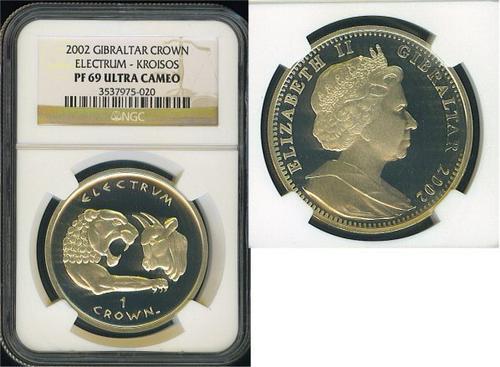 |
|
Valued Member
United States
88 Posts |
Quote:
You can see a gold-silver-copper colour ternary plot on Wikipedia. Sap: Thanks for referencing the ternary plot showing colors! It would be awesome to create a board with actual disks of the alloys arrayed on it! I had a heckuva time trying to copy and save that ternary plot image... kept wanting to be all black around the outside and blot out the lettering. Finally had to just print-screen and crop. Speaking of forgotten precious metals... there's a bunch of weird ones over to the middle-left side of the periodic table. I'd wager you've never seen a coin made of pure hafnium before! Check this out!   The one on the left is pure hafnium, on the right is pure copper. Raw hafnium is a steel gray color, these have been electrically anodized. The copper ones turn out not to be just an afterthought, but a necessity. Hafnium behaves strangely under the press and has the tendency to "smear" on the die rather than move cleanly like copper or silver. I tried many different tricks... oil, steam, graphite etc. But the one thing that worked was simply to strike a couple copper ones between each hafnium. That seemed to "clean" or "prep" the die. I don't actually know why it works! But it does. In case you're wondering what the heck this coin is, and why somebody would bother with hafnium... here's the story: The story goes... (warning, that means I made some of this up!) that some strange looking stragglers hoofed in out of the desert in rural Nevada and traded these for some food and a ride into Tonopah back around 1990. The guy who received them had kept them in a jar ever since presuming them to be worthless. Only recently did he have somebody test the metal and found the green ones to be pure hafnium! Strangely, the odd steeply-pyramidal shape on reverse is the key to understanding this piece. If you were to watch Star Trek Enterprise, season 4, episodes 7, 8, And 9, you'd see the K'ir Shara and understand its significance in Vulcan history. It turns out that back in the days of Surak, some three hundred years before the days of Spock, there was a nuclear war on Vulcan. The Vulcans had divided into two opposing camps, the Irik and the Lahai, and they waged war, ultimate war... so terrible that it was touch-and-go whether the race would survive at all. It was in that time that Surak arose and began to proclaim the philosophy of C'thiya... what we humans call "logic"... but which is actually much more than mere logic. C'thiya is Lahai for "that which is". It was a disciplined mental control specifically tailored to controlling the wildly emotional nature of the Vulcan people. But it was not enough to control emotions, for custom had to change also. It had always been the custom for men, (or women) to engage in duelling over any perceived insult or grievance. And in the days after the War there were so few... so few individuals whose DNA had not been damaged by radiation. Stringent measures had to be enforced to keep people from killing each other over trivialities. So Surak imposed an obligation upon each adherent to C'thiya, that if and insult was received that would require deadly conflict to resolve, the injured party must be willing to accept a blood price in lieu of combat. To refuse would be unpardonable and a shunning offense. And so a sort of economic system developed whereby it became expensive to give offense, sometimes outrageously so. And thus the Vulcans developed a very clear code of conduct with respect to each other, and over the next generation or so the blood price being paid in cash became more symbolic... represented by a simple token. By the times of Spock centuries later the tokens themselves had disappeared from use and were represented by a very simple hand gesture that humans seldom ever perceive. The tokens are found in two basic types... the pure hafnium ones are the pieces that are prized by Vulcan adepts as mind-focalization tools for contemplative appreciation of how far Vulcan culture has progressed. The metal hafnium is chosen as it was the hafnium radiation armor worn by breeding males and females that allowed the race to survive. Hafnium is a better neutron absorber than lead, and it's much stronger. They are anodized blue-green to represent the color of Vulcan blood. The second type are made of pure copper... and of course represent Vulcan blood directly, and of course they're much less expensive than the hafnium ones. The copper ones are frequently seen on earth, as tourists visiting Vulcan like to buy them at the spaceport gift shops and use them to show their friends how they've come to understand C'thiya. As if that could ever happen! The coins are small... dime size, and octagonal. The obverse shows the head of Surak, with his name in both Irik and Lahai. The reverse shows the K'irShara, and that name likewise in both languages. The K'irShara turns out to be the holographic repository of the sum-total of Surak's teachings... so that any adherent to C'thiya who wishes to do so, may experience those teachings at first hand, without any commentary or interpretation. Edited by tmaring
05/24/2012 11:02 am
|
|
Pillar of the Community
United States
1454 Posts |
Dungeons and Dragons geeks from way back like me remember electrum. I used to know the ratio to gold, as well. Maybe 3:1, IIRC. I didn't know that it's not possible to assign relative value to electrum due to its conglomerate properties. Guess I had forgotten it was an amalgamation of gold and silver, which I find very cool for some reason. I'd love to buy one. I've bid on, and lost, that Gibraltar coin once or twice. Thanks for the lesson. Never heard of halfnium. BTW, my spell checker doesn't know much about electrum, either. LOL.
|
|
Pillar of the Community
United States
4008 Posts |
Thanks for posting that electrum coin pic, Vb. On point and very enlightening. |
|
Pillar of the Community
United States
2269 Posts |
Thank you for posting pictures of modern electrum coins. I had no idea that a few modern mints produced electrum coins. I am glad I posted this topic, I had a feeling I would learn something new.
|
| |
Replies: 29 / Views: 32,858 |







 Posted 05/23/2012 07:29 am