| Author |
 Replies: 19 / Views: 2,458 Replies: 19 / Views: 2,458 |
|
New Member
United States
10 Posts |
I bought these two coins at an antique store about a year ago. I paid $350 for both. (one Roman one Turkey) I know all about them because they are registered and I am not wanting to sell them but I would like to know their retail value. Can anyone out there help? Thank you 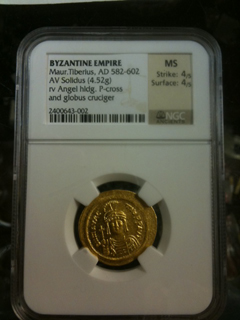 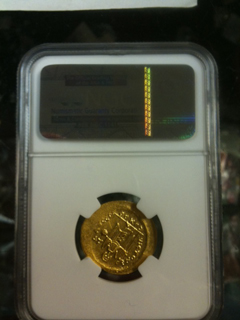 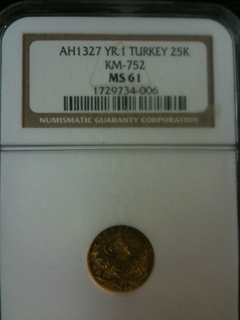 |
|
|
|
Pillar of the Community
United Kingdom
2838 Posts |
Cant help with the second coin but I think you did good with the first one  Easily worth $350 even in an auction setting and on the right day could make more, perhaps even double that. A poorer quality example sold on ebay last month for almost $500. I do have to add though I know nothing about NGC and fakes of these are widespread, I'm not casting aspersions on your coin and wouldn't know enough about them to judge myself. If NGC is respected then you have nothing at all to worry about. A very nice thing to have in your collection Remember to use the 'Reply to Topic' option at the top right of the page to respond about this coin rather than starting a new thread, the mods will have to lock and merge them other wise  New threads for new coins and new subjects only. Edited by bobbyhelmet
05/30/2012 2:36 pm
|
|
New Member
 United States
10 Posts |
felt pretty good on this one because he had his original bill of sale and appraisal from March of 1999 (Miami Appraiser) and he paid $350 for the Roman coin and $106 for the Turkish coin.
If you look them up on NGC you see this exact picture.
|
|
Moderator
 United States
23731 Posts |
I also think you did well. I don't particularly like slabbed coins, but when it comes to ancient Roman and Byzantine gold with all the fakes in the market you know you have gotten a real one.
|
|
Pillar of the Community
United States
2044 Posts |
Also, I heard that those slabs can be faked as well.
|
|
New Member
United States
10 Posts |
I'm not a coin person. I collect antiquities and mostly Pre Columbian pottery. I do love Roman, Egyptian and Greek too. I just ran across these and bought them.
That being said...what's a slab?
|
|
Pillar of the Community
United States
4253 Posts |
The slab is the plastic container. I hate them for ancient coins. I have only bought a couple in slabs, and, once home, immediately broke them out. On a serious note though, I think you should break them out for other reasons. They were sold to you as gold coins. You need to be certain that what you have is what was sold to you, and the only way is to have the coins tested.
|
|
Pillar of the Community
United States
2044 Posts |
A slab is what those coins are in. It's a holder that's supposed to be sealed and air tight. Also called encapsulation. There are more than a few grading companies that after verifying a coin to be authentic as well as a condition grade, they encapsulate the coin into that plastic slab. Mostly, this is done for modern coins. Most ancient coin collectors do not seem to like slabs much. I'm not too fond of them either.
|
|
New Member
United States
10 Posts |
I agree. One of the reasons I like antiquities is that I like to hold and touch them. Can't do that in the slab. I did go to the NGC site and entered the serial numbers on these coins. A picture of this coin in this slab comes up. Exactly positioned, etc. I feel sure they are real and I guess NGC takes pictures of them when they grade them for that reason.
I'm not going to sell them anyway. If and when I do decide to sell them, I'll have them tested. Until then...I'll just believe they are.
|
|
Moderator
United States
23731 Posts |
By going to NGC's website you can verify the numbers on the slab. In your case both numbers were correct for your coins. Granted anything can be faked and slabs have been, but I don't think that's the case with your coins. I would bust them out the first chance I got.
|
|
Bedrock of the Community
Australia
21794 Posts |
I went to a public coin auction a couple of days ago and viewed three lots of aureii, all of which were catalogued as fake but made of very good gold. They all weighed in the 7.5 to 8.0 grammes range, and they were all reserved at just below melt value for pure gold. Three out of four of them sold at the reserve value.
I examined each of these fakes in very closely hand, and I could not pick them as fake. I did not bid.
There are an alarming and increasing number of these very excellent quality fakes around.
It can be inferred from from this thread so far that the slabs may not be genuine. They certainly prevent close examination of their contents, and prevent them from being weighed for verification.
At the very least these coins, should be verified out of their slabs by specialist coin dealer, who has a well known and established reputation for examination of these pieces, at least for the Byzantine one. He should be able to verify the slabs also, if experienced in this area.
I have never been interested in slabbed ancient coins, because of verification difficulties.
What seems to be too good to be true usually is.
Even if they are fakes, and if they are of very good gold, it appears that you have done very well, on gold value alone.
I have 5 pieces of ancient gold. They have all come from dealers, or from auction, that have an excellent reputation in the verification of ancient coins.
|
|
Pillar of the Community
United States
4253 Posts |
 Well said. |
|
Valued Member
United States
168 Posts |
f you do plan on selling these one day I would definitely keep them in the slabs. NGC is one of the best TPG companies which will make these a quick sell if you do plan on selling them in the future. Without the slab their authenticity would be questioned by a potential buyer which would lower the amount of money they would be willing to spend (if you have a smart phone or a scanner scan the barcode on the front of the slab). Edited by w00zi
05/30/2012 7:32 pm
|
|
New Member
United States
10 Posts |
What would scanning the bar code do? I went to NGC's site and here's what they say:
In October 2008, we formally began a photography initiative that allows prospective buyers to see images of coins taken at NGC after certification. These images are available by entering the NGC certification number into the lookup tool on NGC's Web site. How to use the NGC certification verification tool.
As I stated earlier, the pictures are of my coins. I am confident and will resist the urge to break them out.
|
|
Valued Member
United States
168 Posts |
Some of the fake slabs have incorrect barcodes. The barcode information should correspond to the written information on the slab.
Edited by w00zi
05/30/2012 7:50 pm
|
|
New Member
United States
10 Posts |
Here is the link that should take you to my coin on NGC's site. I just went there and entered my number and a picture, front and back, of my coin comes up. This should take you to that picture. http://www.ngccoin.com/certlookup/C...=2400643-002Can't get this to become a link. You will have to type it in. |
| |
Replies: 19 / Views: 2,458 |







 Posted 05/30/2012 3:00 pm


