| Author |
 Replies: 9 / Views: 3,879 Replies: 9 / Views: 3,879 |
|
|
Valued Member
United States
235 Posts |
I have studied pictures of Spanish pillar dollars offered for sale by various dealers in various grades to put together some unofficial standard for grading them so that members of CCF who collect them, or who want an example of one of these historic coins, will not overpay for the coin. I am also including my recent survey of auction prices. Krause's NORTH AMERICAN COINS & PRICES seems to be accurate for the 8-reales pieces but somewhat low for the subsidiary coinages. I hope this guide is useful and will not be removed. Daniel Sedwick offered me some valuable advice, and I thank him.
GRADES
EF Bust Obv: 75% hairlines visible, leaves in crown sharp and distinct
Pillar Obv: jewels at bottom of crown distinct and sharp; fleur-de-lis in center of shield clear and sharp; florets in legend and beside shield detailed and sharp
Rev: "plus ultra" on banner around pillars clearly readable; details on globe, waves, crowns clear and sharp; florets beside date and mintmark detailed and sharp
VF Bust Obv: 50% hairlines visible, leaves in crown separate
Pillar Obv: jewels at bottom of crown worn but separate; fleur-de-lis worn but distinct; lions and castles intact with very little wear; florets in legend and beside shield retain some detail
Rev: the "u" and "l" are visible but weak; details on globes and waves visible; crowns distinct from columns; florets beside date and mintmark retain some detail
F Bust Obv: 25% hairlines visible, leaves in crown outlined but not distinct
Pillar Obv: jewels at bottom of crown partially worn off; border around fleur-de-lis partially worn off; wear on lions and castles noticeable; florets in legend and beside shield have no detail
Rev: only the "u" in "plus" and "l" in "ultra" worn off; some details on globes and few waves visible; crowns beginning to merge with columns; florets beside date and mintmark have no detail
VG Bust Obv: eye and few hairlines visible, leaves in crown barely visible
Pillar Obv: jewels at bottom of crown only slightly visible; border around fleur-de-lis only slightly visible; few details on lions and castles remain
Rev: some of "plus ultra" visible on banners; details on globes and waves almost completely worn off; crowns merged with columns but still fairly distinct
G Bust Obv: outline of bust only with no detail
Pillar Obv: outline of crown and shield remain but jewels worn off; fleur-de-lis, lions, and castles worn smooth or partially worn off
Rev: outline of pillars and banners only; globe, waves, and crowns worn smooth
NB: surface corrosion and pitting may indicate a "sea salvaged" coin
SPANISH COIN AUCTION PRICES
(auction prices for subsidiary coins are 2 to 3 times value in Krause catalog)
Bust 8R VG $50 - $70 VF $150
4R VG $50 - $70 VF $150
2 R VG $30 - $50 VF $60 - $70
1 R VG $15 - $25 VF $40 - $50
½ R VG $15 - $25 VF $40 - $50
Pillar 8R VG $125 VF $250
4R VG $100 VF $200
2 R VG $35 - $50 VF $60 - $70
1 R VG $15 - $35 VF $50 - $60
½ R VG $15 - $35 VF $50 - $60
|
|
|
|
Pillar of the Community
United States
4589 Posts |
I bet swamperbob is vacationing I am suprised he hasnt answerd this one also twokopeki, and bonedigger. So I will reply to get you a bump to the top
|
|
Pillar of the Community
Czech Republic
803 Posts |
Nice post, Houston. Can't believe I missed it the first time around. Dan Sedwick is very knowledgeable when it comes to Spanish Colonials and his grades are pretty much in-line with what I use for Portrait series. I have yet to own a Pillar, so can't really help you prices for those, but Portraits prices range wildly based on the mint, as well as condition. For example, Santiago or Popayan will bring-in multiples of what the same coin from Mexico City would, etc.
~Roman
|
|
Valued Member
 United States
235 Posts |
The prices I have are for coins minted in Mexico City, as they were mostly likely to have circulated in the America colonies (my specialty). I am eager for swamperbob's opinion.
|
|
Pillar of the Community
United States
4589 Posts |
|
|
Pillar of the Community
United States
5362 Posts |
houston_guy462004 - that is a fine summary of a grading system that is useful provided a few simple facts are kept in mind. The coins you are grading were hand struck on rather crudely made planchets and the final strike pressure was anything but uniform. Couple that with wavy or adjusted planchets and at times, you can get an MS or near MS strike missing much of the detail. Surface preservation must enter into the grade and completeness of strike will determine which details were ever on the coin.
I agree that in general prices for minors are low in Krause - but that applies most to grades above Fine. Low grade examples are far more common than comparable US series. I believe that it tied to the fact that coins (especially in Mexico) tended to circulate until worn out. Coin collecting was not particularly important to the average person and OLD issues stayed in circulation longer than in the US.
|
|
Valued Member
United States
235 Posts |
SWAMPERBOB - Again, thank you very much for your comments and "imprimatur" on my efforts to provide some grading guidelines. A particularly difficult problem, as you point out, is determining a weak strike from actual wear. Is there any weay to make this differentiation -- or does it actually matter since the overal effect in the loss of design detail would be the same and the coin would be worth the same either way?
|
|
Pillar of the Community
United States
5362 Posts |
The only way to differentiate wear and weak strike is by examining the preservation of the surfaces. The unstruck surface of a planchet has a different texture than a worn coin. It becomes a matter of getting familiar with what wear really looks like. Actual wear will show and quickly obscure most of the weakly struck spots, but on MS or AU examples it is fairly easy to spot. Once the "luster" from the strike or the "planchet surface texture" is gone it is harder to tell.
Some strike weakess is caused by a tapered or wavy planchet. The patterns of weakess imparted by a tapered planchet do not mimic normal high point wear. Weakness due to planchet problems also occurs on both sides of the coin. You can never have it on one side opposite a well struck portion. But a weakness in detail caused only by strike pressure softens high spot details more uniformly and is difficult to distinguish from wear.
I would agree that the end grade of a weak strike and legitimate wear are similar but not necessarity identical. The more wear there is - the more likely there will be stray marks on the coin - which would tend to lower the grade. But a lightly worn weak strike - would most likely not have as many nicks and rim bumps and accordingly would grade slightly higher. Otherwise, I think that this differentialtion becomes moot when natural wear reaches the level of VF or less.
There is one serious problem with many of the grading services and their treatment of weakly struck screw press coins. At times they will grade essentially on surface preservation alone and disregard the defects of the weak strike. I have seen slabbed Mexican 8Rs graded MS60 that on a wear/strike basis would grade VF based on the missing details. So it is critical, in my opinion to downgrade a coin with missing detail even if the original surfaces are fully intact.
You could of course weigh the coin and add that to the mix of grading factors as well. The 8R series was rather accurate in weight at least in Mexico (my area of specialization). So a coin that weighs 27.03 grams is MS - anything less than 27.00 grams has to grade AU. I do not advocate such a system, because there are exceptions to the weight RULE. In the case of Bolivia and Peru it is far less valuable to use weight. Their weight standards were more tolerant when it comes to underweight strikes.
|
|
Pillar of the Community
Czech Republic
803 Posts |
Bob is absolutely right (as always) about looking at the overall coin when grading it. For example, how would you grade the coin below? It's struck on an uneven planchet (tapered, as per Swamperbob) and you can see the rough areas where the planchet was thinnest. But after examining the coin, you'll see that there is almost no wear on the high points.... 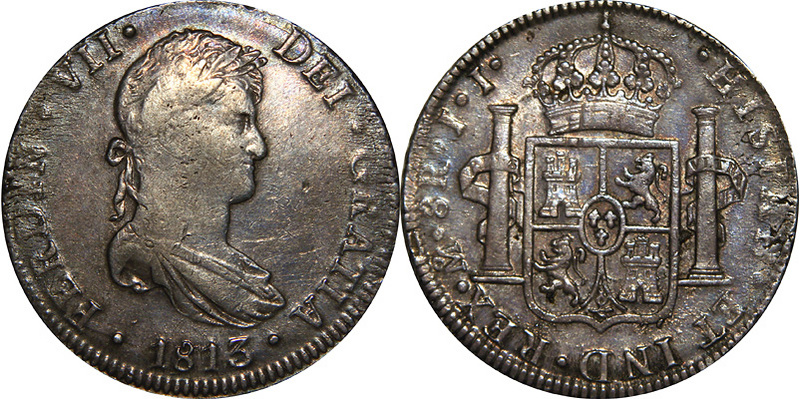 |
|
Valued Member
United States
235 Posts |
The picture is very helpful to understand what swamperbob was talking about. On the left column, the PLUS is missing but on the right column the ULTRA is clear. The planchet must have been uneven. The determination of grade, to some extent, by weight is also an idea that might not have occurred to the average collector like me. I'm glad that an expert agrees that lack of detail, whether from wear or from a weak strike, deserves a downgrade. I have no pictures to post, but it would be helpful if others could post pictures of 8R pieces in various grades. The only authoritative source I found with grades assigned to the coins is Daniel Sedwick's website.
|
| |
Replies: 9 / Views: 3,879 |
|







 Posted 02/22/2007 09:50 am


