| Author |
 Replies: 15 / Views: 1,528 Replies: 15 / Views: 1,528 |
|
|
Valued Member
United States
359 Posts |
A coworker of mine just purchased this 1880 Morgan on ebay. What grade would you give it? 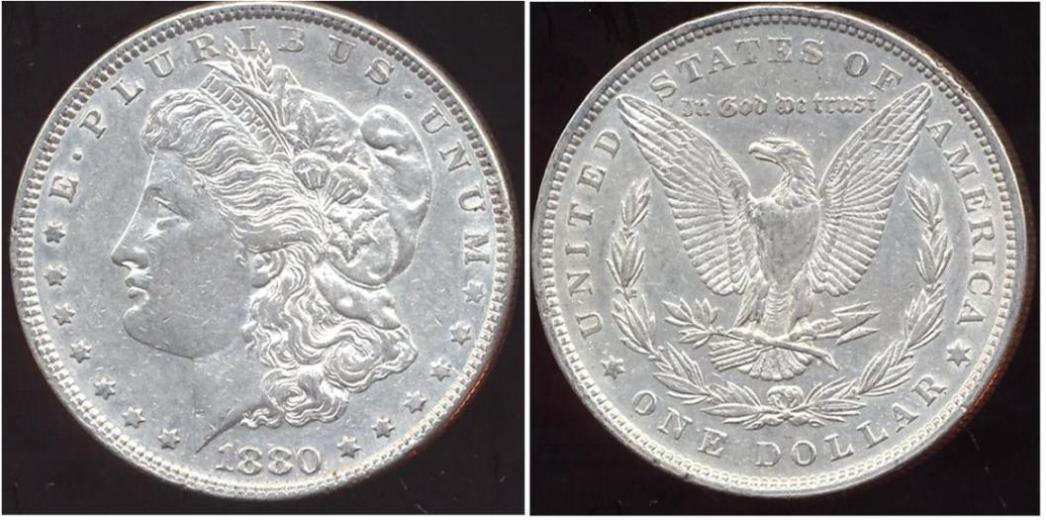 |
|
|
|
Bedrock of the Community
United States
36953 Posts |
|
|
Valued Member
 United States
359 Posts |
Pardon my newbie-ness... I know that cleaning coins is bad, but can someone explain why this devalues them so much? If I have a grimy old coin, is there any acceptable means to clean it without "cleaning" it and taking away all the value?
I'm sure there's another thread on this topic somewhere and a link to something like that would help me a lot.
|
|
Moderator
 United States
23522 Posts |
Quote:
I'm sure there's another thread on this topic somewhere and a link to something like that would help me a lot. Plenty of them, but easily summed up for you.  Quote:
If I have a grimy old coin, is there any acceptable means to clean it without "cleaning" it and taking away all the value? Yes, there are ways, but all of those ways live in the "exception to the rule" shadow area. As a self-defined newbie, you must realize that there's a bunch of learning on your part necessary before considering such a judgment. Because, maybe 97 times out of 100, that "grimy old coin" is worth more grimy than any other way. Such is the emphasis that the hobby as a whole places on the concept of "original surfaces." |
|
Pillar of the Community
United States
2130 Posts |
AU50  to CCF! Edited by chris12018
07/02/2012 5:59 pm
|
|
Pillar of the Community
United States
5854 Posts |
I think it may be around a AU-50/53.
|
|
Valued Member
United States
359 Posts |
Quote:
Yes, there are ways, but all of those ways live in the "exception to the rule" shadow area. As a self-defined newbie, you must realize that there's a bunch of learning on your part necessary before considering such a judgment. Because, maybe 97 times out of 100, that "grimy old coin" is worth more grimy than any other way. Such is the emphasis that the hobby as a whole places on the concept of "original surfaces." This is what my friend and I are trying to understand (pardon our ignorance). Why is a grimy coin, in layman's terms, more valuable than a nice shiny coin? We understand the coin collecting hobby itself puts value on coins as they naturally age. Who/what organization determined this? Is this a world-wide accepted concept? Specifically, why does removing dirt and grime some otherwise desirable coins back to a value near melt? Thanks in advance for some education.  |
|
Bedrock of the Community
United States
36953 Posts |
Most coins cleaned have been done improperly and have been damaged as a result. Coins that have been professionally dipped are not considered the same as cleaned according to the third party graders.
|
|
Moderator
United States
23522 Posts |
Quote:
This is what my friend and I are trying to understand (pardon our ignorance). Why is a grimy coin, in layman's terms, more valuable than a nice shiny coin? We understand the coin collecting hobby itself puts value on coins as they naturally age. Who/what organization determined this? Is this a world-wide accepted concept? Specifically, why does removing dirt and grime some otherwise desirable coins back to a value near melt? I'm going to say this again. Quote:
Such is the emphasis that the hobby as a whole places on the concept of "original surfaces."
Original surfaces. As it is, as it has lived it's life, exactly as it got to you, the new owner. Do not undo what came before, whatever it is, unless what you propose to undo will damage the coin to greater extent if not removed. Far better to pass on a coin whose surfaces you don't like; there will always be another. |
|
Valued Member
United States
359 Posts |
Quote:
Most coins cleaned have been done improperly and have been damaged as a result. Quote:
Do not undo what came before, whatever it is, unless what you propose to undo will damage the coin to greater extent if not removed. These answers get to the meat of I was after. What are some examples of damages inflicted by cleaning? Scratches or gouges the surface? Removing some of the precious metal? Something else? If the 1880 Morgan I posted above hadn't been cleaned, what would its value be compared to its currently cleaned state? I truly appreciate all of the replies here. |
|
Bedrock of the Community
United States
36953 Posts |
Since it is a common date the drop is not going to be that much, maybe 5 or 6 bucks. If this was a scarce date it could be as much as a 50% drop in value.
|
|
Pillar of the Community
United States
1554 Posts |
|
|
Valued Member
United States
180 Posts |
OK another newbie jumping in...
I gave AU-55 also only because it looked like there might
be some slight wear on lower leg of the "M" and the star below it on the obverse....and I freely acknowledge I have no expertise/experience in grading coins...what is the "tell" on the cleaning?
Thanks
|
|
Valued Member
United States
180 Posts |
dooohhhh! Didn't know you could enlarger by clicking on photo.
|
|
Bedrock of the Community
United States
12437 Posts |
Quote:
What are some examples of damages inflicted by cleaning? Scratches or gouges the surface? Yes, mechanical methods of cleaning will leave behind an abundance of scratches and chemical methods with strip off the original patina of a coin. If you have ever watched Antiques Roadshow on PBS, you have probably seen some once-very valuable furniture greatly devalued by a previous owner stripping and refinishing it. That original dark patina of the wood takes many decades to develop and it is a very desirous quality that is prized by antiques collectors. The same concept applies to coins- originality rules above all. Once a coin is cleaned, there is no going back and removing signs of the cleaning is an almost impossible task. Given time, a coin can retone, i.e. develop a new patina, but the scratches will remain and the repatination will not look the same as the original patina due to changes is the reactivity of the coinage metal(freshly cleaned metal is more chemically reactive than metal with some degree of oxidation). Cleaning scratches can also be removed but only by another process that also devalues the coin. One method collectors sometimes use is turning a cleaned coin into a pocket piece. The cleaned coin is literally carried around in your pocket along with other change for a period of months or even years. However, this process removes the cleaning scratches by further wearing the coin down. The coin will then look more natural but it will also be 1-2 grades lower. I do have a question about the 1880 Morgan pictured. Is it just the image quality or do I see coppery color on the rim in the lower right corners? |
|
Bedrock of the Community
United States
36953 Posts |
biokemist6 good explanation above and I think that coppery color you see is from the scanner lighting.
|
| |
Replies: 15 / Views: 1,528 |
|








 Posted 07/02/2012 4:10 pm


