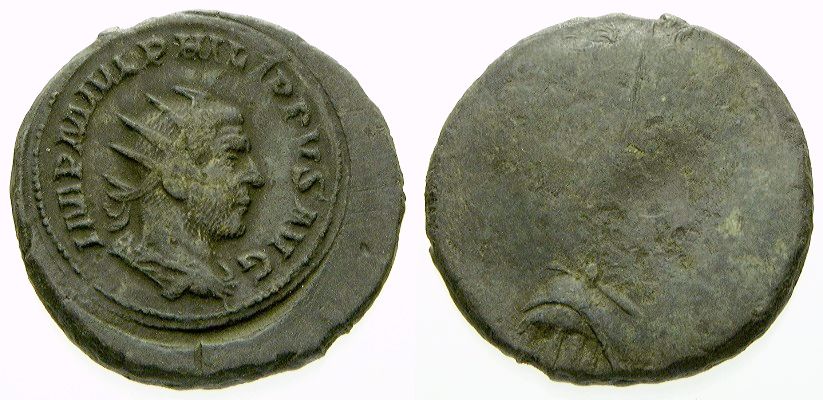
I was under the impression that trail pieces where pressed into clay and harderned and metal wasn't used until the design was ready. The reverse looks like it has what was another bust.
It is a trial die piece of a "Roman coin", all right, but I'm pretty sure it's not from ancient times. The obverse is an exact match for this modern replica on the FORVM fakes database - I'm looking particularly at the shape of the "S", and the strange elongated "1" shape of the second "I" in PHILIPPVS, and the die crack connecting the bottom of the portrait to the beaded border.
The similarities are too close to be coincidental. I'm afraid this may have been an object used to test the efficacy of a modern forger's die.
Don't say "infinitely" when you mean "very"; otherwise, you'll have no word left when you want to talk about something really infinite. - C. S. Lewis
Disclaimer: While a tremendous amount of effort goes into ensuring the accuracy of the information contained in this site, Coin Community assumes no liability for errors. Copyright 2005 - 2026 Coin Community Family- all rights reserved worldwide. Use of any images or content on this website without prior written permission of Coin Community or the original lender is strictly prohibited. Contact Us | Advertise Here | Privacy Policy / Terms of Use












 Posted 07/04/2012 4:36 pm


 to the community.


