| Author |
 Replies: 28 / Views: 4,850 Replies: 28 / Views: 4,850 |
|
|
|
Valued Member
 United States
462 Posts |
Errorone....Your first one is a split before strike very similar to the 1967 Lincoln I pictured.
|
|
Valued Member
Canada
334 Posts |
yes it is zimmy . neither scenario would have caused your coin appearance though .
|
|
Moderator
 Canada
10477 Posts |
Can we get a close up photo of where the "strike-through" meets the rim? is there any evidence on the reverse of differential pressure? Technically, there would have been more metal at the area of the strike through, and being such a large area, that metal would have to go somewhere, assuming the nickel planchet is of standard weight and size...
With the photos here, I concur with errorone2012, and I remain skeptical...
"Discovery follows discovery, each both raising and answering questions, each ending a long search, and each providing the new instruments for a new search." -- J. Robert OppenheimerContent of this post is licensed under a Creative Commons Attribution-NonCommercial 3.0 Unported License. See: http://creativecommons.org/licenses...0/deed.en_USMy eBay store
|
|
Pillar of the Community
Australia
7096 Posts |
This may have been caused by the smaller and different metal composition coin reacting with the surface of the quarter. maybe have been immersed in a slightly acidic solution and has had an electrolytic reaction between the 2 different metals, Not unlike what happens inside the average car battery. The bubbled effect on the quarter suggests that it has been eaten away by some process  |
|
Pillar of the Community
United Kingdom
2624 Posts |
Errorones coins I found interesting :) where one gets stuck to the die and puts an imprint on the one below...
Some errors I just don't get the attraction...the one posted originally is just a damaged coin to me :S maybe I am a philestine. Surely these sorts of errors are pretty easy to fake though?... just put a couple of coins on top of eachother in a flypress and hey presto.
|
|
Pillar of the Community
United States
4897 Posts |
Quote:
just put a couple of coins on top of eachother in a flypress and hey presto.
Easily recognized as what it is....The incused, backward design give those up immediately  BTW, I agree with the acid theory...coin is damaged. |
|
Moderator
Canada
10477 Posts |
Did the coin in question originate from Calgary?  "Discovery follows discovery, each both raising and answering questions, each ending a long search, and each providing the new instruments for a new search." -- J. Robert OppenheimerContent of this post is licensed under a Creative Commons Attribution-NonCommercial 3.0 Unported License. See: http://creativecommons.org/licenses...0/deed.en_USMy eBay store
Edited by SPP-Ottawa
07/22/2012 8:07 pm
|
|
Valued Member
United States
462 Posts |
errorone....I was only showing the coin to prove that a thin blank cent planchet can exist that would have indented my quarter. My cent example got struck but it could have been a thinner blank that ended up on top of the 79 quarter planchet. SPP Ottawa.....below are close ups of the rim area as requested. I don't remember where I got the coin, sorry. 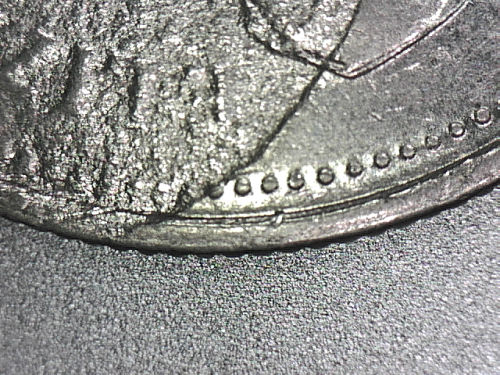 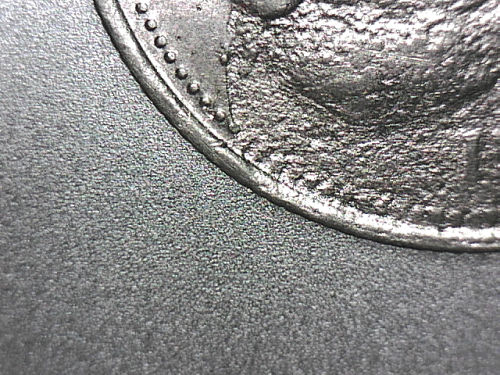 |
|
Pillar of the Community
Canada
2786 Posts |
maybe I am just confused, but why the focus on it being a thin penny planchet as the object that was the strike thru? isn't there a lot of other objects that could be the culprit?
i am by no means an expert, and I am sure others with more experience will correct me, but it looks more like a peel?
or that the planchet was damaged before it was struck? (does it carry the full weight of a regular quarter?)
Edited by Wade
07/22/2012 11:33 pm
|
|
Valued Member
United States
462 Posts |
Weighs 77.1 grains or 5.0 Grams, well within tolerance of a quarter for that year. The focus is on an indented thin cent planchet because of a cents perfect match to the indented area as I illustrated in the initial post. A lamination (peel) would appear to be difficult to produce the arcing appearance.
|
|
Pillar of the Community
United States
2752 Posts |
It looks like a genuine struck-through error to me. The size is similar to that of a cent. While the quarter could have been struck through a thin, split-before-strike cent planchet, the lumpy surface texture is strange. It's certainly not the impression of a striated surface. So I can't be sure it's a cent planchet or something derived from a cent planchet. Struck-through errors are quite frustrating in many instances.
Error coin writer and researcher.
|
|
Moderator
Australia
17006 Posts |
Seems to me the "acid theory" could be proved or disproved rather easily: weigh it, comparing the weight to a normal coin. A strikethrough should weigh exactly the same; an acid-etched coin with this much damage should weigh noticeably less. I'm also reckoning it's corrosion, rather than a strikethrough. Perhaps from somebody making a coin battery, which requires alternating copper and nickel coins. The presence of a strong rim indented around the edge of the corroded area strongly implies to me that it was a finished coin with its own rim, rather than a wafer-thin sliver of a planchet, that was a causal agent. Finally, there's Occam's Razor to consider. A cent planchet breaks clean in half (itself not a particularly probable event), then one of the pieces manages to transport itself into the presses that were striking quarters. Seems more probable to me to be the result of a science teacher's experiment. Don't say "infinitely" when you mean "very"; otherwise, you'll have no word left when you want to talk about something really infinite. - C. S. Lewis
|
|
Valued Member
United States
462 Posts |
Thanks Mike for your assessment. Confirms the strike through. The lumpy surface texture is odd though in trying to confirm what it was struck through although based on the area matching up with a cent, I feel a thin, defective cent planchet had something to do with it. I guess I will never know but a neat coin anyway. Not sure why there are so many acid theorist. My guess is that this error type shows up so infrequently on Canadian coins that the viewers just haven't been exposed to struck through thin planchets and other objects. Below is another example of a struck through error that I posted before. 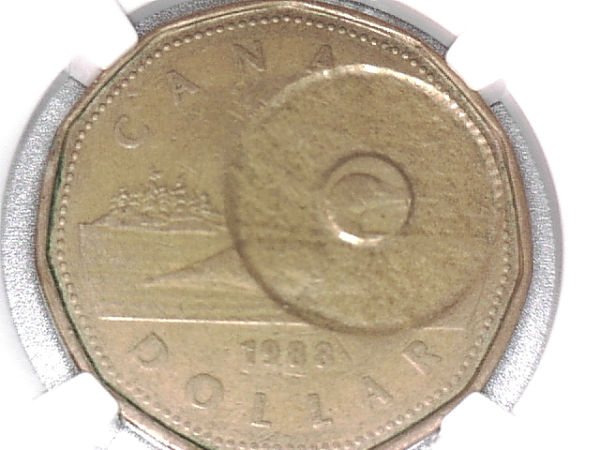 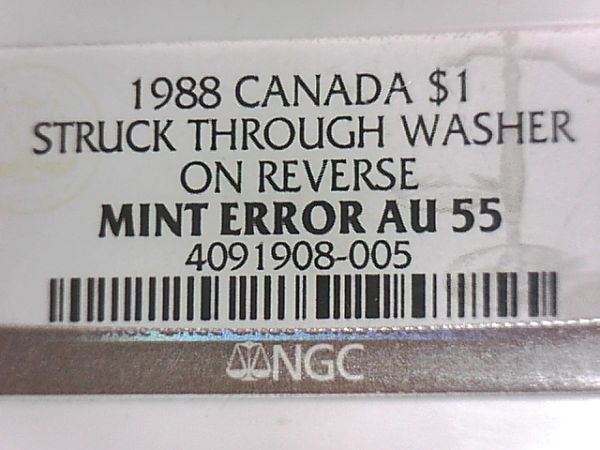 |
| |
Replies: 28 / Views: 4,850 |







 First Page


 Posted 07/22/2012 7:08 pm





