| Author |
 Replies: 9 / Views: 1,590 Replies: 9 / Views: 1,590 |
|
|
Pillar of the Community
United Kingdom
575 Posts |
Condition as on the pictures.One guy wants to make me an offer and I'm not sure about value. What do you think? 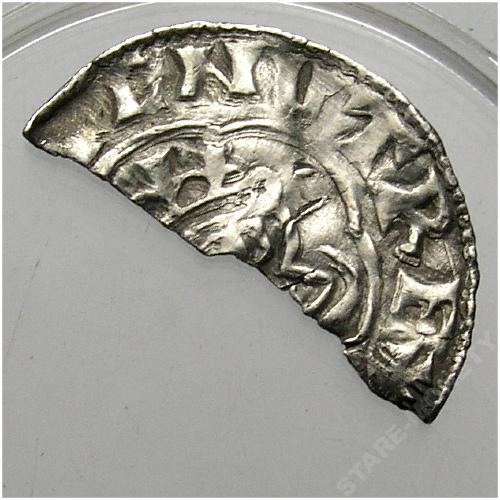 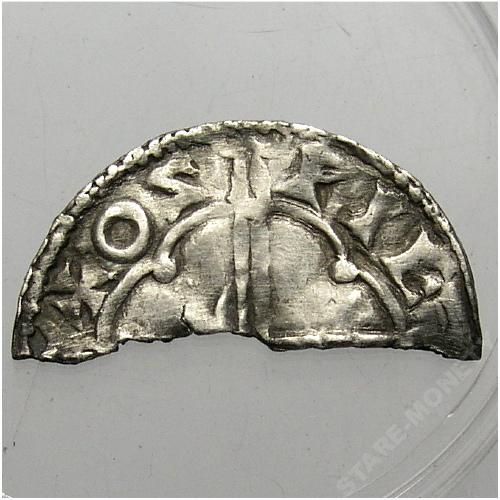 |
|
|
|
Pillar of the Community
Canada
1610 Posts |
This is an old English cut halfpenny (they cut silver pennies in half and called them halfpennies...simple enough). On a proper auction site, this one could sell for ₤25, maybe ₤35 at most (they're not as rare as people think). If the guy offered you around that price or more, you should take it, because you probably won't get a better deal on ebay or other sites IMO . Edited by Apollo
08/02/2012 3:46 pm
|
|
Pillar of the Community
United Kingdom
4208 Posts |
As he says, its a penny cut in half to form a Halfpenny. You can tell as its cut down the cross, and the cross is there so that it can be easily cut into smaller denominations.
I dont know the price, but its worth soemthing for historical story value.
Also, how the hecks did you get that funky £ sign?
|
|
Pillar of the Community
 United Kingdom
575 Posts |
Sorry I did not post some more details.Coin is actually Anglo-Saxon.King Cnut (Canute)[1017-23].Quatrefoil type but I'm not sure about mint and I don't have good reference book on this type of coinage. Quote:
this one could sell for ₤25, maybe ₤35 For this sort of money I will take some any time  I wish Saxon coins was so cheap. |
|
Pillar of the Community
Canada
1610 Posts |
If it is really Cnut the Great, I think it could go higher, maybe up to ₤45-₤50. No wonder I couldn't find a match, I was looking at later kings like William and Henry lol.
|
|
Moderator
 Australia
17006 Posts |
This particular piece would I think be worth almost as much as a whole but low-grade Cnut penny, because the king's name is still clearly readable: CNVT REX.
Don't say "infinitely" when you mean "very"; otherwise, you'll have no word left when you want to talk about something really infinite. - C. S. Lewis
|
|
Pillar of the Community
United Kingdom
709 Posts |
"English Coinage 600-1900" by CHV Sutherland ( London 1973) describes three series of pennies by Cnut.
1st series obverse - left facing bust inside quatrefoil, with text surrounding "CNVT REX ANGLOR" ( sometimes ANGLORVM),
2nd series obverse - left facing bust with pointed helmet inside a circle, surrounding text "CNVT REX A", REX sometimes replaced by RECX, A sometimes replaced by AN or ANG;
3rd series obverse - left facing bust with diadem and sceptre, no circle surround, text as 2nd series.
From these descriptions and the accompanying plates your coin appears to be from the 1st series. The book mentions these were minted in the early troubled part of his reign and varied in weight ( and presumably in quality ).
Your coin differs from the plates in two small respects, otherwise it matches the first series very well.
On the obverse "Cnut" is always written with a distinct "V" instead of "U". Yours appears more rounded at the base. On the reverse the quatrefoil is much more indented. These differences might well be explained by the variation in quality.
I am a total beginner when it comes to early English hammered coins - the above is just my tuppence-worth.
Sadly, the book is not detailed enough to give any more.It answers some questions but leads on to many more. I cannot date your coin any closer, much less give a value.
Edited by Anaximander
08/02/2012 6:43 pm
|
|
Pillar of the Community
United Kingdom
1351 Posts |
A decent cut half is worth £80 to £100.
|
|
Pillar of the Community
United Kingdom
575 Posts |
Thanks for input guys  I'm developing interest in early hammered coins.There is book Id like to recommend.England's Striking History by Chris Perkins.Much cheaper than specialized publications but giving some basic ideas, for example- how to read Lombardic.I found 6 different designs of Cnut's pennies in this book but no exact match. Quote:
English silver pennies seem to have circulated throughout Cnut's realms;indeed some English moneyers had mints in Denmark Maybe this is the reason why I cant find exact coin.Just to many moneyers and places was involved. Quote:
A decent cut half is worth £80 to £100. Sounds really good to me  Edited by valdiman
08/03/2012 3:26 pm
|
|
New Member
United Kingdom
23 Posts |
@Anaximander
This is indeed the 1st series, which is scarcer than the second or third. The dies from the regional mints tend to be stylistically different. I'd date it at between 1017 and 1023.
I can't determine the mint from the moneyer's name (OSFIE), but it is likely to be provincial (ie. not London, Winchester, Canterbury, Lincoln or York). It's clearly readable, so I'd value it at around £75. It would be worth more if you could identify the mint, but I can't find a mention of the moneyer in any of my books.
I'm not a great expert on this subject, but I hope this helps.
|
| |
Replies: 9 / Views: 1,590 |
|









 Posted 08/02/2012 4:27 pm


