Coin Community Family of Web Sites Join Thousands of Coin, Bullion, & Money Collectors
Specializing in Modern Numismatics Royal Canadian Mint products, Canadian, Polish, American, and world coins and banknotes. Vancouvers #1 Coin and Paper Money Dealer Shop for APMEX Bullion on eBay!Join Thousands of Coin, Bullion, & Money Collectors Coin, Banknote and Medal Collectors's Online Mall 300,000 items to help build your collection!


Username:
Password:
Save Password
Forgot your Password?


This page may contain links that result in small commissions to keep this free site up and running.

Welcome Guest! Registering and/or logging in will remove the anchor (bottom) ads. It's Free!

Testing Specific Gravity Of Coins

To participate in the forum you must log in or register.
Author Previous TopicReplies: 11 / Views: 4,994Next Topic  
New Member
BostonJo's Avatar
United Kingdom
33 Posts
 Posted 09/15/2012  08:33 am Show Profile   Bookmark this topic Add BostonJo to your friends list Get a Link to this Message Number of Subscribers
I bought a beautiful Victorian 6d recently.
I had no suspicions until I saw that the same seller had some Chinese and Spanish fake coins.

The sixpence measures the same size as a sixpence of the next year, and weighs almost the same (they're both UNC) but I wondered if it was sterling silver. The sixpence I'm testing it against is toned - I've had it for 40 years, bought from a reputable coin dealer, I'm confident that it is sterling silver.

I've been using the calculation on http://www.coincommunity.com/forum/...&whichpage=1 (the topic is locked, so I can't add to it).

Swamperbob showed ....a series of weights:

First, weigh the coin without the harness, shown below as W
Weigh the harness without the coin in air, shown below as Sa
Weigh the coin suspended in air with the harness, Wa
Weigh the coin suspended in distilled water* with the harness, Ww
(Note: coin should be completely submerged in water)
Weigh the harness alone in water, Sw
(Note: if the harness is wet from a previous measurement, dry off completely before this test).
*Note: add a trace of detergent to break surface tension.

Now you have 5 distinct measurements, from which you can calculate SG as shown:

W
_________________ = Specific Gravity

(Wa-Sa) - (Ww-Sw)

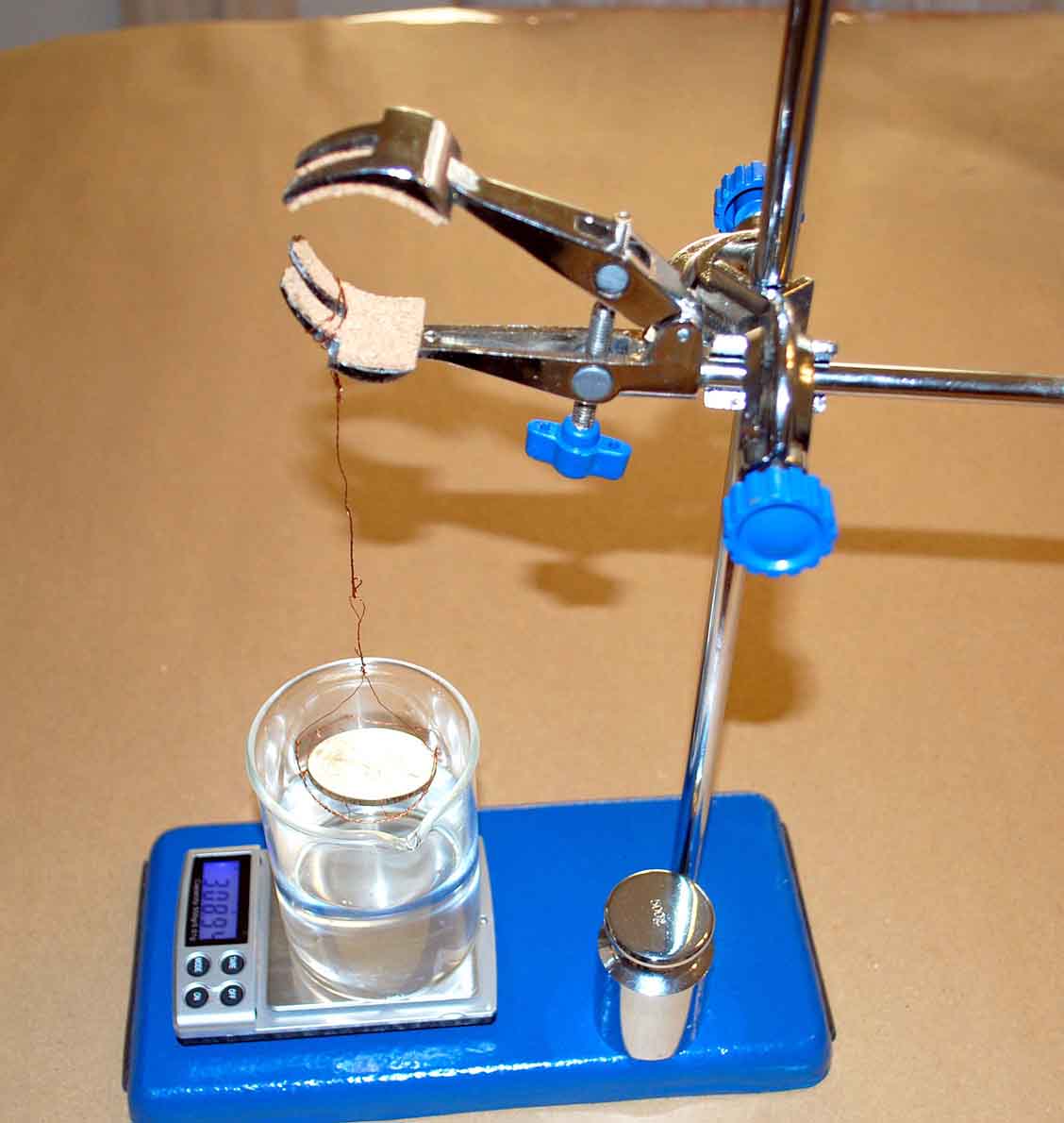
Applying my measurements to the coin pictured above, I arrive at the following equation:

W..................................................2.90
_________________ = _______________________________ = 9.35

(Wa-Sa) - (Ww-Sw)..............(3.65 - 0.75) - (3.34 - 0.75)

However, my measurements are
Weight of coin in air W = 2.83
Weight of coin and harness in air Wa = 4.28
Weight of coin with harness in water Ww = 0.4
Weight of harness in air Sa = 1.45
Weight of harness in water Sw = 0.11

Using the formula, I get 2.83 / (4.28-1.45)-(0.4-0.11) = 1.1047
a totally different result.

Using the coin I know is OK
Weight of coin in air W = 2.80
Weight of coin and harness in air Wa = 4.22
Weight of coin with harness in water Ww = 0.35
Weight of harness in air Sa = 1.45
Weight of harness in water Sw = 0.11
with the result 1.1067

Why are my results so different ?
It's because my values for Ww are so different to W (or Wa), whereas Swamperbob's are very similar.

I've tried this with
a worn Victorian shilling (sterling silver) W=5.35, Ww=0.61, Sw=0.11
a worn Victorian florin (sterling silver) W=10.53, Ww=1.17, Sw=0.11

So, am I doing something wrong, or is the calculation faulty ?

I'm very puzzled.

Please help.

Pillar of the Community
OldSkoolMadSkilz's Avatar
United States
2077 Posts
 Posted 09/15/2012  09:23 am  Show Profile   Bookmark this reply Add OldSkoolMadSkilz to your friends list Get a Link to this Reply
Ah, I see what's happening. You've also calculated the specific gravity of the harness. The dry and wet weights of the harness should be nearly identical. The dry measure should be dry, but the wet measure should be with just the portion that holds the coin submerged. If the wet weight of the harness isn't a tiny but less than dry, something is wrong.

Oh, another thing. The harness should not touch any part of the water container.
Bedrock of the Community
sel_69l's Avatar
Australia
21786 Posts
 Posted 09/15/2012  09:24 am  Show Profile   Bookmark this reply Add sel_69l to your friends list Get a Link to this Reply
Here is a different approach, but I don't know it it is valid, because the crystalline structure of a .925 silver alloy measured by direct specific gravity means, may yield a slightly different density to the method of calculation given below:

Specific gravity of pure silver: 10.50
Specific gravity of pure copper: 8.93

weighted average of .925 silver alloy:

(10.50 x 925 + 8.93 x 75)
-------------------------------------- = 10.3825
1000


A Victorian .925 sixpence in uncirculated condition weighs 2.83 grammes.

The volume of a sixpence using the above weighted average density calculation is:

volume = mass divided by the density,
v = 2.83 divided by 10 .3825
v = 0.2725 cubic centimetres.

You can use this information to provide a check, at least, for your volume measurements.

Edited by sel_69l
09/15/2012 09:36 am
Pillar of the Community
OldSkoolMadSkilz's Avatar
United States
2077 Posts
 Posted 09/15/2012  09:30 am  Show Profile   Bookmark this reply Add OldSkoolMadSkilz to your friends list Get a Link to this Reply
Actually, looking at your readings, I'm thinking that the harness was touching the container.
Pillar of the Community
OldSkoolMadSkilz's Avatar
United States
2077 Posts
 Posted 09/15/2012  09:36 am  Show Profile   Bookmark this reply Add OldSkoolMadSkilz to your friends list Get a Link to this Reply
Also, the weight of the harness in air and water isn't that important depending on what you are doing with the results. If you are trying to determine whether something is 22K vs 14K gold, then yes. If you want to know if something is nickel instead of silver, then no. For that, you can just subtract the two harnessed weights.
Bedrock of the Community
sel_69l's Avatar
Australia
21786 Posts
 Posted 09/15/2012  09:45 am  Show Profile   Bookmark this reply Add sel_69l to your friends list Get a Link to this Reply
I have just 'Googled' for the density of sterling silver, and it was given as

10.36 grammes / cc.

It seems that the atoms in the sterling silver alloy have a slight larger average distance apart, thus yielding a slightly less density than the weighted average density that I calculated.

That would calculate the volume of a sterling silver sixpence at 0.2731 cubic centimetres.

Next time, I might 'gargle' for it; I hope I don't choke!
Edited by sel_69l
09/15/2012 09:49 am
New Member
BostonJo's Avatar
United Kingdom
33 Posts
 Posted 09/15/2012  11:56 am  Show Profile   Bookmark this reply Add BostonJo to your friends list Get a Link to this Reply
sel_69l,
Unfortunately, I don't have any way to measure the volume of the sixpence.

Even if I did, a very slight error in measuring (.005 cubic centimeter) would make the SG seem like 50% silver (10.17) instead of 92.5% silver (10.36).

Neither the harness nor the coin seemed to be touching the side or the floor of the container.

However, it occurs to me that I can check the weight in water roughly by using a larger container on the digital kitchen scales, and I'll try that.
Pillar of the Community
OldSkoolMadSkilz's Avatar
United States
2077 Posts
 Posted 09/15/2012  12:24 pm  Show Profile   Bookmark this reply Add OldSkoolMadSkilz to your friends list Get a Link to this Reply
Hi BostonJo

Yes, you do have a way to measure the volume. As water has a density of 1gm/cc, the difference in weight dry and wet is the volume of the coin.

Also, the water container can't touch the scale platform in any way. The idea is that you are trying to measure the amount of flotation that the water provides. If you take the weight of the coin and subtract the submerged weight, the result is the weight of the water that the coin displaces.
New Member
BostonJo's Avatar
United Kingdom
33 Posts
 Posted 09/17/2012  12:18 pm  Show Profile   Bookmark this reply Add BostonJo to your friends list Get a Link to this Reply
I tried using a larger container on the kitchen scales.
It measures in g (no decimal places) and showed the weight of the sixpence and harness in water as zero.

I tried with an 1887 crown weighing 28g normally; coin and harness in water weighed 3g !


I wondered if the different readings night be because I was using a plastic container (yoghurt pots) so I tried with a glass percolator flask - no difference.

I really don't understand why you get sensible readings and I don't.

Perhaps I'm in a different universe !
Pillar of the Community
Jaobler's Avatar
United States
6381 Posts
 Posted 09/17/2012  3:48 pm  Show Profile   Bookmark this reply Add Jaobler to your friends list Get a Link to this Reply
Density measurement is touchy for many reasons. However, at a minimum you will need a scale capable of accurate measurement to at least the nearest 0.01 grams. I've used this set-up, with a scale that measures up to 500g with 0.01g accuracy and have had decent results. You still have to make sure the harness doesn't touch the container and if there are bubbles trapped under the coin it will totally throw off your results. It is easier to get acceptable results with larger coins. Measuring a sixpence will be a definite challenge. If can work if you're careful but it isn't as simple to perform as you might think.


Testing-Specific-Gravity-Of-Coins
Pillar of the Community
Lobby's Avatar
United States
548 Posts
 Posted 09/17/2012  5:15 pm  Show Profile   Bookmark this reply Add Lobby to your friends list Get a Link to this Reply
I did a similar thing with my specific gravity scale.

https://goccf.com/t/126807&SearchTerms=density

About the only problem I ever have with it is the "harness," touching the sides of the tank and interfering with the weight measurement. I can tell that's happening when the scale won't tare.
Bedrock of the Community
sel_69l's Avatar
Australia
21786 Posts
 Posted 09/18/2012  12:53 am  Show Profile   Bookmark this reply Add sel_69l to your friends list Get a Link to this Reply
So long as you know the density of .925 silver ( 10.36g / cc) and the mass of a Victorian sixpence (2.83 grammes), the volume of the sixpence is easily calculated.
  Previous TopicReplies: 11 / Views: 4,994Next Topic  

To participate in the forum you must log in or register.


Disclaimer: While a tremendous amount of effort goes into ensuring the accuracy of the information contained in this site, Coin Community assumes no liability for errors. Copyright 2005 - 2026 Coin Community Family- all rights reserved worldwide. Use of any images or content on this website without prior written permission of Coin Community or the original lender is strictly prohibited.
Contact Us  |  Advertise Here  |  Privacy Policy / Terms of Use

Coin Community Forum © 2005 - 2026 Coin Community Forums
It took 0.3 seconds to rattle this change. Forums