









 Posted 10/06/2012 07:08 am


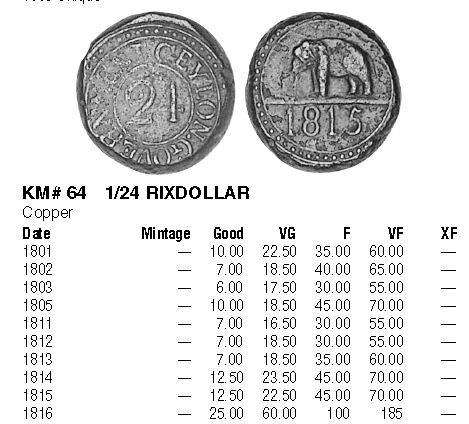
It isn't actually "24 stivers". On this coin the "24" is there to indicate a fractional number, 1/24th of a rixdollar. There were 48 stivers to a rixdollar, so 1/24th of a rixdollar is actually 2 stivers. There's no picture, but here is the NGC database page for the type.Confusingly, they also issued 24 stiver coins, but not in 1815; these were smaller, made of silver, and had a little "St" denomination mark below the "24".
As you can see from the entry in the CCF glossary, a "dump" is a coin that is unusually thick for it's size. Many Indian coins could be classified as "dumps".
The names "stiver" and "rixdollar" are Anglicizations of the names of Dutch coins, the stuiver and rijksdaalder, which were used by the Dutch East India Company on Ceylon before the British takeover in 1798. The rixdollar was a medium-sized silver coin, equivalent to the rupee used on the Indian mainland.
You can also find "stivers" issued in the name of other colonies seized from the Dutch at around the same time, such as Essequibo & Demeraray in Guyana, South America.
As you can see from the entry in the CCF glossary, a "dump" is a coin that is unusually thick for it's size. Many Indian coins could be classified as "dumps".
The names "stiver" and "rixdollar" are Anglicizations of the names of Dutch coins, the stuiver and rijksdaalder, which were used by the Dutch East India Company on Ceylon before the British takeover in 1798. The rixdollar was a medium-sized silver coin, equivalent to the rupee used on the Indian mainland.
You can also find "stivers" issued in the name of other colonies seized from the Dutch at around the same time, such as Essequibo & Demeraray in Guyana, South America.
Don't say "infinitely" when you mean "very"; otherwise, you'll have no word left when you want to talk about something really infinite. - C. S. Lewis


